Category: Uncategorized (Page 1 of 9)

Four Mutinies on the Bounty

Few sea stories have captured the public imagination like the Mutiny on the Bounty. In April 1789, a group of sailors on HMS Bounty, led by the young master’s mate Fletcher Christian, seized the ship from the irascible Lieutenant William Bligh and cast him and his loyalists adrift. The mutineers would scatter across the Pacific, hiding on Tahiti or disappearing into the isolation of Pitcairn Island, while Bligh undertook one of the most astonishing open-boat voyages in maritime history. Because the surviving accounts sharply contradict one another, the tale was destined to become a battleground of interpretation: a perfect canvas for novelists and filmmakers to project questions of leadership, justice, rebellion, and mythmaking.

Charles Nordhoff and James Norman Hall’s 1932 novel Mutiny on the Bounty (part one of their Bounty Trilogy) is the definitive popular version of the story. Written in the style of 19th-century nautical fiction, it features a fictional narrator (Roger Byam), partly inspired by the real midshipman Peter Heywood. The authors weave together Bligh’s official logs, court-martial transcripts, and the memoirs of Heywood and James Morrison, shaping them into a straightforward moral narrative: Bligh as a tyrant whose cruelty pushes decent men to revolt, and Christian as a tragic, reluctant rebel crushed by the consequences of his actions.

The novel is dramatically compelling, richly detailed, and hugely influential. But it is also selective. Nordhoff and Hall harmonize conflicting testimonies to create a coherent story, smoothing away ambiguity. Their Bligh is harsher than many historians now judge him to have been, and their Christian is more romantic, more tortured, and more heroic than the fragmentary historical record supports. As narrative art, the novel is excellent. As history, it is debatable.

Frank Lloyd’s 1935 movie adaptation, Mutiny on the Bounty, starring Clark Gable as Christian and Charles Laughton as Bligh, cemented the legend for generations. It takes Nordhoff and Hall’s interpretation and intensifies everything for cinematic effect. Bligh becomes a nearly cartoonish sadist, sneering, petty, and addicted to cruelty. Christian emerges as a dashing moral hero, a man driven to mutiny by compassion. The Tahitian interlude becomes a romantic Eden corrupted by Bligh’s tyranny.

It is gorgeously shot in black and white, dramatically rousing, and acted with enormous flair, but it veers the farthest from history. Bligh’s strictness, while real, is exaggerated into villainy. Christian’s internal struggle is rewritten into clean melodrama. Still, for classic Hollywood storytelling, it is a hit. The film’s cultural impact was such that, for decades, its version of events was the only version.

Lewis Milestone’s 1962 Mutiny on the Bounty remake, with Marlon Brando as Christian and Trevor Howard as Bligh, arrives with big CinemaScope prestige but a strangely diffused point of view. Brando’s Christian is whimsical, ironic, and detached, a proto-counterculture figure who seems less tortured than bored. Howard’s Bligh is more controlled than Laughton’s but still rigidly villainous, echoing the novel’s version more than historical analysis. The film leans heavily into Tahiti as an exotic paradise, extending the love story but weakening narrative momentum.

The result is handsome, intermittently fascinating, but tonally inconsistent. Brando’s eccentric performance, though engaging, sometimes pulls the story toward satire, while the script seeks to retain classic moral seriousness. It neither fully humanizes Bligh nor fully dramatizes the mutiny as a tragic inevitability. Historically, it remains in the same mythic register as the 1935 film, but without its sharp dramatic spine.

Roger Donaldson’s 1984 film, The Bounty, starring Mel Gibson as Christian and Anthony Hopkins as Bligh, marks the first major adaptation to challenge the established myth. Drawing on more recent scholarship and using Bligh’s own writings as inspiration, it reframes the mutiny as a clash of flawed personalities rather than a simple tale of tyranny.

Hopkins’s Bligh is not sadistic but disciplined, overbearing, ambitious, and socially insecure. He is capable of kindness but blind to how his rigidity alienates his crew. Gibson’s Christian is not a born revolutionary but an inexperienced young officer emotionally overwhelmed by conflict and guilt. The film foregrounds Bligh’s astonishing 3,600-mile open-boat journey with rare accuracy. Tahiti is portrayed not as Eden but as a complex society whose allure and cultural differences unsettle the crew’s discipline.

This version incorporates contradictions rather than ironing them out. It acknowledges that the mutineers gave wildly inconsistent explanations, that Bligh’s harshness was real but within the norms of the era, and that Christian’s motives remain opaque. As storytelling, it is more muted, less swashbuckling, but also far more psychologically credible. And, unfortunately, not as interesting.

The truth of the Mutiny on the Bounty lies somewhere between heroism and dysfunction, and between Bligh’s defensiveness and the mutineers’ self-justification. Modern historians tend to see the mutiny as the product of cumulative interpersonal friction, culture shock in Tahiti, Bligh’s abrasive management, and Christian’s psychological instability. This messy human drama resists clean moral binaries.

The saga of the Bounty endures precisely because it resists definitive interpretation. The 1932 novel shaped the mythic template: Bligh the tyrant, Christian the reluctant rebel. The 1935 film amplified this into an iconic melodrama. The 1962 film embellished it with Hollywood exoticism and Brando’s idiosyncrasies. The 1984 film challenged it with a more balanced, psychologically layered approach. Each version reflects the concerns of its era: authoritarian villains in the 1930s, romantic individualism in the 1960s, and distrust of simple moral narratives in the 1980s.

Favorite Horror Novels, 20th century

  • The Haunting of Hill House (1959), by Shirley Jackson
  • Something Wicked This Way Comes (1962), by Ray Bradbury
  • Rosemary’s Baby (1967), by Ira Levin
  • Hell House (1971), by Richard Matheson
  • The Mist (1980), by Stephen King
  • The Cellar (1980), by Richard Laymon

Dungeons & Dragons Superheroes

I recently played in a short Dungeons & Dragons campaign in which all the characters had to be inspired by classic superheroes, adapted to the medieval fantasy world of Faerûn. I liked the idea so much that I ended up creating a whole list of characters, and having much fun with it. Here are a few of them. The best part is that, if you don’t like my versions of these super-adventurers, you can just create your own.

Spider-Man
Race: Wood Elf
Class: Monk (Open Hand) with a 1–3 level dip in Rogue (Scout)

  • Wood elves have the agility, speed, and keen senses that parallel Spider-Man’s reflexes.
  • Monk gives him Quickened Movement, Unarmored Defense, and high mobility, perfect for wall-running, leaping, tumbling through enemies.
  • Open Hand techniques mimic web-trip, push, and stun effects.
  • Rogue (Scout) represents his urban acrobatics, ambush instincts, and mobility in the alleyways of a fantasy city.
  • His webbing becomes Ki-infused silk ropes produced by magical spiders he once saved in an elven ruin.
  • Signature ability: Silk Line Step – spend 1 Ki to lash a spectral silk line onto a surface and pull yourself as if casting Misty Step.

Wolverine
Race: Mountain Dwarf
Class: Barbarian (Zealot)

  • Dwarves are hardy, stubborn, and famously difficult to kill, perfect for Wolverine.
  • Zealot’s damage resistance and “nearly impossible to kill” nature works like a healing factor.
  • His claws become black-iron dwarven claw bracers, forged as a hereditary weapon.
  • Berserker rage mimics Wolverine’s ferocity.
  • Signature ability: Blackclaw Frenzy – rage activates his ancestral magic, causing the claws to extend and glow with runic fire.

Captain America
Race: Variant Human
Class: Paladin (Devotion)

  • Devotion Paladins embody justice, righteousness, courage.
  • Shield mastery parallels Cap’s iconic combat style.
  • His shield is a blessed relic of a bygone holy order, magically returning to his hand once per round.
  • The super soldier serum is replaced with a divine ritual granting enhanced physical ability.
  • Signature ability: Aegis Throw – throw the shield as a ranged spell attack that ricochets between enemies via divine light.

Iron Man
Race: Rock Gnome
Class: Artificer (Armorer)

  • Artificers literally build magical suits of armor, exactly like Tony Stark but medieval.
  • Rock gnomes have tinkering instincts and a talent for small, intricate mechanisms.
  • His arc reactor becomes a bound elemental shard powering the armor.
  • The suit can switch between Guardian (tank) and Infiltrator (ranged) modes.
  • Signature ability: Elemental Heart Beam – a lightning spell cast through the suit’s chest-crystal.

Hulk
Race: Goliath
Class: Barbarian (Berserker) with 1–2 Druid levels

  • The Hulk is a rage-fueled transformation, and Barbarians already do that.
  • Goliaths are huge, muscular, and tied to elemental/giant heritage.
  • The Druid twist: his rage is a giant-spirit possession, not radiation.
  • His Hulk form is simply his rage pushing him into magically-enhanced size and strength (like Enlarge).
  • Signature ability: Fury of the Mountain King – while raging, he grows a size category and deals extra bludgeoning damage.

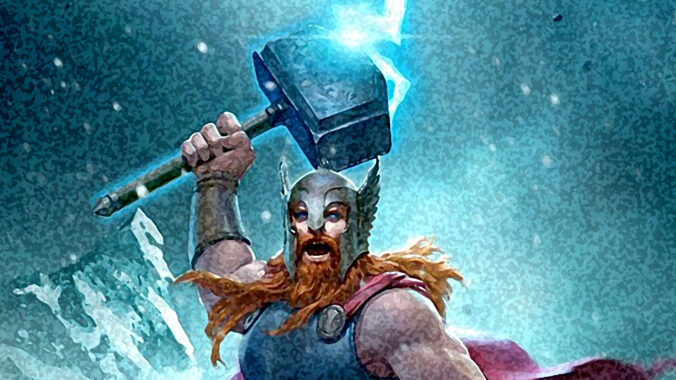
Thor
Race: Protector Aasimar
Class: Cleric (Tempest)

  • Tempest Clerics literally channel thunder, lightning, and divine storms.
  • Aasimar fits the demigod archetype.
  • His hammer is a sentient storm-spirit weapon, not a piece of technology.
  • Divine retribution mimics Mjolnir’s lightning strikes.
  • Signature ability: Stormcaller’s Leap – teleport short distances in a burst of lightning (mechanically: Thunder Step).

Doctor Strange
Race: Human
Class: Wizard (Order of Scribes)

  • Strange is a scholar-mage first and foremost.
  • Scribes Wizards manipulate spellbooks, alter spells on the fly, and conjure spectral script, very Strange-like.
  • His Eye of Agamotto becomes an Ancient Glyph Key, a relic from an extinct wizard order that bends time and space.
  • Signature ability: Many-Gated Mirror – cast Misty Step, Dimension Door, or Arcane Gate through floating runic portals.

I hope you enjoy these medieval superheroes (perhaps even play some of them). I may publish more characters later.

Favorite Horror Novels, 18th/19th century

  • History of the Caliph Vathek (1786), by William Beckford
  • The Monk (1796), by Matthew Gregory Lewis
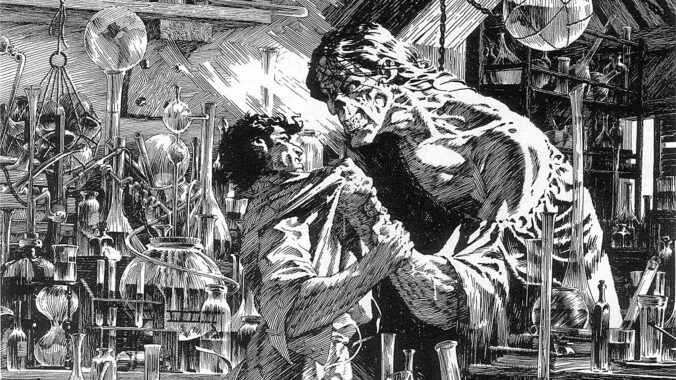
  • Frankenstein (1818), by Mary Shelley
  • Melmoth the Wanderer (1820), by Charles Maturin
  • Varney, the Vampire (1847), by Thomas Prest
  • Carmilla (1872), by Sheridan Le Fanu
  • Strange Case of Dr Jekyll and Mr Hyde (1886), by Robert Louis Stevenson
  • The Picture of Dorian Gray (1890), by Oscar Wilde
  • Dracula (1897), by Bram Stoker
  • The Turn of the Screw (1898), by Henry James

Manchurian Candidates

Richard Condon’s The Manchurian Candidate is one of the defining Cold War thrillers of American literature. Published in 1959, it captures a world of paranoia, espionage, and ideological extremism at the height of the Red Scare. The novel follows Sergeant Raymond Shaw, a decorated Korean War veteran who, unbeknownst to himself, has been brainwashed by Communist agents into becoming an unwitting assassin. The real tragedy (and brilliance) of Condon’s construction is that Shaw’s mother, Eleanor Iselin, is the true villain: an ambitious, ruthless woman who manipulates both her son and her husband, Senator John Iselin, a demagogic McCarthy caricature, to seize political power.

Condon’s prose is cynical and darkly humorous. His world is one where politics is theatre, patriotism a mask for greed, and psychological control the ultimate weapon. The book’s central concept, the creation of a sleeper assassin through brainwashing, tapped directly into Cold War fears about Communist mind control and the fragility of individual will. It is both satire and nightmare, a vision of America’s self-destruction through hysteria and manipulation. The novel’s mix of political cynicism, psychological horror, and sexual tension (especially the quasi-incestuous relationship between Shaw and his mother) gives it a lingering unease that transcends its pulp roots.

John Frankenheimer’s The Manchurian Candidate (1962), starring Frank Sinatra, Laurence Harvey, and Angela Lansbury, was the first screen adaptation of the novel, and is remarkably faithful in tone to Condon’s original, even as it alters several key details. The setting remains within the Cold War, with the Communist conspiracy intact, but Frankenheimer reshapes the story for cinematic clarity and impact.

The film drops much of Condon’s verbose narration and focuses on stark, paranoid visuals and taut performances. Laurence Harvey’s Raymond Shaw is a more tragic, wounded figure than in the book, while Angela Lansbury’s portrayal of Eleanor Iselin is chilling, a manipulative political matriarch who weaponizes maternal affection for control. Her relationship with Shaw remains disturbing, though Frankenheimer’s film makes it more symbolic than explicit.

The satire of McCarthyism is sharpened: Senator Iselin becomes an obvious buffoon, his hysteria exploited by his wife for her own Machiavellian ambitions. The eerie brainwashing sequences, shot with dreamlike cross-cutting between a genteel ladies’ tea and a Communist demonstration, remain some of the most haunting scenes in American cinema in the sixties. Frankenheimer’s film ends on a tragic note, with Shaw breaking free of his conditioning just long enough to stop the assassination but sacrificing himself in the process, a finale that feels more moral and cathartic than Condon’s more cynical ending. The movie is both a product and a critique of its time, when Americans feared both Communist infiltration and their own government’s capacity for manipulation.

Jonathan Demme’s 2004 remake reimagines The Manchurian Candidate for a post–Cold War, post–Gulf War world of corporate power and digital control. The Communist brainwashers are gone. In their place stands Manchurian Global, a multinational conglomerate symbolizing the new face of power: corporate, financial, and global rather than ideological.

Here, the soldiers were captured during the Gulf War, and the brainwashing is achieved not through crude psychological techniques but through biotechnology and microchip implants. The shift mirrors the new century’s fears: not of Communist ideology, but of corporate totalitarianism, surveillance, and technological control. Raymond Shaw (Liev Schreiber) is now a congressman and war hero groomed for the vice presidency, while Denzel Washington’s character (renamed Major Ben Marco) becomes the paranoid veteran uncovering the truth. Meryl Streep’s Eleanor Shaw is modeled less on McCarthy-era figures than on modern political dynasties, her mix of maternal warmth and icy calculation evokes Hillary Clinton as filtered through Lady Macbeth.

The 2004 version trades Cold War dread for corporate conspiracy and biotechnology anxiety. It is slickly directed and well-acted, but its atmosphere of dread feels more diffuse. The brainwashing, once shocking, now feels metaphorical: a commentary on media control, marketing, and mass manipulation. Yet it lacks the biting satire of the novel or the surreal power of Frankenheimer’s film. Its conclusion, in which the brainwashing plot is uncovered by the authorities but kept secret from the public, attempts some sort of closure but can feel naive at certain points, and never reaches the tragic resonance of 1962’s climax.

As a story, the novel remains the most conceptually rich and biting. It captures the spirit of Cold War cynicism with vicious humor and invention. But Frankenheimer’s 1962 adaptation is the most engaging and entertaining, a perfect marriage of paranoia, late noir aesthetics, and tragedy. Its sharp political satire and unforgettable performances give it enduring power.

Favorite Non Giant Movie Monsters

  • Count Graf Orlok (Nosferatu, 1922)
  • Frankenstein’s creature (Frankenstein, 1931)
  • Gillman (Creature from the Black Lagoon, 1954)
  • Alien (Alien, 1979)
  • The Thing (The Thing, 1982)
  • Brundlefly (The Fly, 1986)
  • Pinhead (Hellraiser, 1987)
  • Pale Man (Pan’s Labyrinth, 2007)

In chronological order.

Three Times Tron

When Tron premiered in 1982, it was unlike anything audiences had ever seen. Made by Walt Disney Productions and directed by Steven Lisberger, the film combined live-action footage with computer-generated imagery in ways that were not just new but revolutionary. Yet for all its visual daring, Tron remains a strange hybrid: a movie that wedded an almost childishly simple story to some of the most sophisticated visual technology of its time.

At its core, Tron tells a fairly naive story. Kevin Flynn (Jeff Bridges), a brilliant but wronged programmer, is digitized and transported inside a computer, where he must battle malevolent programs to reclaim evidence of his stolen work. Inside the digital world, programs appear as humanoid avatars of their users, a literal personification of software that feels endearingly clumsy today. The notion that “programs” could have personalities, faiths, and gladiatorial games seems laughably anthropomorphic, a product of a pre-internet imagination still struggling to visualize the invisible.

The plot unfolds as a straightforward hero’s journey filtered through a video-game lens: Flynn becomes a digital messiah, liberating enslaved programs from the tyrannical Master Control Program. There’s little emotional depth or philosophical nuance. The dialogue often lapses into techno-babble or spiritual platitudes about “the users”. Yet, this simplicity arguably works in the film’s favor, allowing the visuals and the conceptual world to take precedence, and its mythic overtones give a primitive sense of grandeur to what might otherwise be just a chase movie in neon armor.

Where Tron truly excels is in its audacious use of technology. Disney’s animators, effects artists, and computer scientists achieved a technical marvel long before digital filmmaking became standard practice. Though only about fifteen to twenty minutes of the film are genuinely computer-generated, the entire aesthetic (fluorescent lines, geometric light patterns, and glowing grids) feels entirely digital. The look was achieved through a combination of backlit animation, optical compositing, and early CGI, giving Tron a coherence and abstraction that was utterly unique at the time.

It was the first major studio film to make computer imagery a central design principle rather than a mere novelty. The light cycles, data tanks, and disc battles remain iconic, not because they are realistic, but because they are pure visual ideas, machines imagined through mathematics and art rather than mechanical engineering. In this way, Tron anticipated the future of digital aesthetics: clean, glowing, and immaterial.

Tron occupies a peculiar space in film history. It is both a corporate experiment by Disney (eager to regain relevance with younger, tech-savvy audiences) and an avant-garde visual project closer to experimental cinema than traditional science fiction. Its neon landscapes and geometric compositions recall the work of artists like Oskar Fischinger or early video art installations. The narrative might be clumsy, but the imagery evokes something visionary: a dream of humanity’s entry into the digital frontier.

When Tron: Legacy was released nearly three decades after Steven Lisberger’s 1982 original, it promised both a revival and a transcendence, a digital myth brought into the 21st century. Directed by Joseph Kosinski and scored by Daft Punk, the film sought to update Tron‘s primitive neon vision into a sleek cyber-symphony of light, geometry, and electronic pulse. What emerged was a visually dazzling but philosophically muddled sequel, oscillating between reverent mythmaking and narrative incoherence.

Even Tron: Legacy‘s fiercest critics concede its audiovisual power. Kosinski and cinematographer Claudio Miranda created one of the most distinctive digital worlds in modern cinema, a realm of sterile beauty, reflective surfaces, and minimalist architecture. Every frame seems designed like a concept art painting: light cycles streaking through black glass, towers pulsing with faint luminescence, Daft Punk’s robotic beats synchronizing with the visual rhythm.

The film’s aesthetic coherence is extraordinary, a total design vision that feels more like an art installation than a story. In this sense, Legacy continues what the original began, not a plausible depiction of computer space, but a dreamlike abstraction of it. It is less about technology than style as metaphysics, a meditation on control, perfection, and isolation rendered through geometry and sound.

Narratively, Tron: Legacy functions as a mythic sequel rather than a direct continuation. Sam Flynn (Garrett Hedlund), the disaffected son of Kevin Flynn (Jeff Bridges), enters the digital world (the Grid) in search of his long-lost father. Inside, he finds a totalitarian system ruled by Clu, a younger digital replica of Flynn who has turned his creator’s ideal of “perfection” into fascist tyranny. The story echoes countless archetypes: the prodigal son, the fallen god, the rebel angel.

And yet, beneath its mythic ambitions lies a host of unanswered questions. How can a digitized human bleed? Why does Flynn’s avatar age? How can a purely digital being like Quorra become flesh in the real world? Why does Tron, after years as the villainous Rinzler, suddenly revert to heroism without explanation? None of these have consistent answers, because Tron: Legacy is not really science fiction. It is digital mysticism.

Its rules are spiritual, not logical. The Grid is portrayed less as software than as an alternate dimension shaped by human thought. Flynn’s aging represents psychological weariness. Quorra’s materialization symbolizes enlightenment crossing into reality. Tron’s “conversion” is the awakening of a suppressed conscience. The film borrows the form of science fiction but uses it as a language for myth, sacrifice, and transcendence.

It is impossible to watch Tron: Legacy without sensing the influence of The Matrix trilogy. Both depict digital realms indistinguishable from reality, overseen by artificial overlords and populated by programs with human personalities. The parallels are striking. The Grid vs. The Matrix: self-contained digital worlds reflecting humanity’s flaws and aspirations. Clu vs. Agent Smith: the creation that turns on its creator, obsessed with perfection and control. Castor vs. The Merovingian: decadent exiles who understand the system better than its heroes. Flynn vs. Morpheus: aging guides who see beyond binary logic. Sam vs. Neo: reluctant heirs to a digital destiny.

However, while The Matrix builds an intricate philosophical architecture around its virtual world, merging cyberpunk with Gnosticism, existentialism, and Buddhist allegory, Tron: Legacy gestures toward profundity but rarely engages it. It borrows the aesthetic grammar of The Matrix (slow-motion combat, slick monochrome interiors, leather-clad deities) but not its intellectual rigor. The result is a film that feels profound while saying little that withstands scrutiny.

The film’s emotional core, the relationship between father and son, offers genuine resonance. Jeff Bridges gives a weary, Zen-like performance as the elder Flynn, a digital ascetic torn between guilt and enlightenment. His dual role as both creator and destroyer (Flynn and Clu) provides the story’s most potent theme: the hubris of trying to perfect the imperfect. In that sense, Legacy flirts with theological depth, with a creator imprisoned by his own creation, echoing Milton’s Paradise Lost more than any programming manual.

Yet the film is also a $170 million corporate product designed to sell both nostalgia and a new generation of merchandise. Its pacing alternates between meditative stillness and promotional spectacle. The human story is often drowned out by digital bombast. For a film about the boundary between real and virtual, it sometimes feels emotionally simulated and curiously cold.

Tron: Ares (Joachim Rønning, 2025) is the third live-action film in the franchise, following Tron (1982) and Tron: Legacy (2010). It takes place about fifteen years after Legacy, and features the rivalry between two corporations, ENCOM and Dillinger Systems, as they fight to bring digital constructs into the real world.

The film does attempt to preserve the franchise’s core concept: users, programs, and digital worlds bleeding into the physical world. But it also shifts the focus from the earlier theme (user/program relationships, deification of the user) into more recently familiar “AI in our world” tropes (corporations, digital beings entering meatspace). It is a semi-sequel (or a soft-reboot) rather than a seamless continuation.

One of the film’s stronger aspects is how it visually nods back to the original Tron aesthetics: neon lines, stark light/dark contrast, reflective surfaces, and minimalist digital architecture. While the original (1982) was limited by its time, its aesthetic language was iconic. Tron: Ares brings that back, especially when programs or entities from the Grid enter the physical world (or vice versa), showing light trails, digitized forms, and the sense of “digital becoming material”.

The plot, however, is weak and full of “unexplained science” moments, particularly regarding the so-called permanence code. This algorithm allows information transferred from the digital world to remain in the real world as matter, from an orange tree to a war machine to a “digital sentient being”. But how would that work? How is that mass created? Where do the atoms come from? Is energy converted into matter, or is there some pre-existing “matter bank”? The film treats this as a technological given rather than even trying to explain it. 

The original Tron remains a landmark for its time: daring, low-budget yet visionary, conceptually brave in its depiction of the digital world. Tron: Ares doesn’t have the same surprise factor (how could it?) and the large budget gloss sometimes dilutes the conceptual edge. The first Tron could be rough and experimental, while this third film is slick and commercial. But it’s still the original that holds cultural weight.

Bad Practices in iPad Games

Sometimes I get asked why I never mention iPad games. Well, that’s because I stopped playing them a while ago. The design philosophy in the current iPad gaming landscape is pernicious, and it made me quit.

Too many iPad games today treat players not as participants but as data points in a monetization funnel. Here are a few practices that annoy me the most.

Most iPad games today run on a carefully calibrated system of deprivation. No matter what you do, you’re always missing something: a few more gold coins to upgrade your hero, a handful of gems to finish construction, or a few energy points to attempt another level. The game will happily sell you what you lack, for real money.

This isn’t accidental. Developers deliberately structure progression so that natural play slows to a crawl after the first few hours. Each new upgrade costs exponentially more, and actions are locked behind timers that can only be skipped by paying real money. It’s a psychological trap, exploiting impatience and the fear of wasted time. What begins as entertainment becomes bookkeeping, an endless loop of waiting, paying, and waiting again. The sense of reward no longer comes from achievement, but from relief: the relief of buying your way out of a delay the game itself created.

In the past, you played games when you wanted. Now, they play you according to their own schedule. “Daily missions”, “weekly events”, “limited-time offers”: these are not bonuses, but tools of behavioral conditioning. Miss a few days and your streak resets, miss an event and your character falls behind. The result is a subtle but powerful transformation of leisure into obligation. Many players don’t realize how much of their day is shaped by digital calendars owned by others. Instead of deciding when to enjoy a game, you’re checking in to maintain progress. The pleasure of play gives way to the anxiety of keeping up. Games no longer fit into your life, you are expected to fit your life around them.

Then come the ads. At first, they seem harmless. Watch a thirty-second video to earn an extra life or a bonus chest. But soon, they become unavoidable. Some games tie essential rewards exclusively to ad-watching, while others interrupt play with mandatory commercials that offer nothing in return. This relentless intrusion reshapes the very structure of the experience. You’re not really playing anymore, you’re performing a repetitive ritual of interruptions, exchanging your attention for digital trinkets. And it’s not just annoying, it’s exploitative. Many ads are misleading, often promoting other games with fabricated footage, and the constant exposure erodes the sense of immersion that good games depend on. The player becomes the product, and their time the currency.

The competitive side of iPad gaming has fared no better. In theory, multiplayer modes should reward skill, strategy, and teamwork. In practice, they often reward only one thing: spending power. Pay-to-win mechanics create a world where the best gear, characters, or power boosts are available only through real money purchases. The consequences are predictable. Players who don’t pay are crushed by those who do. The ladder becomes a measure of disposable income, not talent. Communities fracture into “whales” (big spenders) and “free players”, the latter treated as fodder to populate the ecosystem. The illusion of fair competition vanishes, leaving behind a kind of economic warfare dressed up as entertainment.

If scarcity and pressure weren’t enough, randomness seals the trap. Loot boxes and gacha systems mimic gambling: you spend money for a chance to obtain a rare item or character, without knowing the odds. The excitement of possibility keeps players hooked, but the reality is bleak: the house always wins.

Some games soften the blow with “pity systems” that guarantee a rare drop after a certain number of failures, but these thresholds are calibrated to maximize spending, not fairness. The combination of bright colors, slot-machine sounds, and near-miss psychology isn’t entertainment, it’s manipulation wrapped in confetti.

Even ostensibly fair systems, such as battle passes, often mask deeper fatigue. A well-designed pass could offer steady rewards for regular play, but most games overload them with tasks, timers, and multiple paid tiers. To finish the pass, you must log in daily, complete repetitive chores, and perhaps even pay for “exp boosters” to make it in time. The game becomes a second job, a contract signed under the illusion of fun.

Monetization doesn’t stop at the surface. Many iPad games deploy subtle psychological tricks: fake discounts on items that were never full price, perpetual countdown timers that never truly expire, or oversized “buy now” buttons placed where your finger naturally lands. Some even sell “quality of life” features (basic conveniences like faster auto-play or larger inventories) as premium upgrades. Every design choice is optimized to nudge you toward spending, not playing.

Social features, too, have been co-opted. Guilds and alliances should build camaraderie, but they’re often engineered to create guilt and obligation. You’re asked to donate resources daily, participate in timed events, or risk being expelled from the group. What could have been community becomes coercion, a network of mutual dependence sustained by anxiety.

Some games pretend to solve these problems by calling themselves “idle”. In theory, that means they respect your time and that you earn progress even when not playing. In practice, idle systems are often a disguise for more aggressive monetization. Auto-play features frequently perform better than manual play, turning the player into a spectator while the game runs itself. Progress depends on waiting for timers to expire or paying to make them expire faster. The loop remains the same, only the pacing changes.

None of this is an accident. The modern iPad gaming economy is shaped by powerful incentives. User acquisition costs are high, so once a player is captured, every mechanic must maximize retention and revenue. The App Store’s charts reward daily engagement and in-app purchases far more than artistic merit or originality. And because a small percentage of players (“whales”) account for most of the profits, game design increasingly caters to them at the expense of everyone else. Add rising production costs and the pressure to match console-level visuals, and the result is an environment where aggressive monetization feels not just acceptable, but inevitable.

It doesn’t have to be this way. There are still developers who resist the dark gravity of free-to-play economics. Games that charge a fair upfront price, that offer transparent expansions instead of manipulative microtransactions, that sell cosmetics instead of power. These titles let players progress at their own pace, take breaks without punishment, and enjoy gameplay that feels like discovery rather than labor. They publish their odds openly, respect offline play, and treat players not as a resource to extract but as guests to delight. But, unfortunately, those games are rare.

For the rest of us, awareness is the first defense. Pay attention to how a game structures its economy. Notice how often it interrupts you, how it measures your time, how it tries to sell you back the patience it just took away. Refuse to buy “solutions” to problems the game created. Support studios that charge honestly and design fairly. Write reviews that call out manipulation in clear, specific terms. And above all, remember: if a game feels like work, it’s not you who’s failing, it’s the design that’s exploiting you.

Favorite Movies About Apes

  • King Kong (Merian C. Cooper, 1933)
  • Planet of the Apes (Franklin J. Schaffner, 1968)
  • Gorillas in the Mist (Michael Apted, 1988)
  • Congo (Frank Marshall, 1995)

In chronological order.
Only one movie per franchise.

« Older posts

© 2026 Zander Dulac

Theme by Anders NorenUp ↑