Category: Uncategorized (Page 2 of 9)

The Other Three Airports

Airport (1970) was so successful that it paved the way for three sequels. Unfortunately, none of them was on par with the original movie.

Airport 1975, directed by Jack Smight, was easily the worst one. Released four years later, it clearly reveals how quickly the franchise shifted from melodramatic ensemble drama to pure spectacle. The premise is simple to the point of absurdity: a midair collision between a small plane and a jumbo jet leaves the cockpit crew dead or incapacitated, forcing a flight attendant (Karen Black) to pilot the aircraft until rescue arrives. That’s it, a single setup stretched into nearly two hours of shouting, turbulence, and increasingly implausible heroics.

Where the first Airport balanced human drama with technical realism, Airport 1975 turns those elements into clichés, aiming for spectacle over story, and hysteria over tension. It’s both unintentionally hilarious and historically significant: the film that marks the moment when the “disaster movie” became self-parody.

The credits claim Airport 1975 is “inspired by the novel by Arthur Hailey”. In truth, there’s almost nothing of Hailey left. His original 1968 book and the 1970 film adaptation were grounded in procedural detail, exploring the complex interdependencies of an airport system under stress. His themes were about human competence, bureaucratic failure, and the beauty and danger of technological progress. The sequel jettisons all of that. The only surviving element from Hailey’s world is Joe Patroni (George Kennedy), the no-nonsense maintenance engineer, a minor character in the first film, now magically promoted to Vice President of Operations. Everything else (the midair collision, the stewardess at the controls, the nun with the guitar, the bizarre passengers) is original, though “original” may not be the right word. It’s really a pastiche of Hollywood sensationalism.

Everything that worked in Airport (the grounded realism, the professional tone, the believable human flaws) is mishandled here. The dialogue, once clipped and procedural, has devolved into a soap opera. The cross-cutting tension between the control tower and the plane, once exciting, now feels repetitive. And the star ensemble, once dignified, is now a circus of mismatched personalities: Charlton Heston growling as macho pilot Alan Murdock, Karen Black visibly miserable as the panic-stricken stewardess, and a gallery of celebrities who seem unsure whether they’re in a drama or a variety show. It was a hit at the box office but a critical embarrassment, the kind of movie that made the parody Airplane! (Abrahams, Zucker & Zucker, 1980) inevitable.

The first Airport reflected its time’s casual sexism, with stewardesses as glamorous accessories and female characters often defined by romance or hysteria. But Airport 1975 takes that dynamic and amplifies it into caricature. Karen Black’s Nancy Pryor, the film’s de facto protagonist, is portrayed less as a capable professional than as a trembling, weeping woman thrust into a responsibility she’s unfit to handle. Her male colleagues, especially Charlton Heston’s Murdock, talk about her as if she were a child. “She’s just a stewardess!” becomes a repeated line, almost a refrain. Instead of exploring the psychological tension of being alone in the cockpit, the film milks it for male heroics: the man on the ground shouting instructions, the woman barely coping, and the ultimate salvation arriving (literally) in the form of a male savior (Heston winched through the cockpit window).

Gloria Swanson, playing herself on board the doomed jet, is one of the movie’s strangest touches. The aging silent film legend, dictating her memoirs to her assistant mid-flight, brings a surreal, meta-textual layer, but not intentionally. But that’s not even the most bizarre or mismatched cast member. Linda Blair, just one year after The Exorcist, plays a sick child who never stops smiling, seemingly in a different emotional universe from everyone else. George Costanza’s father, Jerry Stiller, appears in a minor role, supposedly in comic relief. Erik Estrada, later famous as Poncherello in CHiPs, plays a swaggering co-pilot who dies minutes into the story. And to top it all, there’s the singing nun. Helen Reddy as Sister Ruth serenading Linda Blair with a folksy song on guitar is, by general consensus, one of the most excruciating scenes in the history of the genre. It’s meant to humanize the passengers and offer emotional respite, but instead it feels like the filmmakers mistook The Sound of Music for realism.

The movie’s central image, a gaping hole in the cockpit windshield, also provides endless unintentional comedy. In real life, of course, the sudden decompression from such an event would cause catastrophic structural failure and likely suck everyone out. In the movie, though, people stand around chatting calmly while wind whistles in the background, as if someone merely cracked a window. The absence of depressurization effects reveals the film’s approach to realism: none whatsoever. 

The passengers’ reactions to the crisis are so exaggerated and poorly acted that the film often feels like a parody of itself. Extras flail their arms, scream on cue, and faint in synchronized rhythm. The hysteria is theatrical rather than human, a kind of collective overacting that annihilates any tension.

By 1975, the disaster movie formula had become industrial: each picture needed a new set of celebrities, a new catastrophe, and a new way to out-shout the last. Subtlety and realism were casualties of the genre’s own success. Airport 1975 stands as the most transparent case of that self-destruction.

Airport ’77 (Jerry Jameson, 1977) was a step up from the previous fiasco, in tone, direction, and coherence. Universal tried to course-correct: bring in a new director, a more grounded script, and a cast packed with vintage Hollywood royalty. The setup this time is a privately owned Boeing 747, filled with art treasures and VIPs, that crashes into the ocean after being hijacked and ends up resting on the seabed. What follows is a hybrid between an air-disaster film and an underwater survival drama.

One of Airport ’77‘s most striking features is its cast, a cross-generational lineup that looks like a tribute to Hollywood history. James Stewart plays Philip Stevens, a wealthy art collector who owns the doomed jet. His presence lends gravitas even though his role is mainly confined to ground control. Stewart’s dignity elevates even the most ridiculous lines. Joseph Cotten and Olivia de Havilland, both legends of the 1930s and 1940s, add a touch of faded grandeur, their elegance underscoring how far the franchise has drifted from the sober professionalism of the 1970 original. Christopher Lee also gives a restrained, dignified performance, no small feat in a movie about a submerged 747.

Representing the “younger generation”, Jack Lemmon stars as Captain Don Gallagher, a responsible, unflappable professional, the kind of role he rarely played, and one he approaches with understated realism. Lee Grant and Brenda Vaccaro add spice to the cast, though their subplots are essentially filler. The result feels like an Old Hollywood reunion trapped inside a popcorn thriller. It’s oddly touching, even as the script doesn’t quite know what to do with all that talent.

The science of Airport ’77 feels shaky. Once the plane crashes and sinks intact to the ocean floor, the movie asks us to believe that it remains both structurally sound and pressurized hundreds of feet underwater. The final act, in which the Navy raises the plane using giant inflatable air bladders, is even less believable. While lifting submerged objects with buoyant devices is possible in engineering (and was famously dramatized decades later in Raising the Kursk), the notion of quickly elevating a fully intact 747 (probably a 200-ton object) in one piece is more fantasy than engineering.

Airport ’77 sits in an odd place in the series. It’s probably the best-made of the sequels, but also the most unintentionally elegiac, a movie about sinking that feels itself sinking. Watching James Stewart and Olivia de Havilland deliver dignified performances amid absurd circumstances mirrors Hollywood’s own decline into spectacle-driven excess.

By 1979, the Airport franchise was running on fumes. The first film had been a prestige studio production, but its sequels were increasingly mechanical. The Concorde… Airport ’79, directed by David Lowell Rich, is the final, delirious stage. It takes the disaster formula (star ensemble, airborne peril, melodramatic subplots) and cranks it to absurdity.

The premise is already ludicrous: a corrupt arms manufacturer (Robert Wagner) tries to assassinate his own girlfriend, TV journalist Maggie Whelan (Susan Blakely), because she’s about to expose his illegal weapons sales. Instead of silencing her discreetly, he decides to blow up the Concorde she’s flying on, killing a complete passenger list of diplomats, celebrities, and airline staff, to prevent the leak.

This is corporate damage control as interpreted by a Bond villain. Wagner’s company controls advanced missile systems, so he launches actual military-grade missiles at a commercial supersonic jet. When that fails, he sabotages the Concorde’s cargo door, causing havoc on board. It’s an escalating series of assassination attempts so disproportionate they cross into farce.

The script seems unaware of its own absurdity. It plays the attacks straight, with heroic music and solemn reactions. What might have been a tense espionage thriller becomes an accidental satire of late-1970s paranoia and corporate amorality. Capitalism so ruthless it’s literally self-destructive.

George Kennedy’s Joe Patroni returns for a fourth and final appearance, completing one of cinema’s strangest professional evolutions: from chief maintenance engineer (Airport) to vice president of operations (Airport 1975) to consultant and technical adviser (Airport ’77) to Concorde pilot (Airport ’79). It’s as if a car mechanic had become CEO and then suddenly started racing Formula One. Patroni’s transformation from blue-collar engineer to supersonic pilot is utterly implausible. He would need tens of thousands of flight hours, special Concorde training in France, and type certification for a craft that required two co-pilots with extensive test-flight experience.

By 1979, though, Patroni wasn’t a character anymore: he was an institution. Kennedy plays him with deadpan sincerity, as though he knows the entire film depends on his gravelly authority. In a way, Patroni’s improbable career mirrors the series itself, with each installment trying to ascend higher, faster, and further from reality, until it flies right off the edge of reason.

The movie’s centerpiece sequences feature the Concorde dodging heat-seeking missiles by performing aerial maneuvers worthy of a fighter jet. The real Concorde, of course, was a long, slender supersonic transport, fast but not agile. Its wings were optimized for high-altitude speed, not dogfighting. Pulling high-G evasive rolls and inverted dives would have shredded the airframe or knocked everyone unconscious. And yet, in the film, the jet performs full barrel rolls, vertical dives through mountain passes, and near-instant turns to dodge not one but two missiles. The sequence is scored like an action ballet. The audience is meant to gasp, instead they giggle. This was supposed to be the height of Cold War techno-thriller tension, but it ends up as the Looney Tunes version of aviation heroics. As if the missile ballet weren’t enough, the writers outdo themselves with a sequence in which Patroni’s co-pilot (French star Alain Delon, playing Captain Paul Metrand) decides to depressurize the Concorde mid-flight, open a cockpit window, and fire a flare gun to fool an incoming missile. It’s easily one of the most gloriously insane moments in 1970s Hollywood cinema.

Between missile attacks and cabin decompressions, the movie makes time for romance. Alain Delon, the embodiment of Gallic cool, falls for flight attendant Sylvia Kristel, fresh off her Emmanuelle fame. Their chemistry is surprisingly gentle and human, a calm interlude amid chaos, though their scenes feel like they belong in a different film entirely. The French setting gives the movie a veneer of sophistication, as if Universal wanted to borrow a bit of European chic to offset the silliness. But the romance feels underdeveloped and tonally dissonant. The script alternates between pseudo-poetic pillow talk and mechanical exposition about missile guidance systems. Still, Delon brings gravitas, and Kristel’s serene demeanor almost makes the nonsense around them seem poignant (for a few fleeting minutes).

In the final act, the Concorde is damaged by another attack, leaving it with a gaping hole in the fuselage and a hydraulic failure. Yet the crew manages to fly it manually and land on a snowy mountainside near the Alps. In reality, such damage would cause explosive decompression, catastrophic structural failure, and uncontrollable roll moments, especially at supersonic speed. The Concorde’s frame was built for pressure equilibrium, not patchwork survival. Even subsonic flight would be impossible with that kind of breach.

The snowy crash landing pushes the movie fully into fantasy. The plane glides gracefully onto a snowfield, passengers are mildly shaken, and everyone exits smiling. It’s not a disaster, it’s a ski commercial. The movie ends not with tragedy or awe, but with absurd optimism, the cinematic equivalent of a shrug and a champagne toast.

The Concorde… Airport ’79 was a commercial disappointment and a critical laughingstock. It didn’t just kill the Airport series, it effectively killed the disaster genre that Airport had popularized. Audiences had moved on to the new spectacle of space (Star Wars), realism (The China Syndrome), and adult drama (Kramer vs. Kramer). Airport ’79 felt like an artifact of a bygone era: glossy, inert, and oblivious.

Favorite Movies About Dragons

  • Dragonslayer (Matthew Robbins, 1981)
  • Dragonheart (Rob Cohen, 1996)
  • Spirited Away (Hayao Miyazaki, 2001)
  • Reign of Fire (Rob Bowman, 2002)
  • How to Train your Dragon (Sanders & DeBlois, 2010)
  • Age of the Dragons (Ryan Little, 2011)

In chronological order.

The first Airport

The seventies were the decade of disaster movies, and no series represents that better than the Airport franchise.

Airport (1970), directed by George Seaton and produced by Ross Hunter, is one of the defining films of the disaster genre. In fact, it created it. Based on Arthur Hailey’s 1968 best-selling novel, the movie portrays the crisis-filled operations of a Chicago airport during a blizzard, culminating in a bomb threat aboard a Boeing 707. With its ensemble cast (Burt Lancaster, Dean Martin, Jean Seberg, Jacqueline Bisset, George Kennedy, Helen Hayes, Van Heflin), glossy production, and high-stakes melodrama, Airport was a massive commercial hit and an Academy Award success (ten nominations, one win).

It arrived at a time when commercial aviation symbolized progress, cosmopolitanism, and modern anxiety all at once. Its mixture of glamour, procedural realism, and human frailty struck a chord with audiences, and its influence extended into the 1970s with a slew of imitators and sequels.

Hailey’s novel was famous for its documentary-like realism and multiple intersecting storylines. The film stays broadly faithful to that structure and to most of the major characters: the beleaguered airport manager Mel Bakersfeld (Lancaster), the suave pilot Vernon Demerest (Martin), the PR officer Tanya Livingston (Seberg), and the elderly stowaway Ada Quonsett (Helen Hayes). However, Seaton streamlined Hailey’s more detailed bureaucratic and operational passages. The novel spent extensive time describing radar systems, air-traffic procedures, and administrative rivalries. That’s a level of depth the film could only suggest. The movie simplifies or romanticizes many subplots, turning the material into melodrama rather than procedural realism. Where Hailey focused on systems under stress, Seaton focused on people under pressure. Still, the adaptation preserves the novel’s essential tone: an almost reverent fascination with the machinery of modern air travel and the human fallibility that complicates it.

One of the most striking things about Airport today is how quaint it feels as a depiction of aviation culture. The film is an accidental documentary of late-1960s jet-age glamour and logistics. Air travel was a luxury, with passengers dressed formally, meals served with silverware, and airline staff exuding near-military decorum. Equally revealing is what’s absent. There are no metal detectors, no computerized boarding passes, and minimal security. Passengers stroll to the gate minutes before departure. The bomb plot hinges on the ability of a man to walk aboard with a briefcase of explosives, something unthinkable today. The airport itself, with its snowed-in runways, typewriters, and control towers filled with analog gauges, feels like a cross between a cathedral of modernity and a stage play about industrial hubris. And fifty years later, the movie’s casual sexism (stewardesses’ roles, Dean Martin’s flippant charm) and the mix of glamour and chaos in public infrastructure evoke a bygone age, not just of air travel but of optimism in technology.

Airport was Alfred Newman’s final score before his death, and it’s a masterclass in classical Hollywood orchestration. Newman, who had been one of the studio system’s most influential composers (with over forty Oscar nominations and nine wins), wrote a score that oscillates between stately grandeur and rising tension. His central theme, brassy, confident, and sweeping, embodies the romance of aviation. Yet his underscoring of the crisis scenes is crucial, with the gradual layering of suspenseful motifs during the bomb subplot sustaining the film’s tension when the dialogue threatens to drag. Newman’s use of brass and percussion gives mechanical urgency to the airport setting, while his leitmotifs for Ada Quonsett and D.O. Guerrero (Van Heflin) add warmth and pathos. Without Newman’s score, much of the film’s suspense would dissipate. The music provides propulsion, turning what could have been a talky ensemble drama into something that feels airborne.

In a cast of movie stars, Helen Hayes, the “First Lady of the American Theater”, shines in a different light. As Ada Quonsett, the elderly stowaway who sneaks onto planes for fun, she delivers the only entirely endearing and emotionally resonant performance. Her mixture of comic timing and gentle melancholy recalls the screwball heroines of an earlier age, grounding the film in humanity amid its mechanical chaos. Hayes won the Academy Award for Best Supporting Actress for the role, and deservedly so. She brings both levity and wisdom, stealing every scene she’s in, a remarkable feat in a movie crowded with Hollywood glamour and technical spectacle. In a sense, she represents the innocence of travel itself: the wonder of flight before it became routine and impersonal.

Though often dismissed by later critics as glossy pulp, Airport deserves recognition for its craftsmanship and its influence. It codified a narrative structure that would dominate the 1970s: multiple intertwining stories converging on a single disaster. It also marks the transition between two eras, the last gasp of Old Hollywood studio gloss and the dawn of the modern blockbuster. The film’s pacing and melodramatic tone feel dated today, but its fascination with infrastructure and crisis management foreshadows the procedural realism of later television dramas. Its mix of star glamour and catastrophe spectacle became a blueprint for The Towering Inferno, Earthquake, and even TitanicAirport is a polished, sometimes soap-operatic but ultimately iconic film, faithful in spirit to Arthur Hailey’s novel, fascinating as a window into the aviation world of its era, elevated by Alfred Newman’s majestic final score, and humanized by Helen Hayes’s luminous performance. It remains both a disaster film prototype and a nostalgic elegy for the Jet Age’s faith in order, beauty, and flight.

Playing Old CRPGs Again: Wasteland 3

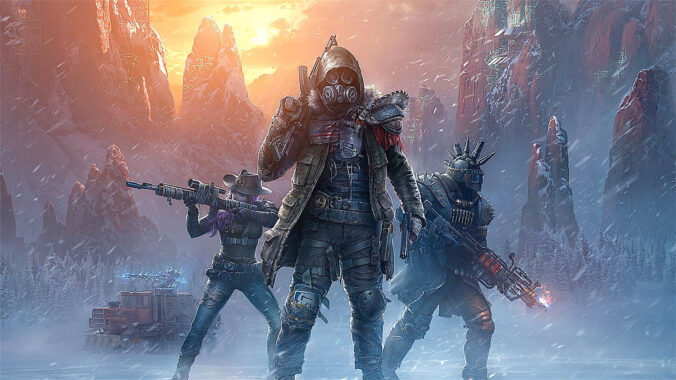
Well, Wasteland 3 is not exactly an old CRPG (it was launched in 2020), and I’m not actually replaying it (because I never had the opportunity to play it before), but after Wasteland 2 it was an obvious choice for this series anyway.

The Wasteland franchise has always carried the weight of history. The original Wasteland (1988) laid the groundwork for post-apocalyptic RPGs and directly inspired the Fallout series. Decades later, Wasteland 2 (2014) revived the series with a modernized isometric format, featuring heavy text and a branching narrative. Wasteland 3 (2020), developed by inXile Entertainment, continues that revival but shifts the setting from the deserts of Arizona to the frozen wastelands of Colorado. This new location gives the franchise fresh thematic ground: coldness, scarcity, and survival under a tyrant’s shadow, while still keeping the Rangers as the moral (or amoral) focal point.

The Rangers once again act as the thin line between order and chaos, but instead of rebuilding the Southwest, they’re drawn into the power struggles of Colorado. The Patriarch, a strongman leader, asks them to capture his rebel children and stabilize his rule in exchange for aid to Arizona. This premise ties naturally into the ongoing Wasteland storyline: Rangers as outsiders forced to broker deals between factions, never truly at home, never entirely in control. It continues the franchise’s tradition of examining the tension between idealism and pragmatism in post-nuclear America.

Compared to the previous title in the series, Wasteland 3 brings several improvements. The turn-based tactical system feels tighter, with clearer action-point management, improved cover mechanics, and more dynamic execution. Full voice acting elevates the narrative and adds personality to factions and NPCs, reducing the fatigue of reading walls of text. Inventory and squad management are far more intuitive than in Wasteland 2, making long play sessions smoother. It’s not revolutionary, but it feels more confident and accessible without losing complexity.

That said, Wasteland 3 is no stranger to technical hiccups. At launch, and even after multiple patches, players reported crashes, quest-breaking bugs, and odd AI behavior. While many of these issues were gradually addressed, some persist even years later (and I experienced a few of them). The game is undeniably playable and fun, but the lingering rough edges betray its mid-budget production and occasionally undermine immersion.

The main story is one of the game’s strengths. Choices ripple through the world: siding with or against factions, deciding the fate of the Patriarch’s family, and ultimately determining what kind of Colorado will emerge. These ramifications create multiple endings that feel meaningfully different, a hallmark of the franchise and a significant reason for replayability. I actually played it twice, once with the Rangers truthfully on the Patriarch’s side and then with the Rangers subtly scheming against him and taking him down in the end.

Some quests shine with moral depth, while others feel rushed or unbalanced. Example of a good quest: Call to Action. This mission epitomizes what Wasteland 3 can do well. You face a moral decision where either path is rewarding, though in different ways. Instead of punishing creativity or diplomacy, the quest recognizes multiple solutions, making the player feel that their role-play matters. Example of a bad quest: Disappeared. The setup, choosing between killing one group of people, killing the other, or negotiating peace, seems promising. Yet the peaceful solution yields no rewards at all, making it ironically the least attractive option. This undermines the spirit of choice-driven gameplay and encourages players to resort to violence, even when their character wouldn’t necessarily choose to do so.

The Refugees faction encapsulates the game’s ambivalence about moral versus mechanical incentives. In theory, Rangers are protectors of the downtrodden, so siding with refugees should feel natural. In practice, however, it’s punishing: helping them brings no material rewards, damages relationships with other factions, and can even result in the refugees attacking you in the end. While this may be thematically intentional, showing the cost of altruism in a broken world, it risks alienating players who feel their compassion is being punished without narrative justification.

The DLC The Battle of Steeltown is a solid addition. It expands the world organically, with new moral quandaries and a fresh industrial backdrop. Its themes of labor, oppression, and survival connect smoothly to the main plot, making it feel like a natural extension. But the DLC Cult of the Holy Detonation is much less successful. It’s disconnected from the main story and relies heavily on gimmicky mechanics, such as ever-spawning enemies. Instead of being more challenging, this design choice makes encounters tedious and repetitive, draining the fun rather than enhancing it.

Wasteland 3 is a worthy successor that strikes a balance between accessibility and depth. Its narrative ambition, colorful factions, and branching paths make it compelling, even if not every quest lives up to the promise. Bugs and some frustrating quest designs hold it back, and the uneven DLCs show both the highs and lows of inXile’s experimentation. Wasteland 3 may stumble at times, but it delivers a memorable, choice-rich RPG that keeps the franchise alive and thriving. It’s a flawed gem, but a gem nonetheless.

Favorite 1900-1950 Visual Art

  • Montagne Sainte-Victoire, Paul Cézanne, 1904
  • The Kiss, Gustav Klimt, 1908
  • The Dance, Henri Matisse, 1910
  • Black Square and Red Square, Kazimir Malevich, 1915
  • Woman with Blue Eyes, Amedeo Modigliani, 1918
  • The Elephant Celebes, Max Ernst, 1921
  • Composition with Red Blue and Yellow, Piet Mondrian, 1929
  • House by the Railroad, Edward Hopper, 1925
  • The Great Machine, Giorgio de Chirico, 1925
  • Autoportrait (Tamara in a Green Bugatti), Tamara de Lempicka, 1929
  • Guernica, Pablo Picasso, 1937
  • Time Transfixed, René Magritte, 1938
  • The Beautiful Bird Revealing the Unknown to a Pair of Lovers, Joan Miró, 1941
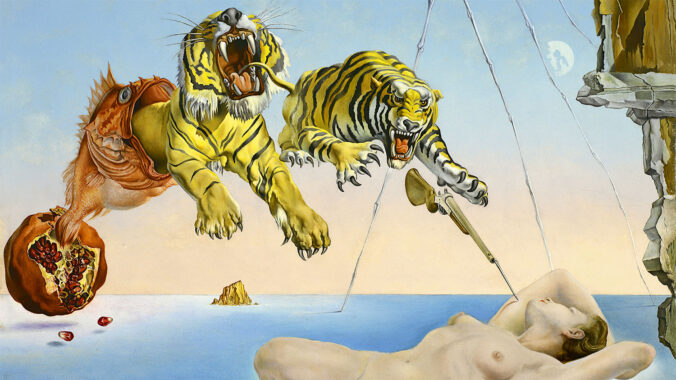
  • Dream Caused by the Flight of a Bee Around a Pomegranate a Second Before Awakening, Salvador Dalí, 1944
  • Christina’s World, Andrew Wyeth, 1948

In chronological order.

The Innocents: essence of the fantastic

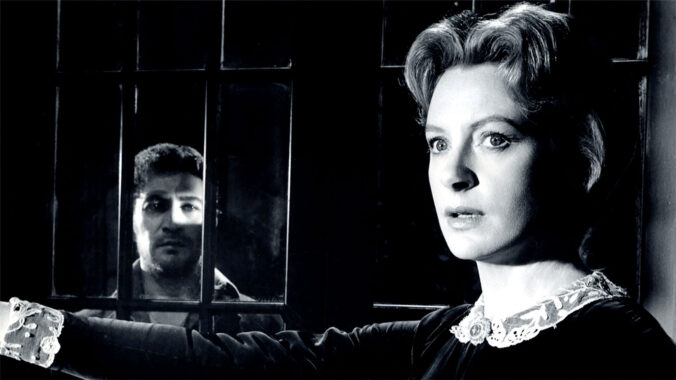
Henry James’s novella The Turn of the Screw is famous for being slippery. Are the ghosts real, or is the governess losing her mind? The 1961 film The Innocents keeps that same spirit of uncertainty, but instead of James’s careful prose, it uses images, sound, and atmosphere to create doubt. The story is essentially the same, but the movie sharpens the tension, leaning into the creepy sexuality and suppressed desire that James only hinted at. Where the book makes you question every line, the film makes you question every shot.

The script started with a stage adaptation, but Truman Capote was brought in to rewrite it. His influence is evident in the sharp, suggestive dialogue and in how the children’s eerie maturity is conveyed without feeling overdone. Capote gave the film its double edge: everything can be read two ways, as either a genuine haunting or as the governess projecting her fears and repressed desires. That balancing act is what makes the movie so unsettling.

Director Jack Clayton avoids cheap scares. Instead, he lets silence and stillness work on you until a sudden figure in a window or a whisper in the dark lands like a thunderclap. His staging is deliberate: characters are positioned like pieces on a board, with distance and movement telling you just as much as the dialogue. The effect is slow-burning dread that never quite gives you release.

The black-and-white photography by Freddie Francis is breathtaking. He plays with overexposed whites, deep shadows, and reflections so that even a bright garden feels uncanny. Ghostly shapes seem to appear naturally in the frame, with no special effects needed. Wide shots capture everything in sharp focus, forcing you to wonder if that shadow in the corner is real or just your imagination. This isn’t just pretty camerawork, it’s cinematography designed to make you doubt your own eyes.

Deborah Kerr is the movie’s anchor. She plays the governess with total conviction, which is scarier than if she’d gone for hysteria. You believe she cares for the children, but her intensity makes you worry she’s also dangerous. Kerr was older than the governess in the book, which works brilliantly, as she feels like someone who has kept her emotions bottled up for years, now cracking under the strain. The final scenes wouldn’t hit nearly as hard without her layered performance.

Literary critic Tzvetan Todorov defined the “fantastic” as that moment when you can’t decide if something is supernatural or just psychological, and you’re stuck in that hesitation. The Innocents is a textbook case. Every ghost sighting can be explained naturally, and every “rational” explanation leaves room for the uncanny. The film never tips its hand, and that’s why it lingers so powerfully.

The Turn of the Screw has been filmed many times, but most versions stumble by taking too firm a stance one way or the other. Some make it a straight ghost story, others a psychological breakdown. A few are handsome productions, but none capture the same knife-edge uncertainty. The 2020 film The Turning tried but felt contrived. Probably the closest spiritual successor isn’t even an adaptation: Alejandro Amenábar’s The Others (2001), which gets the atmosphere and ambiguity right (up until the final reveal).

The Nightcomers (Michael Winner, 1972), intended as a prequel, demonstrates precisely how to ruin this kind of story. By providing us with an explicit backstory about Quint and Miss Jessel (with Marlon Brando as Quint), it explains what James and Clayton wisely left ambiguous. Instead of mystery, we get tawdry melodrama. The children’s corruption is spelled out, and the air of dread collapses into cliché. In trying to “fill in the blanks”, the movie drains away all the power of the original.

Mike Flanagan’s Netflix miniseries The Haunting of Bly Manor combines James’s story with other works of his, reframing it as a tale of love, grief, and memory. It’s beautifully acted and emotionally satisfying, but it isn’t The Innocents. Where Clayton’s film keeps you trapped in doubt, Bly Manor builds a mythology of ghosts and explains how they work. It goes for catharsis instead of unease. As a result, it’s touching but far less haunting.

Final word: The Innocents remains the gold standard. Capote’s sly script, Clayton’s restrained direction, Francis’s brilliant visuals, and Kerr’s magnetic performance combine to make a film that never gives you an answer. It’s that refusal to resolve the mystery that makes it unforgettable.

Favorite 1850-1900 Visual Art

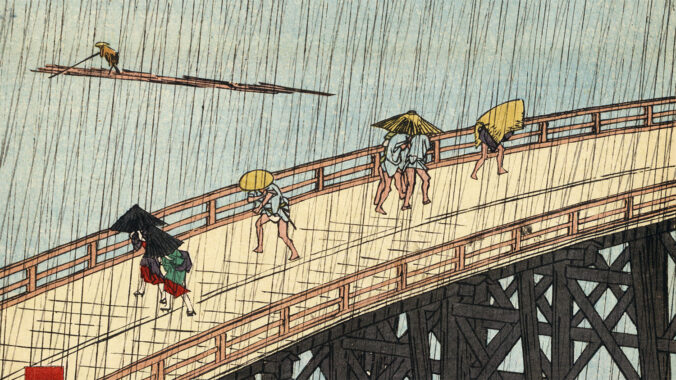
  • Sudden Shower Over Shin-Ohashi Bridge, Utagawa Hiroshige, 1857
  • The Heart of the Andes, Frederic Edwin Church, 1859
  • Lady Lilith, Dante Gabriel Rossetti, 1873
  • Woman with a Parasol, Claude Monet, 1875
  • Young Man at His Window, Gustave Caillebotte, 1876
  • Rising Moon over Mount Nanping, Tsukioka Yoshitoshi, 1885
  • A Sunday Afternoon on the Island of La Grande Jatte, Georges Seurat, 1886
  • The Lady of Shalott, John William Waterhouse, 1888
  • Starry Night, Vincent van Gogh, 1889
  • The Scream, Edvard Munch, 1893

In chronological order.

Three Dredds

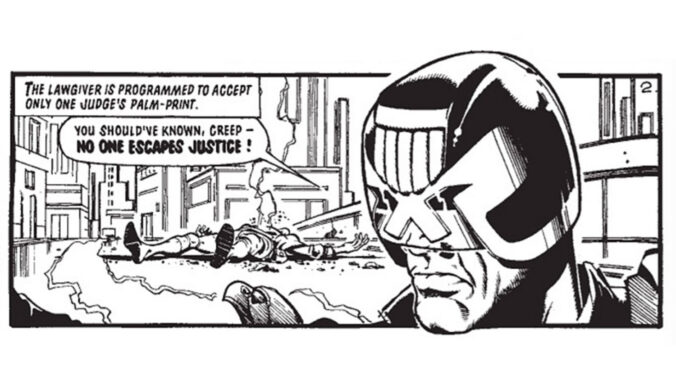
I’ve recently had the chance to see two movies I had never seen, Judge Dredd (Danny Cannon, 1995) and Dredd (Pete Travis, 2012). They are both adaptations of the comic strip Judge Dredd, but they differ significantly from each other.

Judge Dredd first appeared in 1977 in 2000 AD, a British weekly anthology comic, created by writer John Wagner and artist Carlos Ezquerra. The strip was a reaction against both American superhero excess and the bleak prospects of late-20th-century urban life. The setting, Mega-City One, was a sprawling dystopian metropolis stretching along the American eastern seaboard, plagued by crime, unemployment, and social decay.

Dredd himself was conceived as the ultimate law enforcer: judge, jury, and executioner rolled into one. He wore a militaristic uniform with oversized pauldrons, hid his face behind a helmet, and spoke in terse, authoritarian commands. The character was never meant to be a hero in the traditional sense. Instead, the comics satirized authoritarianism, policing, and state power. The world of Judge Dredd is one in which the law is absolute but also absurd, reflecting anxieties about fascism, militarization, and the erosion of civil liberties.

A key point is that Wagner and Ezquerra didn’t present Dredd as purely admirable or purely villainous. He was both protector and oppressor, embodying the contradictions of a society that sacrifices freedom for security. This ambivalence made the strip unique: readers could cheer for Dredd’s brutal efficiency one moment and recoil at his inhumanity the next.

The first significant attempt to bring the character to the screen was the 1995 film, Judge Dredd, directed by Danny Cannon and starring Sylvester Stallone. Hollywood, however, took significant liberties, as it often does. The movie largely abandoned the satirical edge of the comics in favor of a more conventional action hero flick.

Two controversial choices defined this adaptation. First, Stallone removed the helmet for much of the film, undermining one of the character’s essential traits. In the comics, Dredd’s facelessness symbolizes his role as an impersonal instrument of the law. By showing his face, the movie personalized him, trying to turn him into a sympathetic action hero. And then there’s the tone shift. Instead of a biting critique of authoritarian justice, the film leaned on big explosions and campy humor. Rob Schneider’s annoying comic-relief sidekick, created just for the movie, epitomized this tonal mismatch.

The socio-political undertones were diluted. The movie glossed over issues like corruption and cloning, instead favoring an individualistic narrative where Stallone’s Dredd proves his innocence and defeats his evil twin. Rather than questioning the legitimacy of a justice system where one man can sentence citizens on the spot, the film framed Dredd as a misunderstood hero whose authoritarian streak was simply misapplied by others.

This 1995 version attempted to graft the DNA of Judge Dredd onto the template of a mid-90s blockbuster, featuring big sets, one-liners, and uncritical thinking. The satire and ambiguity of the source material were sacrificed in favor of marketable heroics.

Seventeen years later, Pete Travis’s Dredd, with Karl Urban in the title role, corrected many of its predecessor’s missteps. Urban kept the helmet on throughout, preserving the character’s anonymity and symbolism. The tone was stripped down, brutal, and unflinching, definitely closer to the original grim satire.

The film centers on a single day in Mega-City One, with Dredd and rookie Judge Anderson (this character exists in the comics, but is far from being a rookie) trapped in a mega-block under siege by a drug lord, Ma-Ma. The plot is minimalist, almost claustrophobic, but it highlights key elements of the Dredd mythos.

It’s about the system, not the man. Dredd is not a maverick but an avatar of institutional justice. He doesn’t question the system, he enforces it ruthlessly. His humanity is glimpsed only in subtle ways, primarily through his mentorship of Anderson.

Violence is part of the routine. The film portrays violence with a grim realism. The saturation of slow-motion drug sequences contrasts with Dredd’s mechanical efficiency, underscoring the dehumanizing effects of both crime and policing.

There’s always socio-political commentary. While not overtly satirical, the film critiques a society where entire populations are warehoused in high-rise blocks, policed by authoritarian judges. Anderson’s psychic empathy provides a faint counterweight, reminding viewers that the Judges’ system is ultimately inhuman.

Unlike the 1995 movie, Dredd doesn’t try to make its protagonist lovable. He is the law, nothing more, nothing less. The world here is bleak but consistent: when society collapses, authoritarianism fills the vacuum, but at the cost of individuality and compassion.

I found it interesting to compare specific details in the two adaptations, such as Dredd’s uniform and the depictions of Mega-City One. Stalone wears what appears to be a spandex or Lycra bodysuit, which is remarkably close to what we see in the comics. However, on screen, the costumes look theatrical, flashy, and even campy. Instead of intimidating authoritarian uniforms, they read like superhero cosplay. Urban wears leather and Kevlar-style armor, designed to resemble real-world riot gear combined with tactical SWAT outfits. They kept the helmet, badge, shoulder armor, and overall silhouette, but toned down the bright colors and cartoon exaggerations. Boots and gloves are black, the eagle is muted bronze instead of blaring gold, and the armor looks worn and functional. Not comic-accurate in color or extravagance, but they’re far more convincing in a live-action dystopia. We see the same contrast with the environment. The 1995 Mega-City One is highly futuristic, neon-lit, vertical, like Blade Runner on steroids. Numerous CGI cityscapes, flying vehicles, and giant billboards. It looks like an over-designed movie set rather than a chaotic, lived-in society. The 2012 Mega-City One is a grittier, more grounded interpretation. From afar, it appears as a sprawl of crumbling modern cities, with mega-blocks rising like concrete fortresses amid a sea of urban decay. On the ground, it resembles Detroit or Baltimore with added dystopian rot: graffiti, gang-ruled projects, bleak streets. This nails the tone of Mega-City One as a decayed, crime-ridden society on the brink of collapse.

In conclusion, the 1995 movie incorporates some authentic details (clone origin, Rico, Fargo, Mega-City One, Cursed Earth), but reshapes them into a Hollywood-friendly narrative: the wrongly accused hero, the evil twin, the wise mentor, and the comic-relief sidekick. The comics were far more satirical, cynical, and episodic, whereas the movie attempted to mold Dredd into the conventional blockbuster protagonist. The 2012 Dredd doesn’t try to adapt any single classic storyline, instead it condenses the world’s essence into a tight, brutal scenario. It’s more faithful in spirit than the 1995 film because it retains the helmet, the authoritarian tone, and the oppressive city, but it strips away the comic’s satirical absurdity in favor of realism.

Favorite 1800-1850 Visual Art

  • The Great Red Dragon and the Woman Clothed in Sun, William Blake, 1803
  • La Grande Baigneuse, Jean-Auguste-Dominique Ingres, 1808
  • Wanderer Above the Sea of Fog, Caspar David Friedrich, 1818
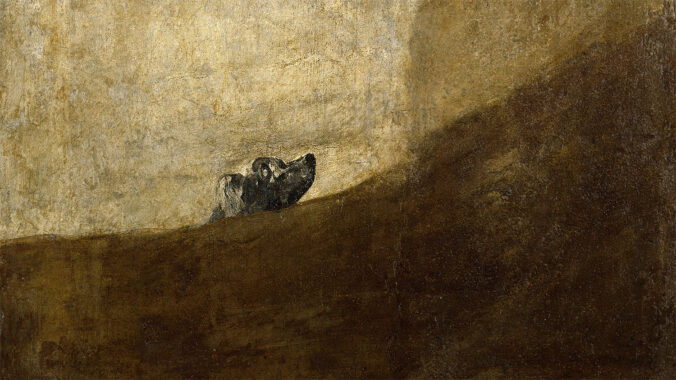
  • El Perro, Francisco Goya, 1823
  • The Great Wave off Kanagawa, Katsushika Hokusai, 1831
  • The Course of the Empire: The Consummation, Thomas Cole, 1836
  • Takiyasha the Witch and the Skeleton Spectre, Utagawa Kuniyoshi, 1844
  • Rain, Steam, and Speed – The Great Western Railway, J.M.W. Turner, 1844

In chronological order.

« Older posts Newer posts »

© 2026 Zander Dulac

Theme by Anders NorenUp ↑