Category: Uncategorized (Page 6 of 10)

Favorite 1980s Graphic Narrative

  • Les Passagers du Vent (1980), by François Bourgeon
  • Maus (1980), by Art Spiegelman
  • The Incal (1980), by Alejandro Jodorowsky and Moebius)
  • The Nikopol Trilogy (1980), by Enki Bilal
  • Torpedo (1981), by Enrique Sánchez Abulí and Jordi Bernet
  • X-Men: Days of Future Past (1981) by Chris Claremont and John Byrne
  • V For Vendetta (1982), by Alan Moore and David Lloyd
  • Akira (1982), by Katshuiro Otomo
  • Nausicaä of the Valley of the Wind (1982), by Hayao Miyazaki
  • Les Cités Obscures (1982), by François Schuiten and Benoît Peeters
  • Usagi Yojimbo (1984), by Stan Sakai
  • Les Compagnons du Crépuscule (1984), by François Bourgeon
  • Les Tours de Bois-Maury (1984), by Hermann
  • Crisis on Infinite Earths (1985), by Marv Wolfman and George Pérez
  • Watchmen (1986), by Alan Moore and Dave Gibbons
  • Batman: The Dark Knight Returns (1986), by Frank Miller
  • Batman: Year One (1987), by Frank Miller and David Mazzucchelli
  • The Sandman (1989), by Neil Gaiman and several artists

In chronological order of first publication.

Playing Old CRPGs Again: Avernum Trilogy

Next on my adventures into old CRPGs, I got into the Avernum Trilogy, by Spiderweb Software. I never played the original Exile series from the 1990s, but I did play the remake series, renamed Avernum, six games published from 2000 to 2009. However, those games no longer work on new computers. Fortunately, Jeff Vogel (owner of Spiderweb Software) has been launching new remakes of the series, and the first trilogy is already available. All these games are deeply rooted in traditional CRPG design, featuring turn-based combat, non-linear storytelling, and a vast, immersive underground world.

In Avernum: Escape from the Pit (2011), the player assumes the role of a group of prisoners exiled into the vast subterranean realm of Avernum, a cavernous world beneath the surface controlled by the tyrannical Empire. Unlike many CRPGs where the protagonist is a chosen hero, Escape from the Pit presents a world where survival is the first goal, and grander ambitions unfold naturally.

Thematically, the game explores oppression, resistance, and exile, drawing from dystopian fiction and the American frontier myth. The player’s choices (to merely survive, seek revenge, or escape) create a sense of agency, though the narrative structure remains relatively fixed. As expected from an independent game, the graphics are simple but very functional.

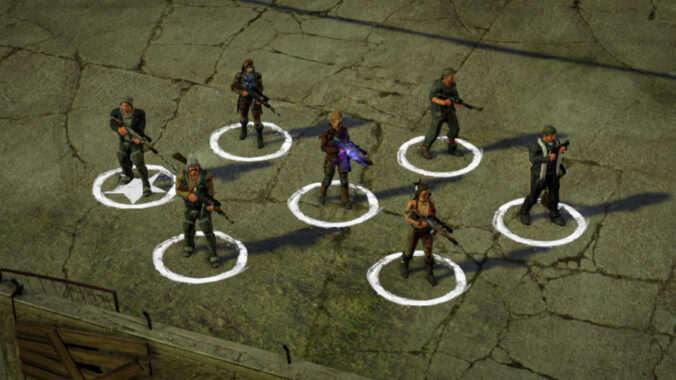
The game retains Spiderweb’s signature turn-based combat and isometric, grid-based exploration. It features deep tactical gameplay with a variety of abilities and skills. Character progression is robust, offering numerous build options. For this run, my group of four adventurers consisted of two dual-wielding fighters in the front and an archer and a priest/mage hybrid in the back. It was not the most efficient formation but it was fun to play. Magic users become very powerful around the middle of the game, so a group of mages and priests would have been a much stronger choice.

The underworld of Avernum is vast and interconnected, filled with hidden ruins, cities ruled by desperate exiles, and factions vying for dominance. The sense of discovery (finding lost vaults, encountering strange cave-dwelling races, or unearthing the history of Avernum) makes exploration very satisfying.

Avernum II: Crystal Souls (2015) was my favorite in the trilogy. It builds upon its predecessor by escalating the stakes and presenting a full-scale war between Avernum and the Empire, with the alien-like Vahnatai acting as an unpredictable third force. In the previous game we got hints of the existence of this ancient people, and meeting them here and learning about their culture deepens the world’s lore, bringing elements of lost civilizations and enigmatic magic into play.

Themes of war, diplomacy, and cultural misunderstanding drive the story. The presence of the Crystal Souls, ancient Vahnatai artifacts stolen by humans, introduces a compelling central conflict that asks whether peace is even possible or if mutual destruction is inevitable.

For this game, based on the previous experience, my group of four adventurers consisted of just one dual-wielding fighter, one priest, and two mages (who dealt an absurd amount of damage with their area of effect spells).

Avernum II: Crystal Souls is a step up from its predecessor in terms of complexity and scope. The story is stronger, the world more developed, and the choices feel more impactful. It stands as the most substantial narrative experience in the trilogy.

Avernum III: Ruined World (2018) tried to be more ambitious but didn’t fully succeed. It takes the series in a different direction by allowing players to go to the surface world for the first time, a land now devastated by an unknown menace. Instead of fighting for survival in the underworld, the game shifts to a post-apocalyptic tone, where players must navigate a collapsing Empire.

The problem was that, instead of the well developed and unique settlements we can visit in the previous games, what we find in the surface world are very generic towns with very generic inhabitants. For example, while we were used to named NPCs with their own back stories populating the towns, here we have the same merchants (blacksmith, weaver, etc) appearing in any town you go and having the same dialogue lines. It feels very repetitive, almost like the developers didn’t have enough time to properly populate the large number of settlements in the game.

The game’s central theme is civilization in decline. And if you take too long to solve the mysteries and complete your missions you will see towns destroyed, refugees fleeing, and the slow encroachment of a new alien threat. Unlike its predecessors, which are tightly structured, Ruined World is more open-ended, allowing players to shape the fate of the surface world through their actions. This new direction enhances player agency, but it also creates pacing issues. The urgency of the disaster can clash with the open-world exploration, making it easy to miss key story beats.

The party I used in Avernum II was so successful that I followed the same structure in Avernum III: one dual-wielding fighter, one priest, and two mages. And I advanced in the main quest as fast as I could, trying to prevent too much destruction to the surface world. Although this strategy worked well, it left me with the sensation that I didn’t explore the game world as well as I wished.

The shift to the surface is both a strength and a weakness. The devastated world is compelling, but lacks some of the uniqueness that made Avernum‘s underground setting so engaging. The world is more reactive than in previous games, but it can feel a bit overwhelming and unfocused compared to the tighter narrative of Crystal Souls.

I did enjoy replaying the Avernum trilogy. It excels in worldbuilding, tactical combat, and non-linear storytelling. While Escape from the Pit sets the stage with a strong survival narrative, Crystal Souls delivers the best story and character depth. Ruined World is the most mechanically ambitious, but its sprawling open-world design can dilute its storytelling.

Favorite 1970s Graphic Narrative

  • Lone Wolf and Cub (1970), by Kazuo Koike and Goseki Kojima
  • Yoko Tsuno (1970), by Roger Leloup
  • Métal Hurlant (1974), various authors
  • Arzach (1975), by Moebius
  • Paracuellos (1975), by Carlos Giménez
  • Le Garage Hermétique (1976), by Moebius
  • American Splendour (1976), by Harvey Pekar and several artists
  • The Extraordinary Adventures of Adele Blanc-Sec (1976), by Jacques Tardi
  • ElfQuest (1978), by Wendy and Richard Pini
  • X-Men: The Dark Phoenix Saga (1979), by Chris Claremont and John Byrne

In chronological order of first publication.

Dickens, Poe, and the Impressively Large Raven

In one of my weekend trips to Philadelphia, I went to the Parkway Central Library to visit Grip. If you are a reader of Charles Dickens or Edgar Allan Poe you may know a thing or two about him.

In 1941, Charles Dickens published the novel Barnaby Rudge, which had been serialized in the same year in his own weekly periodical Master Humphrey’s Clock. As a companion to the title character, Dickens added a large and talkative raven called Grip. His idea, expressed in a letter to a friend, was to make the bird “immeasurably more knowing” than the protagonist. Grip is often described in the book with almost human attributes, like when he is listening to a conversation “with a polite attention and a most extraordinary appearance of comprehending every word, to all they had said up to this point; turning his head from one to the other, as if his office were to judge between them, and it were of the very last importance that he should not lose a word”. One of my favorite bits offers an amusing account of his movements: “he fluttered to the floor, and went to Barnaby — not in a hop, or walk, or run, but in a pace like that of a very particular gentleman with exceedingly tight boots on, trying to walk fast over loose pebbles”.

Dickens explains in the preface to Barnaby Rudge that Grip was a composite of two ravens that he had owned. The first one lived in the stable and terrorized the dog, often stealing his dinner. Unfortunately, when the stable was being painted, he also decided to steal and eat the paint. He died of lead poisoning. Hearing of this sad loss, a friend sent another raven to Dickens, this one “older and more gifted”. The second bird also made the stable his home but habitually explored a larger area. “Once, I met him unexpectedly, about half-a-mile from my house, walking down the middle of a public street, attended by a pretty large crowd, and spontaneously exhibiting the whole of his accomplishments.” He died after three years or so, and since then Dickens was, to use his own word, ravenless.

Both ravens were called Grip, so it’s unclear which one Dickens decided to have stuffed and mounted in a somewhat grandiose display box. Saved for posterity in taxidermic splendor, Grip was auctioned after the author’s death and changed hands a few times before taking residence in Philadelphia.

It was a cold Saturday morning when I took the elevator to the almost empty third floor of the Parkway Central Library. The security guard was getting ready to eat his breakfast burrito and ushered me in with a nod of this head. I traveled the L-shaped corridor of the Rare Books Department, surrounded by old volumes locked behind the glass doors and observed by a few solemn statues: two versions of Johannes Gutenberg, with and without his hat, and a magnificently bearded Charles Dickens at age fifty-seven. Around the corner, at the end of the hall, there he was, Grip, surprisingly large and ominously black. The bird is, indeed, impressive, and suggests, even in death, the imposing presence it may have had in life.

Grip is in an elaborate glass and wood box, which was placed inside another glass box. This arrangement creates a system of unwanted reflections, frustrating to casual photographers. The kind librarian who was on early duty that day saw me struggling to get a good angle and, unable to help me solve that particular problem, decided to offer me something else. She unlocked the Elkins Room and invited me to spend some time there.

William McIntire Elkins was a collector of rare books with a particular predilection for Dickens. He bequeathed his collection to the Free Library of Philadelphia, and when he died in 1947 his whole reading room, complete with books and shelves, tapestries and chandeliers, and even a fireplace, was moved to the Parkway Central Library. One of the most precious objects in this beautiful personal library is the writing table used by Charles Dickens from 1837 up to his death in 1870. There it was, small but elegant. On the worn surface, as if to leave no doubt who it had belonged to, the initials C.D. roughly chiseled by the author himself.

But back to Grip. I don’t think I have ever seen a raven that big, stuffed or not. It’s fun to imagine how meeting a live bird of that size, moving and talking, would have been an impressive experience. It captivated Dickens’s imagination and, via the printed page, reached another author on the other side of the ocean, Edgar Allan Poe.

Grip may not be the direct inspiration for The Raven, one of the most famous poems in the English language (and other languages as well, translated to French by Charles Baudelaire and by Stéphane Mallarmé, and to Portuguese by by Machado de Assis and by Fernando Pessoa, just to mention a few respected names) but it certainly had some influence over Edgar Allan Poe.

Poe was not only familiar with Barnaby Rudge but also wrote a full review of the book for Graham’s Magazine in 1842. “The raven, too, intensely amusing as it is, might have been made, more than we now see it, a portion of the conception of the fantastic Barnaby.” Apparently, Poe would have preferred a stronger connection between Grip and Barnaby. “Each might have differed remarkably from the other. Yet between them there might have been wrought an analogical resemblance, and, although each might have existed apart, they might have formed together a whole which would have been imperfect in the absence of either.” Poe’s The Raven was published in 1845.

At certain point in Barnaby Rudge, two characters are talking about the raven. One of them asks “What was that? Him tapping at the door?”, while the other responds “It was in the street, I think. Hark! Yes. There again! ‘Tis some one knocking softly at the shutter.” And in the first few verses of The Raven we can find “While I nodded, nearly napping, suddenly there came a tapping, / As of some one gently rapping, rapping at my chamber door. / ’Tis some visitor, I muttered, tapping at my chamber door— / Only this and nothing more.” Inspiration? Coincidence? Unrelated?

The Raven is one of the most celebrated literary pieces in history, and inspired all kinds of homages, from Freddie Mercury singing Nevermore to Bart Simpson transmuted into a raven in Treehouse of Horror, and not forgetting, of course, the Baltimore Ravens, Super Bowl champions of 2000 and 2012. One of my favorite weird connections is Paul Gauguin’s painting Nevermore, a reclined female nude with a raven in the background next to the word “nevermore”. For some obscure reason, Gauguin denied the obvious association with Poe’s poem and claimed he meant the raven to be just a symbol for the devil. Curiously, the first time Grip appears in Barnaby Rudge he seems to enjoy repeating “I’m a devil, I’m a devil, I’m a devil. Hurrah!”

Dickens fan, or Poe fan, or just curious to see an impressively large stuffed raven? Go to Philadelphia and visit Grip. He’s a devil.

Favorite 1960s Graphic Narrative

  • The Fantastic Four (1961), by Stan Lee and Jack Kirby
  • The Amazing Spider-Man (1963), by Stan Lee and Steve Ditko
  • Blueberry (1963), by Jean-Michel Charlier and Jean “Moebius” Giraud
  • Creepy (1964), various authors
  • Eerie (1966), various authors
  • Lone Sloane (1966), by Philippe Druillet
  • Corto Maltese (1967), by Hugo Pratt
  • 5 por Infinito (1967), by Esteban Maroto

In chronological order of first publication.

Playing Old CRPGs Again: Adjusting the Plan

My initial idea was to explore old CRPGs roughly chronologically, but I’ve encountered a couple of technical obstacles. First, obviously, I no longer own all those games I played a decade or two ago. Second, with the evolution of hardware and operating systems, some games no longer work on recent computers. Third, I currently only have access to a MacBook Pro, and many of the games on the list are only available for PC. 

After Darklands, I wanted to play Betrayal at Krondor (1993) or The Elder Scrolls: Arena (1994), but I only own the PC versions of these games. Same for Diablo (1996) and The Elder Scrolls II: Daggerfall (1996). Next on the list was the Baldur’s Gate series, which I would like to play in sequence: Baldur’s Gate (1998), Baldur’s Gate: Tales of the Sword Coast (1999), Baldur’s Gate: Siege of Dragonspear (2016), Baldur’s Gate II: Shadows of Amn (2000), Baldur’s Gate II: Throne of Bhaal (2001), and finally Baldur’s Gate 3 (2023). That, of course, will take a long time.

So before getting into the whole Baldur’s Gate series (again), I thought of playing the Spiderweb Software games. The first one I played in the past was Nethergate (1998), which I remember enjoying very much. It was loosely based on the Roman occupation of Britain, and you could choose to play as the Celts or the Romans. While I no longer have my original copy of Nethergate, I do have the revamped version Nethergate: Resurrection (2007), but it’s for PC. Next, there is the Avernum series, six games from 2000 to 2009, but the versions I own no longer work on newer Mac OS X systems. Fortunately, Jeff Vogel (owner of Spiderweb Software) periodically revamps his games, and there is a new version of the Avernum series from the 2000s (which itself is a new version of the Exile series from the 1990s). So this is what I will be (re)playing next: Avernum: Escape from the Pit (2011), Avernum 2: Crystal Souls (2015), and Avernum 3: Ruined World (2018). Do recently revamped versions of old games still count as old games?

Favorite pre-1960 Graphic Narrative

  • Little Nemo in Slumberland (1905), by Winsor McCay
  • Les Aventures de Tintin (1929), by Hergé
  • Flash Gordon (1934), by Alex Raymond
  • Secret Agent X-9 (1934), by Dashiell Hammett and Alex Raymond
  • The Phantom (1936), by Lee Falk
  • Prince Valiant (1937), by Hal Foster
  • Blake & Mortimer (1946), by Edgar P. Jacobs
  • Lucky Luke (1946), by René Goscinny and Morris
  • The Adventures of Alix (1948), by Jacques Martin
  • Tex (1948), by Gian Luigi Bonelli and Aurelio Galleppini
  • El Eternauta (1957), by Héctor G. Oesterheld and Francisco Solano López
  • Asterix (1959), by René Goscinny and Albert Uderzo

In chronological order of first publication.

M x 3

I always find it interesting how different moviemakers adapt the same book for the screen. But it feels a bit uncomfortable when the source material is not a book but another movie. It’s like the director of the remake is saying to the original director, “I can make your movie better than you can”. And, more often than not, it’s not better. With very few exceptions (like Scarface, The Fly, or The Departed), remakes have very little to offer.

This week, I watched one original movie and two remakes, just trying to understand why someone would think it was a good idea to reinvent one of the most influential films in cinema history, often regarded as the bridge between silent expressionist cinema and modern sound filmmaking. I’m talking about Fritz Lang’s M (1931), a tense psychological thriller and social critique telling the story of a serial child murderer terrorizing a German city and the desperate hunt to capture him, both by the police and the criminal underworld. The film’s groundbreaking use of sound, visual storytelling, and deep thematic exploration make it a cornerstone of world cinema.

M was one of Germany’s first sound films and demonstrated how sound could be used creatively rather than just as a technical novelty. Unlike many early talkies that relied heavily on dialogue, M employs silence and selective soundscapes to heighten tension. The most famous example is the killer’s whistling of In the Hall of the Mountain King (an orchestral piece composed by Edvard Grieg), which serves as an aural motif signaling his presence and eventual downfall. Lang also uses off-screen sound innovatively, allowing unseen actions to be heard, creating suspense and a sense of lurking danger.

While M precedes the classic film noir era, its dark cityscapes, moral ambiguity, and focus on crime and psychology profoundly influenced the genre. It also established many conventions of the psychological thriller, particularly depicting a disturbed protagonist and the society that hunts him.

M is not a full-fledged expressionist film like Lang’s earlier Metropolis (1927), but it retains the movement’s influence in its high-contrast lighting, distorted cityscapes, and striking use of shadow. Fritz Arno Wagner’s cinematography uses deep shadows and stark compositions to evoke paranoia and entrapment, reinforcing the film’s themes of surveillance and pursuit.

Released during the final years of the Weimar Republic, M reflects the anxieties of a German society in turmoil. Economic instability, rising crime, and the growing power of authoritarianism are all subtly present in the film. The public hysteria and mob mentality depicted eerily foreshadow the rise of Nazi Germany, where scapegoating and vigilantism became state policy.

Peter Lorre’s portrayal of Hans Beckert, the child murderer, is one of the most chilling yet sympathetic performances in film history. Unlike traditional movie villains, Beckert is not a faceless monster but a tormented man driven by impulses he cannot control. His climactic monologue, in which he pleads for understanding, complicates the audience’s feelings toward him, making M one of the first films to explore the psychology of a killer in depth.

The film also avoids simplistic portrayals of good and evil. The criminals, led by Schränker, organize themselves as vigilantes, highlighting the blurred line between law and crime. The police and underworld both pursue Beckert with equal fervor, but for different reasons: justice versus self-preservation.

Lang structures the film like a procedural, showing the parallel investigations of the police and the criminal syndicate with a methodical precision that heightens the suspense. The intercutting between these two factions, particularly in the film’s latter half, is an early example of dynamic montage editing, keeping the tension tight and the narrative fluid.

Beyond its surface as a crime thriller, M is a meditation on justice and society’s response to evil. The film’s final moments, where Beckert faces an unofficial “trial” by the criminal underworld, raise difficult questions: does justice require legal institutions, or can mob rule be just as effective? The film offers no clear answers, leaving the viewer in a state of moral unease.

Lang himself would flee Germany soon after M, as the Nazis sought to co-opt his talents for propaganda. His later Hollywood films, including The Big Heat (1953) and Scarlet Street (1945), continued exploring crime and moral ambiguity themes, but M remains his most haunting and prescient work.

Twenty years later, someone in Hollywood decided it was a good idea to offer a new version of this classic movie. Joseph Losey’s M (1951) is a relatively faithful adaptation, relocating the story from Weimar Germany to postwar Los Angeles. The basic premise remains: a city is terrorized by a child murderer, prompting both the police and the criminal underworld to hunt him down. However, some key differences stand out.

The 1951 film reinterprets the themes of surveillance, paranoia, and societal breakdown within the context of postwar America, a country grappling with the Red Scare and growing anxieties about urban crime. The movie hints at the increasing role of police surveillance in public life, an element that wasn’t as pronounced in Lang’s version. Losey’s M also places a heavier emphasis on police work, making it feel more like a crime procedural than a psychological thriller. While competently executed, the investigation scenes lack the tension and visual inventiveness of Lang’s film.

Peter Lorre’s portrayal of Hans Beckert in the original is iconic, a mix of childlike vulnerability and monstrous compulsion. David Wayne does a respectable job in the 1951 remake, but his performance lacks the same intensity. His climactic monologue, one of the most important scenes in Lang’s film, feels weaker and less impactful.

Joseph Losey’s M doesn’t really justify its existence. While Losey was a skilled filmmaker, and some of his later works (The Servant and The Prowler, in particular) showcase his talent, his M fails to escape the shadow of the original. The remake suffers from being too close to Lang’s film while offering little that is genuinely innovative. If anything, it demonstrates how crucial style and directorial vision are, since M (1951) retains much of the plot but loses the eerie, unsettling atmosphere that made Lang’s version unforgettable.

Only two years later, we got another adaptation, this time coming from Argentina. Unlike Losey’s remake, El Vampiro Negro (The Black Vampire), directed by Román Viñoly Barreto, is more of a reimagining than a direct remake. The film keeps the basic premise (a child murderer being pursued by both the police and criminals) but shifts the focus in a way that gives it a unique identity.

The most significant and interesting change is the introduction of a nightclub singer (played by Olga Zubarry) as the protagonist. She becomes a key witness in the case, and the film uses her perspective to explore themes of powerlessness, moral complicity, and social injustice. This provides a fresh angle, as the original movie was primarily focused on male characters. By introducing the singer as a major character, the film incorporates themes of gendered violence and societal hypocrisy. She is marginalized by men in power, making her struggle parallel to the larger moral questions the film poses about justice and corruption.

Instead of a grotesque figure like Peter Lorre’s Beckert, the killer in El Vampiro Negro (played by Nathán Pinzón) is depicted as a more subdued and tormented figure. The film leans more into psychological drama than horror, making the murderer’s presence feel less terrifying but more pitiable. Unlike Lang’s stark and clinical approach, El Vampiro Negro has a more melodramatic style, emphasizing emotional turmoil. The noir-style cinematography is striking, though still not as innovative as Lang’s expressionist techniques.

Surprisingly, El Vampiro Negro takes a more creative approach, providing a different perspective and thematic depth. The focus on a female character and the inclusion of gendered violence and systemic injustice make it stand out. It shifts the narrative from a strictly procedural crime thriller to something more emotionally resonant and socially aware. While it doesn’t surpass Lang’s original, at least it offers a new lens through which to view the story. The change in emphasis, from a study of justice and mob mentality to an exploration of gender and power, gives it artistic merit as a reinterpretation rather than just a copy.

If one were to watch any of the remakes, El Vampiro Negro is the more interesting and justifiable reinterpretation, while Losey’s M is an example of how difficult it is to remake a masterpiece without adding something genuinely new. Fritz Lang’s M is not just a masterful thriller. It is a profound statement on justice, paranoia, and humanity’s darker instincts. Its technical innovations, narrative complexity, and psychological depth make it one of the greatest films ever. Nearly a century after its release, M remains as chilling and thought-provoking as ever.

Playing Old CRPGs Again: Back into the Darklands

When Microprose launched Darklands in 1992, I became obsessed with the game. I played it hour after hour, day after day, week after week, always experimenting with new ways to explore the game world and vanquish the enemies. Replaying it now was still very satisfying, despite the dated graphic presentation.

Unlike the high-fantasy worlds inspired by Ultima or Dungeons & Dragons, Darklands is set in a historically grounded 15th-century Holy Roman Empire, where alchemy, saintly miracles, and medieval folklore are real. The game offers an open-ended experience where players can travel across Germany, engaging in political intrigue, mercenary work, or combating supernatural horrors like demons and witches. The dynamic world reacts to the player’s choices, and success relies on combat and diplomacy, alchemy, and knowledge of religious traditions. Though the interface and graphics are dated by modern standards, the sheer depth of the game makes it a rewarding experience.

Darklands, like many Microprose games of that time, comes with a comprehensive printed manual, a tome packed with historical references, gameplay mechanics, and world-building details. It was a rich companion that provided context for medieval German society, the role of saints, alchemical formulas, and the political landscape. It was as much an educational piece as a gameplay guide, encouraging players to immerse themselves in the setting rather than just skim for controls and shortcuts. In an era before easy internet guides, such manuals were crucial, and Darklands set a high standard with its depth and authenticity.

The character creation system is another remarkable aspect, resembling a mini-game in itself. Instead of simply selecting stats, players shape their characters’ past by choosing their upbringing, professions, and career paths, each choice influencing skills, attributes, and even aging. A character who has spent decades mastering alchemy will be formidable but will start with reduced vitality due to age. This approach forces players to balance youthful adaptability with the benefits of experience, making the process both strategic and deeply immersive.

Features like a detailed manual and an elaborate character creation system have largely vanished from modern gaming, replaced by quick in-game tutorials designed to get players into the action within minutes. The shift is likely due to evolving player expectations and a diminishing willingness to engage with slower, text-heavy introductions. Games today prioritize accessibility, which is not necessarily a bad thing. Still, it does mean that the sense of deep preparation and gradual mastery (once integral to RPGs) has been lost. Whether this reflects a decline in attention span or just a change in design philosophy is debatable, but it’s hard to deny that something valuable has been left behind.

One of the most fascinating elements of Darklands is its integration of medieval mythology, presenting a world where alchemical potions work, dragons haunt remote regions, and Christian saints can grant divine intervention (if one prays correctly). This blending of folklore with historical accuracy creates a unique atmosphere, reinforcing the idea that people in the Middle Ages truly believed in these forces. The inclusion of Christianity as a mythological system alongside pagan and occult elements is a subtle but intriguing move, especially for players with an atheistic perspective, as it places all supernatural elements on equal footing. Rather than preaching faith, Darklands treats belief as a mechanic, where devotion and knowledge of religious customs yield tangible results, mirroring the worldview of the era rather than modern sensibilities.

For my replay of Darklands, I went with an old strategy that I call the Blood, Sweat & Tears Plan. That is a jazz-rock band that started in the sixties and keeps playing under the same name but with none of the original musicians present. They were replaced gradually, but the band’s identity remains the same. In the game, the party accumulates fame and riches (money and equipment) that stay with the group even if individual members are replaced. So, I created a system for ending up with a strong group of adventurers reaching their peak based on previous party members’ blood, sweat, and tears.

I start with three fighters (with a past of recruit, soldier, and veteran, successively) and one healer (noble heir, student, physician). Their job is to accumulate fame and money, doing missions from fighting thugs in back alleys to defeating baron robbers in their castles. Once the healer is well trained in Read & Write, and the group is well equipped (including the coveted 37q plate armor from Nurnberg), I replace the fighters. This second party consists of one fighter who is marked to be expendable (recruit, soldier, veteran), one young fighter (recruit) with high perception, one young healer-alchemist (recruit) with high intelligence, and the old healer from the previous formation. These guys will advance deeper into the plot, going through the sabbat and the Monastery, and finally exploring the Citadel for the first time, where the expendable fighter is sacrificed (it’s an episode where you lose a team member, but with this revolving door strategy we can use this to our advantage). Meanwhile, the first young fighter is trained in artifice, and the healer-alchemist gets his healing and alchemy up to 60. In the Monastery, they can get 45q plate armor for everyone and +60 Latin. Time for the third party, which gets a second expendable fighter (recruit, soldier, veteran) to replace the first, a new young fighter (recruit) with high agility, a new healer-alchemist (recruit) with high intelligence, and keeps the high perception fighter from the previous formation. They basically repeat what the second party did, along the way training the healer-alchemist in healing and alchemy up to 60, collecting saint knowledge and alchemy formulas, and sacrificing the expendable fighter again. Then I get to my final party: the fighter with high perception, the fighter with high agility, a new young fighter (recruit) also with high agility, and the healer-alchemist with high intelligence. These guys have the fame, money, equipment, and loot accumulated by the previous formations. They are able to get all saint knowledge available and train everyone in religion up to 90, get the best equipment in the game, and finish all the quests, including killing dragons, clearing mines, and completing the cycle of Sabbat, Monastery, and Citadel. Very satisfying gameplay.

In many ways, Darklands was ahead of its time. While it never became a commercial success, its influence can still be seen in later RPGs that emphasize historical authenticity and player-driven narratives. It remains a cult classic, a relic of an era when games were sprawling, unapologetically complex, and designed for those willing to lose themselves in their depths.

« Older posts Newer posts »

© 2026 Zander Dulac

Theme by Anders NorenUp ↑