- Sherlock (2010–2017)
- The Walking Dead (2010–2022)
- Treme (2010–2013)
- Black Mirror (2011-2016)
- Game of Thrones (2011–2019)
- The Newsroom (2012-2014)
- House of Cards (2013–2018)
- Orphan Black (2013–2017)
- Better Call Saul (2015–2022)
- Stranger Things (2016–2025)
- The Good Place (2016–2020)
- Succession (2018–2023)
Category: Uncategorized (Page 8 of 10)
The next game in my revival series was Lands of Lore: The Throne of Chaos (Virgin Games, 1993), developed by Westwood Studios, the same guys who made the first two instalments of Eye of The Beholder. And this game has a very similar interface, with some clear improvements over the predecessors. Stepping away from the Dungeons & Dragons license, Lands of Lore brought its own mythology in what looks like a hybrid of RPG and adventure genres.
Set in the high-fantasy world of Gladstone, the game presents a classic struggle between good and evil. The story revolves around a powerful artifact, the Nether Mask, and the efforts of the kingdom to thwart its misuse by the malevolent sorceress Scotia. The player assumes the role of a chosen champion tasked by King Richard to prevent Scotia’s rise to power. The themes are quintessentially from medieval fantasy, with elements of heroism, betrayal, and mysticism.
You can’t create your own character and have to choose one of the available heroes to play. I went with Michael, a balanced choice with skills in both combat and magic. The party grows as the adventure progresses, with companions joining temporarily based on the plot. The challenges include the usual exploration and puzzle-solving, with combat against a diverse array of enemies. Resource management is crucial, as sometimes there’s a lack of food and potions (using magic to heal between battles will save the day), and your weapons don’t last forever. The puzzles are well-designed, often requiring good observation and a lot of experimentation.
It was quite pleasing playing Lands of Lore: The Throne of Chaos again. And I had the version released on CD, which came with great voice acting, including Patrick Stewart as King Richard.
Then I decided to play the sequel, Lands of Lore: Guardians of Destiny (Virgin Games, 1997). It marked a shift in tone and gameplay for the series. Developed by the same Westwood team, the game was designed during a period of significant technological change in gaming, including the rise of 3D graphics and free-roaming environments. As a result, it departed from the grid-based system of its predecessor, embracing a more dynamic and cinematic experience. Today it looks a bit primitive, and I prefer the traditional Eye of the Beholder style, but I can understand they wanted to try something innovative for the time. It just didn’t feel like it belonged to the same series.
The sequel takes place years after the events of The Throne of Chaos and follows Luther, a cursed young man caught in a struggle between opposing forces of light and dark. The story explores themes of duality, redemption, and destiny, with Luther’s transformations into beast and lizard forms playing a central role in both narrative and gameplay. It’s critical to learn when to use Luther’s beast form for combat and his lizard form for agility and puzzle-solving.
I never played Guardians of Destiny when it was launched, and playing it now wasn’t really a satisfying experience. Gameplay is a bit clunky and the game crashed constantly (I know, it wasn’t originally designed for a super fast computer made a quarter of a century later). So I gladly put it away and started looking for the next one.
- The West Wing (1999–2006)
- The Sopranos (1999–2007)
- Alias (2001-2006)
- The Wire (2002-2008)
- Firefly (2002–2003)
- House (2004–2012)
- How I Met Your Mother (2005-2014)
- Dexter (2006–2013)
- Mad Men (2007-2015)
- Breaking Bad (2008-2013)
- Fringe (2008–2013)
- True Blood (2008–2014)
I’ve recently bingewatched the many iterations of Lost in Space. The “castaway as hero” idea is surprisingly adaptable. It has been marooned on islands, stranded on planets, and even hurled across galaxies. As a concept, it all started with one resourceful guy: Robinson Crusoe and his tale of survival that kicked off a whole genre, sparked imitators and adaptations, and eventually landed an entire family Lost in Space.
In 1719, Daniel Defoe’s Robinson Crusoe hit the shelves, changing the literary world forever. Possibly inspired by the true story of Alexander Selkirk, a marooned Scottish sailor who survived alone on an island for over four years, Defoe created a character that wasn’t just about survival. He was about resilience, ingenuity, and conquering the wilderness. Crusoe embodied the everyman, facing an unknown world with only his wits and some salvaged tools from his shipwreck. Robinson Crusoe became a huge hit, inspiring readers with its themes of self-reliance and adventure. The novel’s success wasn’t just due to its gripping story but also to Defoe’s new, realistic style that made readers feel like they were living each harrowing day alongside Crusoe.
But let’s not forget that Crusoe, by our contemporary standards, was not such a good guy. All that resilience, self-reliance, and determination were supported by his contemporary belief in European superiority, a mindset that defined much of the colonial age. When his shipwreck occurs, he’s en route to buy slaves, demonstrating his view of other people as property. Later, his treatment of Friday, the native man he rescues on the island, also reflects this perspective. Instead of asking for his name, Crusoe just names him “Friday” and establishes himself as “Master”, reinforcing the hierarchy typical of colonial relationships. While Crusoe teaches Friday his language and customs, he doesn’t treat him as an equal. Instead, he sees himself as “civilizing” Friday, which reflects a distinctly European, colonial view of the world and its people. Despite this (or perhaps because of this), Robinson Crusoe resonated widely with readers, not just as a tale of survival, but as a story that expressed Europe’s growing fascination with exploration and domination.
With Robinson Crusoe‘s massive popularity, writers rushed to create similar tales of isolation and survival in hostile environments. Thus was born the “Robinsonade”, a genre that echoed Crusoe’s trials, only with new settings, characters, and scenarios. Robinsonades often share certain characteristics: a protagonist isolated in a hostile or unfamiliar environment and forced to rely on ingenuity to survive, themes of self-discovery, and the idea of re-civilizing oneself while taming the wild around them.
Some notable examples include The Coral Island (1858), by R.M. Ballantyne, where three boys are stranded on a Polynesian island, and Lord of the Flies (1954), by William Golding, which turns the Robinsonade on its head by showing kids devolving into savagery rather than embracing civility. Robinsonades captivated readers by making them ask “What would I do in that situation?”.
If Robinson Crusoe did his thing solo, The Swiss Family Robinson (1812), by Johann David Wyss, took a family of castaways and set them loose on an exotic island. Here, we get the full family adventure, complete with domestic disputes, moral lessons, and an endless supply of miraculously useful shipwrecked supplies. The story follows a pastor, his wife, and their children as they shipwreck on an uninhabited island. Together, they build a treehouse, tame wild animals, and create a self-sustaining mini-society, all while keeping a spirit of togetherness and moral fortitude. Even as a kid, I found that book extremely boring. But in its time the novel became one of the most popular Robinsonades, particularly for children. It made the idea of surviving as a family team seem achievable and even fun, despite the occasionally outlandish plot devices.
Inspired by The Swiss Family Robinson, creator Irwin Allen brought a twist on the Robinsonade to the small screen with Lost in Space in the 1960s: here, the Robinson family is lost again, but in space. Set in the distant future of 1997 (which seemed much more futuristic in 1965, when the series was launched), the series follows the Robinson family as they embark on a mission to colonize a distant planet to escape Earth’s overpopulation. Their ship, the Jupiter 2, is sabotaged by the scheming Dr. Zachary Smith, who accidentally strands himself along with the Robinsons in an uncharted galaxy.
This version of Lost in Space brought us classic, campy 1960s scifi: clunky robots, cardboardy sets, and the iconic catchphrase “Danger, Will Robinson”. Dr. Smith, who began as a sinister villain, quickly morphed into a clumsy comedic character, stealing every scene with his cowardly antics. Though entertaining at times, the original Lost in Space made no effort to be realistic and relied too much on slapstick humor and “monster of the week” episodes. It was fine for its time, but it often lacked depth or continuity. However, it did spark imaginations and set the stage for the scifi family adventures to come.
In 1998 we got Lost in Space, the big-screen adaptation meant to reintroduce the Robinsons to a new generation. Starring Gary Oldman as a creepier Dr. Smith and a whole lot of CGI, this movie went full throttle with its special effects. The story largely stayed the same: the Robinson family, Dr. Smith’s betrayal, and the quest to return home. While the film had some cool moments, it also had a bit of an identity crisis. It was tonally inconsistent, wavering between scifi action and family drama, and it often got lost in its own convoluted plot twists. Despite the star-studded cast (William Hurt, Matt LeBlanc, Mimi Rogers, Heather Graham, and good old eerie Oldman), it fell flat with audiences, who were left scratching their heads over some confusing story choices (especially that poorly conceived time travel bit). It didn’t exactly do justice to the Robinsons’ legacy, unless you enjoy that kind of late-90s blockbuster energy. And that alien monkey is an unforgivably stupid idea.
And then came the 2018 Netflix reboot of Lost in Space. Finally, a version that explored the original concept with some depth and creativity. The Robinsons were once again stranded in a hostile galaxy, but this time with a serious upgrade in production, storytelling, and character depth. This series put the focus back on family dynamics, making each Robinson a fleshed-out character with distinct strengths, flaws, and personal arcs.
This Lost in Space skillfully blended high-stakes drama with visually stunning scifi worlds, bringing a modern spin to the Robinsonade. But what makes it really work is the reinvention of the main characters
John Robinson (Toby Stephens) is now a career military man. He begins the series as a somewhat distant father and husband. His years away on duty strained his relationship with his family, particularly Maureen, and left him struggling to connect with his children. However, throughout their perilous journey, John evolves into a steadfast protector and a more emotionally available father, proving his devotion to his family through acts of heroism and sacrifice. His practical mindset and combat skills are crucial in ensuring the family’s survival.
Maureen Robinson (Molly Parker), very differently from the previous versions, is now the brains behind the Robinsons’ mission to colonize space. She is a brilliant scientist, fiercely determined, resourceful, and willing to make tough decisions to ensure her family’s survival. Maureen’s love for her children is her main drive, though her single-minded focus sometimes causes friction, particularly when her ambition leads her to make morally ambiguous choices. She’s a powerful portrayal of a mother and leader in equal measure.
The Robinson sisters, who had very little agency in their previous iterations, now are strong figures with their own character arcs. Judy (Taylor Russell), the eldest, is now Maureen’s daughter from a previous relationship, adding an interesting dynamic to the family structure. A young doctor with nerves of steel, she is a natural leader and role model for her siblings. Her mixed-race heritage is a refreshing update to the character and adds a modern dimension to the family’s story. Penny (Mina Sundwall), the middle child, provides much of the series’ humor and heart. She’s sarcastic, creative, and sometimes impulsive, balancing the serious stakes of the story with her lighthearted quips and teenage perspective. She’s also, in a way, the narrator of the story.
Will Robinson (Maxwell Jenkins), boy genius, is in the center of the narrative, not so much for his personality but because of his link with the Robot. He can be an annoying character at times, especially when he combines an idealistic moral compass with the very naive and inexperieced decision making process of a child.
The Robot (Brian Steele) was completely reinvented for this series, from his looks to his origins. Now he is an alien machine with a mysterious past. Initially terrifying, he transforms into Will’s loyal guardian after an early act of compassion. The Robot’s arc explores themes of redemption and free will, as he struggles to reconcile his violent past with his new role as a family ally. His bond with Will is one of the show’s emotional pillars, offering moments of warmth and tension alike. And yes, the Robot says “Danger, Will Robinson”.
Someone decided that Don West (Ignacio Serricchio) should be the comedic character in the group, and he was demoted from the dashing pilot and adventurer of the original series to a bumbling roguish mechanic. I think he was supposed to be the lovable scoundrel with a heart of gold, but no character carrying a pet chicken can be taken seriously.
And finally, Dr. Smith (Parker Posey), the most interesting reinvention for this version of Lost in Space. Unlike the campy villain of the original series, this Dr. Smith is a cunning and dangerous sociopath, willing to exploit anyone to survive. Her backstory reveals a troubled and desperate individual who uses deception as her primary weapon. Despite her villainous tendencies, her complexity makes her a fascinating character, the kind you love to hate but can’t entirely dismiss. Her unpredictability keeps everyone on edge.
Where the original series was largely episodic, the 2018 reboot gave us a more serialized story that built real suspense and stakes, making each escape and confrontation feel genuinely perilous. The modern Lost in Space didn’t just update the effects, it also enriched the emotional layers and themes.
In chronological order.
- Twin Peaks (1990-1991)
- The Fresh Prince of Bel-Air (1990-1996)
- Babylon 5 (1993–1998)
- Star Trek: Deep Space Nine (1993–1999)
- NYPD Blue (1993-2005)
- Everybody Loves Raymond (1996-2005)
- 3rd Rock from the Sun (1996–2001)
- Stargate SG-1 (1997–2007)
- Buffy the Vampire Slayer (1997-2003)
Eye of the Beholder (SSI, 1991) was the first computer game that I felt represented the spirit of the tabletop Dungeons & Dragons (which, at the time, was in its AD&D 2nd Edition). Another advantage for me was that the story happened beneath the city of Waterdeep, a famous location for fans of Dungeons & Dragons. Khelben Arunsun, one of the Lords of Waterdeep, tasks our group of adventurers to go investigate what’s wrong in the city sewers, and that’s just the beginning of a large dungeon expedition.
The game was somewhat similar to the first The Bard’s Tale but it looked much better. Objects in your inventory were represented by images rather than just text. Music and sounds were more realistic. Mouse support made it easier to play. And, although the continuous time combat was not as pleasing as the turn based mode of The Bard’s Tale, the whole experience was much more engrossing. Having recently played The Bard’s Tale, one single feature (or lack of it) by itself makes the game much more pleasurable in comparison: there is no need to carry torches or to spend mana points casting light, as the dungeons are naturally lit. In contrast, while in The Bard’s Tale food was not a consideration, in Eye of the Beholder you have to carry rations and make sure your characters don’t starve.
Mapping the dungeons on graph paper was part of the experience of playing a CRPG at the time. But trying to play that way in 2024, after decades of games with an automapping feature, was just too irksome. Fortunately, I found an application called The All-Seeing Eye, which adds automapping to the Eye of the Beholder series. It only works on Windows systems, but it was well worth temporarily switching from my new cool Mac to my crappy old PC just to enjoy the game with maps.
Eye of the Beholder is not as demanding as The Bard’s Tale can be, but it’s not an easy game. The mindflayers on level 11 are particularly nasty, because they can simply paralyze the whole party and then attack until everyone is dead. Fortunately, the Kenku level offers an opportunity for grinding, as the Kenkus will continually respawn, so you can reach the mindflayers with a robust party.
My team was formed by Max (human male paladin), Xul (dwarf male fighter/thief), Leonora (human female cleric), and Salvador (human male mage). The names are inspired by surrealist painters. They all start at level 3. Thanks to all the grinding in the Kenku level, and also by not accepting extra members to share the experience points, my party finished the game around level 8, more specifically Max at level 8, Xul at level 7/9, Leonora at level 8, and Salvador at level 8. Killing the beholder Xanathar, the last monster, required a lot of maneuvering and the use of a trap conveniently located nearby.
Eye of the Beholder II: The Legend of Darkmoon (SSI, 1991) uses basically the same engine from the previous game, with prettier art. After defeating Xanathar in the first adventure, our mission now is to investigate the Darkmoon temple and find the scout sent by Khelben Arunsun earlier. The threat is much worse this time. While the big boss in the first game was a beholder, the villain here is Dran Draggore, a dragon in human form who was using Xanathar as a pawn in his own plans and now has an army of many creatures, including several beholders.
Even with all the grinding in the previous game, my team didn’t seem overpowered at all. But the equipment they brought was good, even better than anything found in the first phases here. Fighting the multiple beholders in the Silver Tower can be quite annoying, because they have the ability to simply kill a party member with a single attack. Find two or three beholders together and you will be reloading your game. My party for the second game: Max (human male paladin, level 8, imported from EOB1), Xul (dwarf male fighter/thief, level 7/9, imported from EOB1), Leonora (human female cleric, level 8, imported from EOB1), Salvador (human male mage, level 8, imported from EOB1), San-Raal (elf male mage level 8, rescued from the catacombs), Calandra (human female fighter, level 9, rescued from the catacombs and tagging along just until the party finds her replacement), and Tanglor (half-elf male fighter/cleric, rescued from the Silver Tower and replacing Calandra because a second cleric is more useful than a third fighter).
There’s much more respawning in this game than in the previous one, so grinding for more experience is not a problem. With a bit of patience, I managed to win the final fight against Dran Draggore, who actually has to be defeated twice, first in his human form and then as a dragon. I had much fun playing these two games, and it was particularly nice to be able to import my characters from the first to the second game. It’s a feature that I learned to appreciate with Eye of the Beholder.
But then there was Eye of the Beholder III: Assault on Myth Drannor (SSI, 1993). Big disappointment. The storyline is generic and uninspired. The gameplay is monotonous and repetitive. Even the graphics are inferior in comparison with the previous two games. I’m not sure why they didn’t have Westwood Associates developing the game like they did with the first two, and instead used a new team to deliver this fiasco. I played it for a while but got too bored to continue. On to the next game…
In chronological order.
- Hill Street Blues (1981)
- ‘Allo ‘Allo! (1982-1992)
- Cheers (1982–1993)
- Blackadder (1983)
- Moonlighting (1985–1989)
- L.A. Law (1986-1994)
- Star Trek: The Next Generation (1987-1994)
- Quantum Leap (1989–1993)
- Seinfeld (1989-1998)
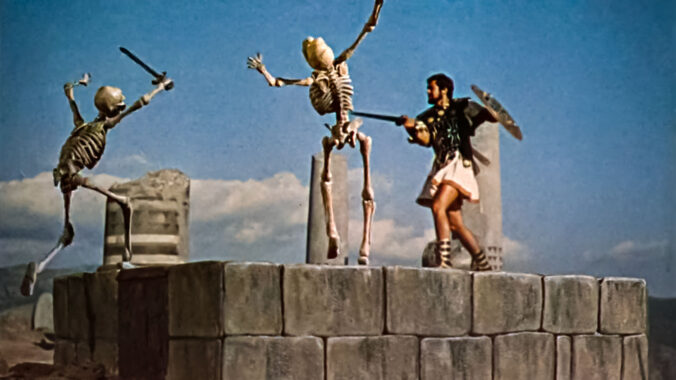
The stop animation of Ray Harryhausen has always fascinated me. That sword fight against skeletons in Jason and the Argonauts (Don Chaffey, 1963) will forever have a place in my heart. So, when I recently had the chance to watch three of his films, I didn’t hesitate. None of these are great movies, but even the worst of them has some good moments.
The 7th Voyage of Sinbad (Nathan Juran, 1958) is a classic in the realm of fantasy cinema. At that point, it was a significant leap forward in visual effects, establishing itself as a milestone for stop-motion animation and popularizing the genre of mythological fantasy adventures.
The true standout of The 7th Voyage of Sinbad is Ray Harryhausen’s stop-motion animation, which brought to life some of the most iconic creatures in cinematic history. From the menacing cyclops to the serpentine dragon and the sword-fighting skeleton, Harryhausen’s work elevated the film far beyond its contemporaries. His unique Dynamation process, which combined live-action and stop-motion animation, allowed fantastical creatures to interact with the human characters in a way that felt groundbreaking at the time. The battle between Sinbad and the skeleton is particularly memorable, later influencing fantasy films like Jason and the Argonauts and even contemporary blockbusters. While the monsters may look dated by today’s standards of computer-generated imagery, they still hold a certain charm and sense of wonder. The tactile, handcrafted nature of Harryhausen’s animation gives the creatures a weight and physical presence that CGI often lacks. In fact, modern audiences may appreciate the artistry and patience required to bring these creatures to life frame by frame.
The film follows the basic structure of a classic adventure tale, with Sinbad and his crew embarking on a perilous journey to the island of Colossa in order to find a way to reverse the curse placed on Princess Parisa, who has been shrunk by the evil sorcerer Sokurah. The plot is simple, but it effectively serves as a vehicle for the fantastical encounters and adventures that unfold. This Sinbad (Kerwin Mathews), however, strays significantly from the original character from the Arabian Nights tales. Rather than focusing on Sinbad as a seasoned sailor, the film presents him more as a heroic adventurer, imbuing him with qualities of both a swashbuckling action hero and a chivalrous knight. This transformation aligns with mid-20th-century Hollywood’s tendency to simplify and romanticize complex source material for mainstream audiences, packaging it as family-friendly entertainment. The result is, unfortunately, largely one-dimensional, serving as the archetypal hero figure without much complexity.
The mythological elements also don’t conform with the original Middle Eastern tales and instead offer a blend with Greek mythology, perhaps in an attempt to have a broader, more universal appeal. However, this fusion sometimes lacks cohesion, feeling more like a showcase of Harryhausen’s creatures than a unified narrative. At some points, we wonder whether this is Sinbad or Ulysses.
The villain Sokurah (Torin Thatcher) ends up being a more interesting character, despite the over-the-top performance. Driven by ambition and greed, he is a classic antagonist in the tradition of mythological evil-doers, though he too remains somewhat shallow. The princess Parisa (Kathryn Grant) is given little to do besides being the damsel in distress. Her character, like many female roles in adventure films of the era, is underdeveloped and primarily serves as a plot device rather than an active participant in the story.
The rousing musical score, by no other than Bernard Herrmann, with its use of exotic instruments and bold, sweeping melodies, enhances the film’s mythical atmosphere and adds to the excitement of Sinbad’s various encounters. Yes, that’s the man who created the soundtrack for Orson Welles’s Citizen Kane and Alfred Hitchcock’s Vertigo, North by Northwest, Psycho, among many others.
It’s also worth noting that The 7th Voyage of Sinbad reflects the cultural attitudes of the 1950s, particularly in its portrayal of Middle Eastern characters and settings. Like many films of its era, it relies on Westernized interpretations of non-Western cultures, resulting in some problematic depictions and a lack of authenticity. Sinbad, for instance, is portrayed by a white actor, and the film’s version of the Middle East is filtered through an exotic, orientalist lens that flattens the culture into a fantasy world for Western audiences.
The Golden Voyage of Sinbad (Gordon Hessler, 1973), tries to repeat the success of The 7th Voyage of Sinbad using the same blend of mythological ambience, swashbuckling action, and groundbreaking stop-motion animation. But, for an adventure movie, it has a very slow pace. Some sequences, particularly in the middle portion of the film, feel sedate and lack the urgency needed to maintain momentum. The episodic structure of Sinbad’s journey can also make the film feel somewhat disjointed at times, with the plot sometimes pausing for the next creature encounter rather than unfolding organically.
This Sinbad (John Phillip Law) is a bit more charismatic than his predecessor, but once again doesn’t have the same screen presence as the villain Koura (Tom Baker, who would later achieve fame as the Fourth Doctor in Doctor Who), an evil magician (it’s always an evil magician, isn’t it?). Baker imbues Koura with a menacing presence and a deeper motivation than many fantasy villains of the time. His desperation to regain his youth and power adds a layer of pathos to his character, making him more than just a stock villain. Koura is cunning and relentless, using dark magic at great personal cost, which slowly drains his life force. This adds an intriguing dynamic between the hero and villain, as Koura becomes increasingly desperate and physically weakened as the story progresses, making him a tragic antagonist. In contrast, Sinbad’s love interest, Margiana (Caroline Munro) seems to be there just to display her cleavage, the only thing preventing her from disappearing in the background.
There are also some anachronisms. The original Sinbad from One Thousand and One Nights is supposed to have lived between the 8th and the 9th centuries. However, here he decides to travel to Lemuria, a lost continent hypothesized only in the 19th century by zoologist Philip Sclater. But this is a fantasy movie with magic and mythological creatures, so it may not matter.
Once again, the true star of The Golden Voyage of Sinbad is Ray Harryhausen’s stop-motion work. Among his extraordinary creatures, this time we have a centaur and a griffin in a deadly battle, and the fascinating six-armed goddess Kali, a statue brought to life. As always, Harryhausen’s work retains a sense of wonder even in a modern context, because the craftsmanship behind the animation feels tangible. The creatures possess a surreal quality that sets them apart from today’s computer-generated monsters, making the action sequences feel dreamlike and otherworldly.
Sinbad and the Eye of the Tiger (Sam Wanamaker, 1977), is the weakest in the Sinbad trilogy brought to life by producer Charles H. Schneer by Ray Harryhausen. It follows the same idea of having a Sinbad detached from the original Arabian Nights tales and mixed with elements from Greek mythology. At this point, however, there’s a sense of formulaic repetition.
This Sinbad (Patrick Wayne, the son of legendary actor John Wayne), is quite bland. He lacks the charisma and gravitas needed to make Sinbad a compelling figure, leaving the character as little more than a stoic action hero. The great villain this time is reduced to a yelling caricature, Zenobia (Margaret Whiting, the British actress, not the American country singer). Her transformation into various animals and her pursuit of Sinbad create some tension, but the character lacks the depth and tragic elements of Koura from The Golden Voyage of Sinbad. And all that yelling leaves you wondering if that is supposed to be funny or is just the result of overacting and poor directing skills. There’s also Melanthius (Patrick Troughton, known for his role as the Second Doctor in Doctor Who), introduced as a wise man and eccentric scientist, but his wisdom is highly doubtful. He manages to interrogate someone and give her more information than he is able to extract. Then, in the same scene, he acquires a potion that enlarges creatures and decides to test it on a poisonous wasp, creating a lethal monster that endangers everyone on the ship. Lastly, as expected, we have Princess Farah (Jane Seymour, who would later win two Golden Globes and one Emmy) largely relegated to a passive role, as is the fate of all of Sinbad’s love interests in this series.
Once more, Ray Harryhausen’s stop-motion creations are the most significant highlight of the film. There’s a mechanical minotaur (creatively named Minoton), a massive saber-toothed tiger, a giant troglodyte (which reminds us of the cyclops from the first movie), and a menacing baboon that houses the spirit of a cursed prince. Unfortunately, though, while impressive in its own right, the stop-motion animation feels less fluid and polished than in previous films, which may reflect both the demands of the increasing complexity of the creatures and the potential limitations of the budget or production schedule.
The quest structure (traveling from one mystical location to the next while overcoming a series of obstacles) follows the formula established in the previous films. However, it feels more mechanical here, with little sense of novelty or innovation. There are some anachronisms here too. Again, the original Sinbad from One Thousand and One Nights is supposed to have lived between the 8th and the 9th centuries. But Melanthius refers to Archimedes of Syracuse, who lived in the 3rd century BCE, as if they were contemporaries. Anyone cares about these inconsistencies?
If you have to choose just one of these movies, get the first one. The 7th Voyage of Sinbad remains a landmark film in the fantasy genre, particularly for its groundbreaking use of stop-motion animation. While its narrative and characters are somewhat shallow, the film succeeds in creating a world of wonder and adventure that continues to captivate audiences. Its influence on the genre is undeniable, paving the way for later films that embraced the fantastical and the mythological.
In chronological order.
- Columbo (1971-1977)
- M*A*S*H (1972-1983)
- Kojak (1973–1978)
- The Six Million Dollar Man (1973-1978)
- Planet of the Apes (1974)
- Fawlty Towers (1975 & 1979)
- The Incredible Hulk (1977-1982)
- Battlestar Galactica (1978–1979)
Ah, how many hours I spent roaming the streets of Skara Brae with a party of underdeveloped and underequipped adventurers, just trying to get enough experience to be able to explore the catacombs under the city. The Bard’s Tale was the first computer game where I got the sense of playing an RPG, instead of just fighting against weak design and poor mechanics.
For this rerun, I got the remastered version launched by inXile Entertainment in 2018, The Bard’s Tale Remastered Trilogy, which is fantastic. It revamps the graphics without losing the flavor of the original, unifies the mechanics of the three games, and adds some precious features like automap or being able to save the game anywhere.
The first time I played this game, I only finished the first story, Tales of the Unknown: The Bard’s Tale (1985), and never had a chance to play The Bard’s Tale II: The Destiny Knight (1986) or The Bard’s Tale III: Thief of Fate (1988). My plan now was to go through all the three games with the same party of adventurers. My team was formed by Trane (male human paladin), Ella (female human paladin), Basie (male dwarf warrior, who was seriously underperforming and was replaced), Duke (male human paladin, who replaced Basie), Chet (male human bard), Monk (male elf conjurer/sorcerer/wizard/magician), Mingus (male elf conjurer/sorcerer/wizard/magician), and Billie (female elf magician/sorcerer/wizard/conjurer). The names are inspired by jazz musicians.
It is a hard game, generating a mix of frustration (from things like rooms that extinguish any light source and turn you around, or being frequently poisoned by spiders in the dungeon without having any cure other than running back to the city looking for a temple) and satisfaction (sometimes just surviving a tough fight in the dungeon and being able to return to the surface before everyone died of spider poisoning was celebrated like a big victory). Even with auto mapping (added in the remastered version), The Bard’s Tale does a very good job of confusing the player into getting lost. Some diabolical locations mix zones of darkness, spinners, teleporters to identical rooms, and other niceties. But, with much patience and much grinding, I managed to complete the first game.
I fought the last battle in Tales of the Unknown: The Bard’s Tale, against Mangar and his vampire lords and greater demons (which he continues to summon), at level 22 for Trane, Ella, and Chet, 20 for Duke (who joined the party later), and level 7/7/7/5 for Monk, Mingus, and Billie. After the experience gained in the last combat, Trane, Ella, and Chet jumped to level 26, Duke to 23, and Monk, Mingus, and Billie to 7/7/7/7 plus a stack of extra experience. They also had a bit over one million gold in the bank and some nice trinkets to be transferred to the next game.
The Bard’s Tale II: The Destiny Knight is even more brutal than the first Bard’s Tale, but if you import an experienced party from the previous game the beginning of the story is much more pleasant. The first dungeon we find in the starting city of Tangramayne hosts many of the tricks from the first game, plus a couple of new ones. As if the spinners, teleporters, and dark rooms weren’t annoying enough, there are two situations here where you can get stuck for a long time. There’s a chasm that cannot be traversed unless you have accepted a certain winged creature from a previous location into the party (and you are not given that information). If you are travelling with a full party of seven, it’s unlikely that you will replace one of your loyal adventurers with an unknown monster you found in a dungeon. But without the winged creature there is no way to progress. Then, after the chasm there is a door that will only open if your bard is playing a certain song. If you unwisely decided to have a party without a bard in a game called The Bard’s Tale, there is no way to pass through those doors. At least the rewards for this quest are amazing. Even with a veteran party like mine, the experience I got at the end was enough to jump three levels ahead.
The trickery gets much worse later in the game, but I think the worst case is found early at Fanskar’s Castle, where you have to choose one among three doors, and two of them will lead to rooms where the party is instakilled just by entering: “As you enter the room a fiery cavalcade assaults your mortal forms, destroying you instantly.” As if this wasn’t bad enough, you have to make your choice in the dark, without a compass, and the doors have spinners before them. That doesn’t only kill your characters, it also kills the fun.
And then there is the part that made me quit the game. It’s called Dargoth’s Tower, which can be accessed from the city of Philippi. After several levels full of spinners, anti-magic squares, darkness areas, and other traps, you finally get to the top level. Fighting Dargoth and his minions is not a problem. But to get the third piece of the MacGuffin you are looking for, the Destiny Wand, you have to go through a maze. It starts with a riddle that has an answer of eleven (!) words that have to be guessed from various vague hints found throughout the tower and then entered in a specific order. That done, you are teleported and given a warning about a timer (there is a beating heart sound in the background to indicate that time is running off). Then you have to go through a specific sequence of places fighting monsters and collecting the passwords they give. The whole area is full of spinners and it’s not possible to cast spells (so you have no compass). Halfway through this process, there is a corridor with a door on one side and a magic mouth on the other, seven squares apart. You need to collect six different sentences from the mouth, and to get each one requires you to exit the corridor and reenter. Between the door and the mouth there are two spinners and between the spinners a trap that drains hit points. To get in and out with one sentence, it takes a long time to deal with the spinners and some damage from the trap. To get all the sentences you have to go through that twelve times. Even if you manage to survive the damage from the trap, the timer runs out before you can complete the sequence of sentences and your party simply dies. It’s the most infuriating dungeon design I have ever encountered. This is not entertainment, it’s torture.
I was really looking forward to playing with the same party through all the three games. But after this annoying level design in the second game I lost the will to continue. You can only use the same party in the last game if you finish the previous one, so I just abandoned the whole thing. Very disappointing. On to the next game…