Tag: d&d

Dungeons & Dragons Superheroes

I recently played in a short Dungeons & Dragons campaign in which all the characters had to be inspired by classic superheroes, adapted to the medieval fantasy world of Faerûn. I liked the idea so much that I ended up creating a whole list of characters, and having much fun with it. Here are a few of them. The best part is that, if you don’t like my versions of these super-adventurers, you can just create your own.

Spider-Man
Race: Wood Elf
Class: Monk (Open Hand) with a 1–3 level dip in Rogue (Scout)

  • Wood elves have the agility, speed, and keen senses that parallel Spider-Man’s reflexes.
  • Monk gives him Quickened Movement, Unarmored Defense, and high mobility, perfect for wall-running, leaping, tumbling through enemies.
  • Open Hand techniques mimic web-trip, push, and stun effects.
  • Rogue (Scout) represents his urban acrobatics, ambush instincts, and mobility in the alleyways of a fantasy city.
  • His webbing becomes Ki-infused silk ropes produced by magical spiders he once saved in an elven ruin.
  • Signature ability: Silk Line Step – spend 1 Ki to lash a spectral silk line onto a surface and pull yourself as if casting Misty Step.

Wolverine
Race: Mountain Dwarf
Class: Barbarian (Zealot)

  • Dwarves are hardy, stubborn, and famously difficult to kill, perfect for Wolverine.
  • Zealot’s damage resistance and “nearly impossible to kill” nature works like a healing factor.
  • His claws become black-iron dwarven claw bracers, forged as a hereditary weapon.
  • Berserker rage mimics Wolverine’s ferocity.
  • Signature ability: Blackclaw Frenzy – rage activates his ancestral magic, causing the claws to extend and glow with runic fire.

Captain America
Race: Variant Human
Class: Paladin (Devotion)

  • Devotion Paladins embody justice, righteousness, courage.
  • Shield mastery parallels Cap’s iconic combat style.
  • His shield is a blessed relic of a bygone holy order, magically returning to his hand once per round.
  • The super soldier serum is replaced with a divine ritual granting enhanced physical ability.
  • Signature ability: Aegis Throw – throw the shield as a ranged spell attack that ricochets between enemies via divine light.

Iron Man
Race: Rock Gnome
Class: Artificer (Armorer)

  • Artificers literally build magical suits of armor, exactly like Tony Stark but medieval.
  • Rock gnomes have tinkering instincts and a talent for small, intricate mechanisms.
  • His arc reactor becomes a bound elemental shard powering the armor.
  • The suit can switch between Guardian (tank) and Infiltrator (ranged) modes.
  • Signature ability: Elemental Heart Beam – a lightning spell cast through the suit’s chest-crystal.

Hulk
Race: Goliath
Class: Barbarian (Berserker) with 1–2 Druid levels

  • The Hulk is a rage-fueled transformation, and Barbarians already do that.
  • Goliaths are huge, muscular, and tied to elemental/giant heritage.
  • The Druid twist: his rage is a giant-spirit possession, not radiation.
  • His Hulk form is simply his rage pushing him into magically-enhanced size and strength (like Enlarge).
  • Signature ability: Fury of the Mountain King – while raging, he grows a size category and deals extra bludgeoning damage.

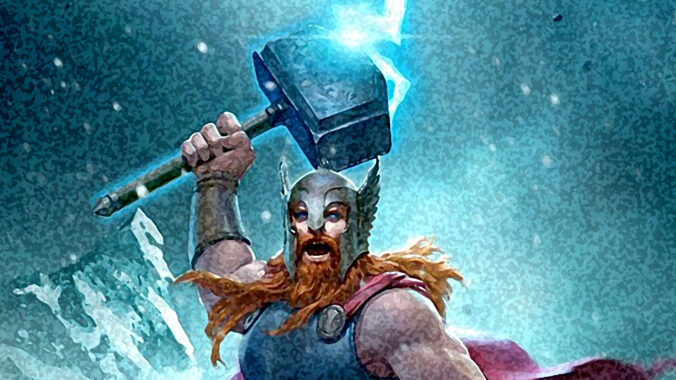
Thor
Race: Protector Aasimar
Class: Cleric (Tempest)

  • Tempest Clerics literally channel thunder, lightning, and divine storms.
  • Aasimar fits the demigod archetype.
  • His hammer is a sentient storm-spirit weapon, not a piece of technology.
  • Divine retribution mimics Mjolnir’s lightning strikes.
  • Signature ability: Stormcaller’s Leap – teleport short distances in a burst of lightning (mechanically: Thunder Step).

Doctor Strange
Race: Human
Class: Wizard (Order of Scribes)

  • Strange is a scholar-mage first and foremost.
  • Scribes Wizards manipulate spellbooks, alter spells on the fly, and conjure spectral script, very Strange-like.
  • His Eye of Agamotto becomes an Ancient Glyph Key, a relic from an extinct wizard order that bends time and space.
  • Signature ability: Many-Gated Mirror – cast Misty Step, Dimension Door, or Arcane Gate through floating runic portals.

I hope you enjoy these medieval superheroes (perhaps even play some of them). I may publish more characters later.

Playing Old CRPGs Again: Eye of the Beholder Trilogy

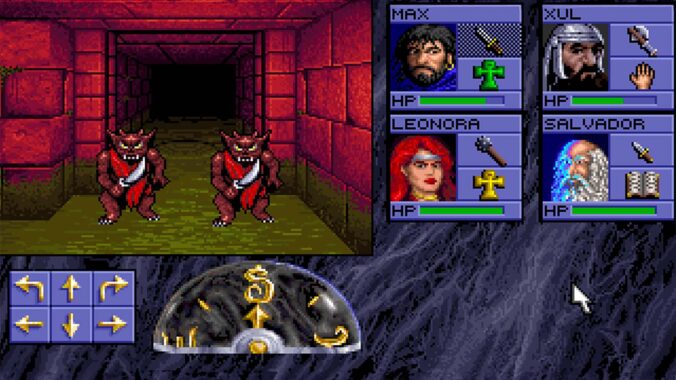
Eye of the Beholder (SSI, 1991) was the first computer game that I felt represented the spirit of the tabletop Dungeons & Dragons (which, at the time, was in its AD&D 2nd Edition). Another advantage for me was that the story happened beneath the city of Waterdeep, a famous location for fans of Dungeons & Dragons. Khelben Arunsun, one of the Lords of Waterdeep, tasks our group of adventurers to go investigate what’s wrong in the city sewers, and that’s just the beginning of a large dungeon expedition.

The game was somewhat similar to the first The Bard’s Tale but it looked much better. Objects in your inventory were represented by images rather than just text. Music and sounds were more realistic. Mouse support made it easier to play. And, although the continuous time combat was not as pleasing as the turn based mode of The Bard’s Tale, the whole experience was much more engrossing. Having recently played The Bard’s Tale, one single feature (or lack of it) by itself makes the game much more pleasurable in comparison: there is no need to carry torches or to spend mana points casting light, as the dungeons are naturally lit. In contrast, while in The Bard’s Tale food was not a consideration, in Eye of the Beholder you have to carry rations and make sure your characters don’t starve.

Mapping the dungeons on graph paper was part of the experience of playing a CRPG at the time. But trying to play that way in 2024, after decades of games with an automapping feature, was just too irksome. Fortunately, I found an application called The All-Seeing Eye, which adds automapping to the Eye of the Beholder series. It only works on Windows systems, but it was well worth temporarily switching from my new cool Mac to my crappy old PC just to enjoy the game with maps.

Eye of the Beholder is not as demanding as The Bard’s Tale can be, but it’s not an easy game. The mindflayers on level 11 are particularly nasty, because they can simply paralyze the whole party and then attack until everyone is dead. Fortunately, the Kenku level offers an opportunity for grinding, as the Kenkus will continually respawn, so you can reach the mindflayers with a robust party.

My team was formed by Max (human male paladin), Xul (dwarf male fighter/thief), Leonora (human female cleric), and Salvador (human male mage). The names are inspired by surrealist painters. They all start at level 3. Thanks to all the grinding in the Kenku level, and also by not accepting extra members to share the experience points, my party finished the game around level 8, more specifically Max at level 8, Xul at level 7/9, Leonora at level 8, and Salvador at level 8. Killing the beholder Xanathar, the last monster, required a lot of maneuvering and the use of a trap conveniently located nearby.

Eye of the Beholder II: The Legend of Darkmoon (SSI, 1991) uses basically the same engine from the previous game, with prettier art. After defeating Xanathar in the first adventure, our mission now is to investigate the Darkmoon temple and find the scout sent by Khelben Arunsun earlier. The threat is much worse this time. While the big boss in the first game was a beholder, the villain here is Dran Draggore, a dragon in human form who was using Xanathar as a pawn in his own plans and now has an army of many creatures, including several beholders.

Even with all the grinding in the previous game, my team didn’t seem overpowered at all. But the equipment they brought was good, even better than anything found in the first phases here. Fighting the multiple beholders in the Silver Tower can be quite annoying, because they have the ability to simply kill a party member with a single attack. Find two or three beholders together and you will be reloading your game. My party for the second game: Max (human male paladin, level 8, imported from EOB1), Xul (dwarf male fighter/thief, level 7/9, imported from EOB1), Leonora (human female cleric, level 8, imported from EOB1), Salvador (human male mage, level 8, imported from EOB1), San-Raal (elf male mage level 8, rescued from the catacombs), Calandra (human female fighter, level 9, rescued from the catacombs and tagging along just until the party finds her replacement), and Tanglor (half-elf male fighter/cleric, rescued from the Silver Tower and replacing Calandra because a second cleric is more useful than a third fighter).

There’s much more respawning in this game than in the previous one, so grinding for more experience is not a problem. With a bit of patience, I managed to win the final fight against Dran Draggore, who actually has to be defeated twice, first in his human form and then as a dragon. I had much fun playing these two games, and it was particularly nice to be able to import my characters from the first to the second game. It’s a feature that I learned to appreciate with Eye of the Beholder.

But then there was Eye of the Beholder III: Assault on Myth Drannor (SSI, 1993). Big disappointment. The storyline is generic and uninspired. The gameplay is monotonous and repetitive. Even the graphics are inferior in comparison with the previous two games. I’m not sure why they didn’t have Westwood Associates developing the game like they did with the first two, and instead used a new team to deliver this fiasco. I played it for a while but got too bored to continue. On to the next game…

GMing D&D: Lost Mine of Phandelver and Dragon of Icespire Peak

I have enjoyed an uncountable number of hours playing Dungeons & Dragons (D&D), and many of them being the Game Master (GM). I particularly find pleasure in being the GM for a group of people who are playing D&D for the very first time. Guiding new players into the game, helping them create and grow the characters, sharing with them the magic of discovering new worlds, all this is a reward in itself. I often use the official starting adventures published by Wizards of the Coast, Lost Mine of Phandelver (from the the 5th Edition Starter Set) and Dragon of Icespire Peak (from the 5th Edition Essentials Kit). They are both good, but they can be improved with a few tweaks (something to be expected from good GMs), and I do that by merging the two into one single adventure.

Merging Lost Mine of Phandelver (LMoP) and Dragon of Icespire Peak (DoIP) into one single adventure is an idea that pops up naturally, because both stories are set in the same geographical area (southeast of the city of Neverwinter, close to the Sword Mountains) and both adventures were designed for characters of the same level (1–5 suggested on LMoP and 1–6 suggested on DoIP).

I begin the campaign with the LMoP adventure. The party can follow the initial plot, dealing with the goblin ambush, finding Sildar Hallwinter, and discovering the Black Spider’s involvement with the Wave Echo Cave. I particularly enjoy that very first fight, the goblin ambush on the road to Phandalin. It’s the first time the players experience combat and start to learn how their individual abilities can interact and collaborate into achieving victory. Well, it’s also funny when things go wrong. Even though those goblins are just a few weak foes, that first encounter requires some thought for a party of level 1 characters. I’ve seen one group of adventurers be totally wiped out by the little critters, thanks to some bad planning and a few unlucky dice throws. After some laughs, the players rerolled their characters and did a much better job the second time around.

When the party reaches Phandalin and starts exploring the village and the surrounding areas, I introduce hooks and rumors related to the troubles in the region described in DoIP. I emphasize the growing threat of the white dragon, Cryovain, and the cultists. Phandalin becomes the central hub for both campaigns. NPCs such as Sildar Hallwinter and Harbin Wester can provide information about the increasing danger in the region, tying the two plots together. Side quests from both campaigns become seamlessly incorporated into the storyline. This can involve encounters with the dragon cultists and their activities, as well as additional threats in the wilderness. In case the players don’t show enough initiative to follow those clues by themselves, Daran Edermath can provide missions for the party guiding them to those locations.

I let them explore and accumulate experience with the side quests, and eventually give them information about one person who knew the location of Cragmaw Castle (that’s where they need to go to rescue Gundren Rockseeker, their original employer and owner of the mine of Phandelver). It’s a druid named Reidoth, usually found in the area around Thundertree, a ruined village East of Neverwinter. That’s where the party will encounter their first dragon, and it’s where I apply my own patch to fix one thing that I consider a problem.

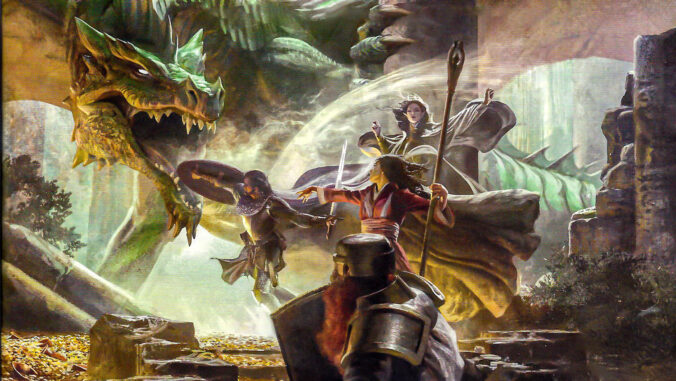
There’s a young green dragon called Venomfang living in a tower in Thundertree. Apparently, the game designers put it there as an example of how not every monster should be fought and how not every problem should be solved by force. The players could avoid the dragon or could try to negotiate with it. But my experience is that every newbie just wants to fight the dragon. It’s their first one and they want to be heroes (and also collect the dragon’s loot). Even the illustration on the cover of LMoP shows a party of adventurers fighting a green dragon. This is a young green dragon with 136 hit points and armor class 18, which makes three attacks per turn (one with its bite and two with its claws) and exhales poisonous gas in a 30-foot cone. Also, once you engage into a fight there is no way to flee, because Venomfang has a flying speed of 80 feet, plus blindsight, darkvision, and a passive perception of 17. Experienced players may manage to defeat it with some luck, but it’s too much for a party of low level newbies. And while your players may laugh at being vanquished by weak goblins in their very first fight in the game, it’s no fun to see a TPK (total party kill) this far into the adventure. So I give them a little help. Reidoth, the druid, gives all of them potions of poison resistance (those are good for an hour, enough time to fight the dragon) and offers support during the combat (he won’t attack the dragon but will cast healing spells from the background). This gives them a chance of defeating the dragon and finding among the loot the Dragon Slayer Sword (+1 bonus to attack and damage rolls, plus extra 3d6 damage to dragons), which will be of great value in the fight against Cryovain, the dragon of Icespire Peak (Reidoth won’t be there to help them).

Once the players are through all (or most of) the side quests, I like to combine the climactic encounters from both adventures into a single, epic finale. Wave Echo Cave (which is the final challenge in LMoP) and Icespire Hold (which is the final challenge in DoIP) are not too far from each other, so I establish that there is a tunnel connecting both locations. After the party enters one of these locations, I create some event that blocks their exit through the same route and leaves them with the other location as the only way out. This creates a large and challenging final dungeon to be explored, but at this point the characters should be at least level 6 (with the two campaigns combined, there are more side quests and therefore more experience points to be collected). The party eventually discovers that the Black Spider (from LMoP) and the dragon cultists (from DoIP) are working together to harness the power within Wave Echo Cave for a dark purpose.

I’ve GMed Lost Mine of Phandelver and Dragon of Icespire Peak merged together like this many times with first-time players, and we all had much fun with it. The sense of accomplishment and the bonds formed during these initial adventures make it a truly rewarding experience for both the players and the GM.

© 2026 Zander Dulac

Theme by Anders NorenUp ↑