Tag: harryhausen

Reinventing the myth of Jason and the Argonauts

After watching Ray Harryhausen’s three Sinbad movies (see Traveling with Sinbad and Ray Harryhausen), I wanted to rewatch Jason and the Argonauts, and this week I did just that.

Jason and the Argonauts (Don Chaffey, 1963) remains one of the most enduring cinematic retellings of Greek mythology. Not because of narrative accuracy but because of its visionary special effects, evocative score, and mythic tone. Though the film adapts the ancient myth of Jason’s quest for the Golden Fleece, it does so with considerable creative liberty, transforming the story into a fantasy epic for mid-20th-century audiences. At the heart of its enduring appeal is Ray Harryhausen’s groundbreaking stop-motion animation and Bernard Herrmann’s thundering orchestral score, all set against the sun-drenched ruins and coastlines of southern Italy.

The film draws from the Argonautica, by Apollonius of Rhodes, and other classical sources but condenses, modifies, and sometimes wholly invents elements of the myth. Key figures from the legend are present (Jason, Pelias, the Argonauts, Medea), but many of the events are streamlined or altered.

Some things align with the myth. Jason’s mission to retrieve the Golden Fleece to reclaim his throne from the usurper Pelias. The divine involvement of Hera, who acts as Jason’s protector and benefactor, consistent with some classical sources. The encounter with Phineas and the harpies and the passage through the Clashing Rocks are lifted directly from the Argonautica.

However, the gods are simplified, functioning more like chess players than characters within an epic cosmology. Hera and Zeus appear as a bickering couple who watch Jason’s progress from Mount Olympus, a device more aligned with modern narrative convenience than classical theology. Characters like Hercules are reduced to brief side roles and comic relief rather than the tragic, complex figures of myth. Medea’s character, crucial in myth as both a helper and later a tragic antagonist, is largely sanitized. Her betrayal of her people and the dark magic she employs in the original are omitted. In a way, she is reduced to a passive romantic interest. The climactic battle with the skeletons has no basis in the original myth but brilliantly replaces the more prosaic theft of the Fleece.

These alterations are not flaws but rather necessary cinematic inventions to fit the tone and pacing of a family-friendly mythological adventure. The film is not a literal transposition of the myth, but is mythic in spirit, compressing sprawling source material into an archetypal hero’s journey, which, for many viewers, is Greek mythology, or at least its cinematic avatar.

The special effects in Jason and the Argonauts represent the apotheosis of Ray Harryhausen’s career. Using his patented Dynamation technique, he infused life into creatures of myth in a way no live-action or early CGI could. Four sequences, in particular, stand out.

Talos, the bronze giant who guards the treasure of the gods, is rendered with a weight and presence that convey true menace. His creaking joints and inhuman movement evoke the unsettling uncanniness of ancient statuary come to life. His death, bleeding ichor from his heel as he topples into the sea, is visually and emotionally stunning.

The Harpies are terrifying in their grotesque, birdlike design and relentless torment of the blind prophet Phineas. Harryhausen manages to elicit pathos for Phineas while showing off the harpies’ chaotic and disruptive power.

The Hydra is a marvel of design, even if misplaced in this story (it was not Jason who fought the Hydra, it was Hercules who did it as part of his Twelve Labors). Although the stop-motion animation of so many moving heads is a logistical feat, Harryhausen controls the scene with elegant pacing. The monster’s defeat directly leads to the summoning of the skeletons.

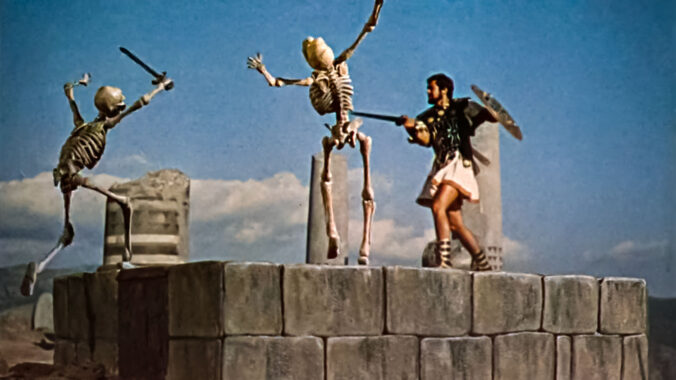
The Skeleton Fight is perhaps the most famous Harryhausen sequence. This sword battle between Jason, his companions, and seven skeleton warriors raised from the Hydra’s teeth took four months to animate. It is a masterclass in timing, choreography, and spatial storytelling. The skeletons are more than visual tricks. They seem cunning and malicious, and their coordination with live actors is astonishing. Unlike most modern effects, Harryhausen’s creatures feel tactile. They occupy the world of the actors, enhanced by careful compositing and clever blocking. The monsters are the drama, not mere obstacles.

Bernard Herrmann’s score for Jason and the Argonauts is monumental, brooding, and filled with heroic grandeur. Known primarily for his work with Hitchcock (Psycho, Vertigo, The Birds), Herrmann here brings an entirely different register, one inspired by classical modes and Wagnerian brass. Talos’s theme is a percussive, ominous motif: mechanical, slow, and unrelenting, matching the statue’s unholy animation. The skeleton battle is scored with whirling strings and jarring dissonances, emphasizing the unnaturalness of the combat. The love theme for Jason and Medea is restrained, evoking Greek antiquity without slipping into Romantic cliché. Herrmann’s use of brass and percussion gives the score a ceremonial, almost religious tone, appropriate for a tale driven by gods and fate.

While set in mythic Hellas, the film was primarily shot in southern Italy. The choice lends the movie an authentic Mediterranean atmosphere unmatched by Hollywood backlots. The architecture and ruins seen throughout the film ground the fantastical story in a recognizably ancient world. The First Temple of Hera at Paestum (used in the harpy scenes) is particularly striking. Its weathered Doric columns and open spaces are both majestic and desolate, reinforcing the tragedy of Phineas’s blindness and torment. Rather than building sets, the film uses these ruins to suggest timelessness and the lingering shadow of divine presence. Palinuro and the Amalfi Coast stand in for various seascapes and island vistas. The jagged cliffs, sun-bleached rocks, and deep blue waters give the journey a convincing epic scale. The cinematography (by Wilkie Cooper) captures these locations with painterly composition, highlighting both the natural beauty and eerie grandeur of the ancient world. In this sense, the movie has more visual fidelity to Greece than most later productions filmed in studio-heavy settings.

Jason and the Argonauts is not a scholarly retelling of Greek mythology. It is a cinematic myth in its own right. With its blend of spectacle, artistry, and archetypal storytelling, it embodies the timeless spirit of heroic adventure. While scholars may balk at its liberties, and purists may miss the tragic edge of Medea’s betrayal or the complexity of Hercules’s presence, the film captures the awe and terror of encountering the unknown, the monstrous, and the divine. It is perhaps best remembered not for its plot but for its moments: Talos turning his head, the Hydra writhing in battle, the skeletons crawling from the earth. These images, combined with Herrmann’s music and the ancient stones of Paestum, transcend fidelity to myth to become a modern myth of their own.
Traveling with Sinbad and Ray Harryhausen

The stop animation of Ray Harryhausen has always fascinated me. That sword fight against skeletons in Jason and the Argonauts (Don Chaffey, 1963) will forever have a place in my heart. So, when I recently had the chance to watch three of his films, I didn’t hesitate. None of these are great movies, but even the worst of them has some good moments.

The 7th Voyage of Sinbad (Nathan Juran, 1958) is a classic in the realm of fantasy cinema. At that point, it was a significant leap forward in visual effects, establishing itself as a milestone for stop-motion animation and popularizing the genre of mythological fantasy adventures.

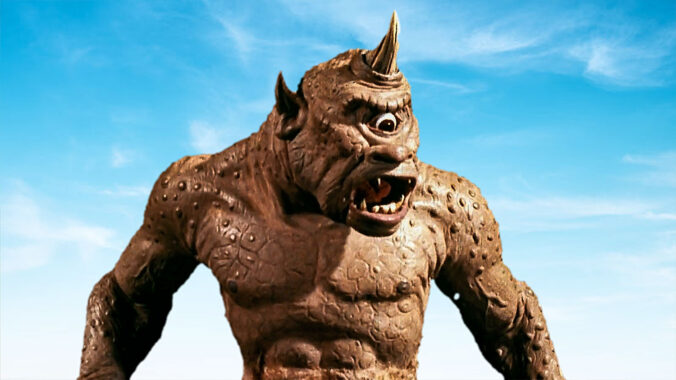
The true standout of The 7th Voyage of Sinbad is Ray Harryhausen’s stop-motion animation, which brought to life some of the most iconic creatures in cinematic history. From the menacing cyclops to the serpentine dragon and the sword-fighting skeleton, Harryhausen’s work elevated the film far beyond its contemporaries. His unique Dynamation process, which combined live-action and stop-motion animation, allowed fantastical creatures to interact with the human characters in a way that felt groundbreaking at the time. The battle between Sinbad and the skeleton is particularly memorable, later influencing fantasy films like Jason and the Argonauts and even contemporary blockbusters. While the monsters may look dated by today’s standards of computer-generated imagery, they still hold a certain charm and sense of wonder. The tactile, handcrafted nature of Harryhausen’s animation gives the creatures a weight and physical presence that CGI often lacks. In fact, modern audiences may appreciate the artistry and patience required to bring these creatures to life frame by frame.

The film follows the basic structure of a classic adventure tale, with Sinbad and his crew embarking on a perilous journey to the island of Colossa in order to find a way to reverse the curse placed on Princess Parisa, who has been shrunk by the evil sorcerer Sokurah. The plot is simple, but it effectively serves as a vehicle for the fantastical encounters and adventures that unfold. This Sinbad (Kerwin Mathews), however, strays significantly from the original character from the Arabian Nights tales. Rather than focusing on Sinbad as a seasoned sailor, the film presents him more as a heroic adventurer, imbuing him with qualities of both a swashbuckling action hero and a chivalrous knight. This transformation aligns with mid-20th-century Hollywood’s tendency to simplify and romanticize complex source material for mainstream audiences, packaging it as family-friendly entertainment. The result is, unfortunately, largely one-dimensional, serving as the archetypal hero figure without much complexity.

The mythological elements also don’t conform with the original Middle Eastern tales and instead offer a blend with Greek mythology, perhaps in an attempt to have a broader, more universal appeal. However, this fusion sometimes lacks cohesion, feeling more like a showcase of Harryhausen’s creatures than a unified narrative. At some points, we wonder whether this is Sinbad or Ulysses.

The villain Sokurah (Torin Thatcher) ends up being a more interesting character, despite the over-the-top performance. Driven by ambition and greed, he is a classic antagonist in the tradition of mythological evil-doers, though he too remains somewhat shallow. The princess Parisa (Kathryn Grant) is given little to do besides being the damsel in distress. Her character, like many female roles in adventure films of the era, is underdeveloped and primarily serves as a plot device rather than an active participant in the story.

The rousing musical score, by no other than Bernard Herrmann, with its use of exotic instruments and bold, sweeping melodies, enhances the film’s mythical atmosphere and adds to the excitement of Sinbad’s various encounters. Yes, that’s the man who created the soundtrack for Orson Welles’s Citizen Kane and Alfred Hitchcock’s Vertigo, North by Northwest, Psycho, among many others.

It’s also worth noting that The 7th Voyage of Sinbad reflects the cultural attitudes of the 1950s, particularly in its portrayal of Middle Eastern characters and settings. Like many films of its era, it relies on Westernized interpretations of non-Western cultures, resulting in some problematic depictions and a lack of authenticity. Sinbad, for instance, is portrayed by a white actor, and the film’s version of the Middle East is filtered through an exotic, orientalist lens that flattens the culture into a fantasy world for Western audiences.

The Golden Voyage of Sinbad (Gordon Hessler, 1973), tries to repeat the success of The 7th Voyage of Sinbad using the same blend of mythological ambience, swashbuckling action, and groundbreaking stop-motion animation. But, for an adventure movie, it has a very slow pace. Some sequences, particularly in the middle portion of the film, feel sedate and lack the urgency needed to maintain momentum. The episodic structure of Sinbad’s journey can also make the film feel somewhat disjointed at times, with the plot sometimes pausing for the next creature encounter rather than unfolding organically.

This Sinbad (John Phillip Law) is a bit more charismatic than his predecessor, but once again doesn’t have the same screen presence as the villain Koura (Tom Baker, who would later achieve fame as the Fourth Doctor in Doctor Who), an evil magician (it’s always an evil magician, isn’t it?). Baker imbues Koura with a menacing presence and a deeper motivation than many fantasy villains of the time. His desperation to regain his youth and power adds a layer of pathos to his character, making him more than just a stock villain. Koura is cunning and relentless, using dark magic at great personal cost, which slowly drains his life force. This adds an intriguing dynamic between the hero and villain, as Koura becomes increasingly desperate and physically weakened as the story progresses, making him a tragic antagonist. In contrast, Sinbad’s love interest, Margiana (Caroline Munro) seems to be there just to display her cleavage, the only thing preventing her from disappearing in the background.

There are also some anachronisms. The original Sinbad from One Thousand and One Nights is supposed to have lived between the 8th and the 9th centuries. However, here he decides to travel to Lemuria, a lost continent hypothesized only in the 19th century by zoologist Philip Sclater. But this is a fantasy movie with magic and mythological creatures, so it may not matter.

Once again, the true star of The Golden Voyage of Sinbad is Ray Harryhausen’s stop-motion work. Among his extraordinary creatures, this time we have a centaur and a griffin in a deadly battle, and the fascinating six-armed goddess Kali, a statue brought to life. As always, Harryhausen’s work retains a sense of wonder even in a modern context, because the craftsmanship behind the animation feels tangible. The creatures possess a surreal quality that sets them apart from today’s computer-generated monsters, making the action sequences feel dreamlike and otherworldly.

Sinbad and the Eye of the Tiger (Sam Wanamaker, 1977), is the weakest in the Sinbad trilogy brought to life by producer Charles H. Schneer by Ray Harryhausen. It follows the same idea of having a Sinbad detached from the original Arabian Nights tales and mixed with elements from Greek mythology. At this point, however, there’s a sense of formulaic repetition.

This Sinbad (Patrick Wayne, the son of legendary actor John Wayne), is quite bland. He lacks the charisma and gravitas needed to make Sinbad a compelling figure, leaving the character as little more than a stoic action hero. The great villain this time is reduced to a yelling caricature, Zenobia (Margaret Whiting, the British actress, not the American country singer). Her transformation into various animals and her pursuit of Sinbad create some tension, but the character lacks the depth and tragic elements of Koura from The Golden Voyage of Sinbad. And all that yelling leaves you wondering if that is supposed to be funny or is just the result of overacting and poor directing skills. There’s also Melanthius (Patrick Troughton, known for his role as the Second Doctor in Doctor Who), introduced as a wise man and eccentric scientist, but his wisdom is highly doubtful. He manages to interrogate someone and give her more information than he is able to extract. Then, in the same scene, he acquires a potion that enlarges creatures and decides to test it on a poisonous wasp, creating a lethal monster that endangers everyone on the ship. Lastly, as expected, we have Princess Farah (Jane Seymour, who would later win two Golden Globes and one Emmy) largely relegated to a passive role, as is the fate of all of Sinbad’s love interests in this series.

Once more, Ray Harryhausen’s stop-motion creations are the most significant highlight of the film. There’s a mechanical minotaur (creatively named Minoton), a massive saber-toothed tiger, a giant troglodyte (which reminds us of the cyclops from the first movie), and a menacing baboon that houses the spirit of a cursed prince. Unfortunately, though, while impressive in its own right, the stop-motion animation feels less fluid and polished than in previous films, which may reflect both the demands of the increasing complexity of the creatures and the potential limitations of the budget or production schedule.

The quest structure (traveling from one mystical location to the next while overcoming a series of obstacles) follows the formula established in the previous films. However, it feels more mechanical here, with little sense of novelty or innovation. There are some anachronisms here too. Again, the original Sinbad from One Thousand and One Nights is supposed to have lived between the 8th and the 9th centuries. But Melanthius refers to Archimedes of Syracuse, who lived in the 3rd century BCE, as if they were contemporaries. Anyone cares about these inconsistencies?

If you have to choose just one of these movies, get the first one. The 7th Voyage of Sinbad remains a landmark film in the fantasy genre, particularly for its groundbreaking use of stop-motion animation. While its narrative and characters are somewhat shallow, the film succeeds in creating a world of wonder and adventure that continues to captivate audiences. Its influence on the genre is undeniable, paving the way for later films that embraced the fantastical and the mythological.

© 2026 Zander Dulac

Theme by Anders NorenUp ↑