Tag: horror

28 Days/Weeks/Years: Rage, Ruin, and Rewriting the Infected

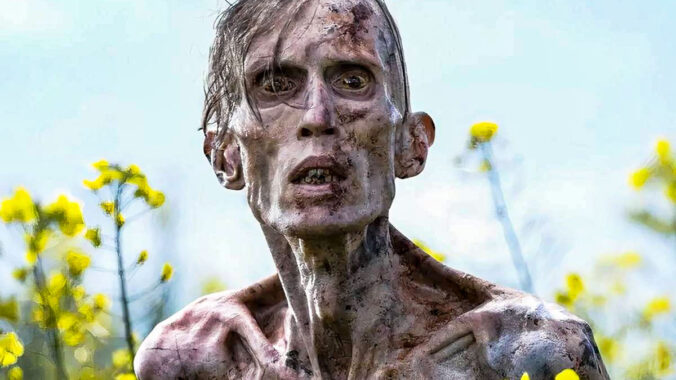
When 28 Days Later (Danny Boyle, 2002) appeared, it did not simply revive the zombie film. It replaced it with something leaner, faster, and more psychologically pointed. The infected were not undead bodies driven by hunger but living humans stripped down to a single overwhelming impulse. That conceptual precision gave the film its force. The famous opening, Jim (Cillian Murphy) waking alone in a hospital and wandering through an emptied London, has often been compared to the later beginning of the tv series The Walking Dead, but the resemblance is mostly structural. In Boyle and Garland’s film the hospital is not just a place between life and death: it is the threshold between civilization and the revelation of what lies beneath it.
The Rage virus is crucial because it keeps the horror grounded in biology and behavior rather than folklore. The infected do not feed, do not organize, and do not build anything. They attack because they are pure discharge. Their violence is expressive, not instrumental. That makes them terrifying in the short term but unsustainable in the long term, a detail the film quietly emphasizes when it suggests that many of them will eventually starve. Rage, in this world, cannot create a new order. It can only burn through the existing one.

This biological logic supports the film’s moral argument. The true threat is not the infected but what remains of human society once restraint is removed. The soldiers Jim encounters are not functioning as representatives of a system, they are men cut loose from it. Their brutality is feudal and personal, an attempt to reconstruct power through domination and control. The film’s vision of “man preying on man” operates on the smallest scale: a handful of individuals reverting to coercion and sexual violence as a survival strategy. The infected are the eruption of rage, while the soldiers are its conscious counterpart.

28 Weeks Later (Juan Carlos Fresnadillo, 2007) shifts the level of analysis. Its extraordinary opening, in which Don (Robert Carlyle) abandons his wife in order to escape, makes cowardice rather than cruelty the initiating sin. From that moment onward the film is concerned less with individual moral collapse than with the logic of systems. The repopulation of London under NATO supervision is presented as a triumph of procedure: biometric screening, containment zones, surveillance. The disaster that follows is not the result of sadism but of institutional thinking. When the military begins shooting civilians it is acting according to a doctrine in which the distinction between infected and uninfected has become operationally irrelevant.

The presence of the United States military has often been read as an accusation, as if the film were suggesting that only Americans would be capable of such a response. In practice the choice functions as a cinematic shorthand for global containment power. The Americans represent the machinery of intervention, the external force that arrives with logistics, firepower, and the ability to leave. Britain becomes a managed disaster zone. The emotional distance this creates is essential: the violence is not personal, and no one enjoys it. It is procedural, the endpoint of a security logic that treats human beings as variables. In the context of the mid-2000s, with its preoccupation with “collateral damage” and the trade-off between safety and civil liberties, the film reads as a study in how systems abandon ethics in the name of efficiency.

The graphic novels that bridge the two films expand this perspective rather than altering it. They move across scattered survivor communities and emphasize the slow normalization of cruelty. Their importance lies in reinforcing the central idea that the Rage virus does not create monsters so much as remove the structures that allow people to pretend they are not capable of monstrosity. Throughout this phase of the series the infected remain a biological event. They cannot form a culture. They are the negative image of one.

The conceptual break arrives with 28 Years Later (Danny Boyle, 2025). Here the infected are no longer short-lived explosions of aggression but a persistent population capable of feeding, reproducing, and organizing under figures such as the Alpha, Samson. The film does not provide a medical mechanism for this transformation. The absence is striking because the earlier films derived so much of their authority from a pseudo-epidemiological realism. What replaces that realism is mythic logic. The infected are no longer patients but a people.

This shift alters the dramatic conflict. The earlier films were structured around the opposition between ethical and non-ethical modes of being, between the fragile discipline of civilization and the release of rage. In 28 Years Later the tension becomes something closer to civilization confronting a rival form of humanity. The survivors who live in isolated, ritualized communities are themselves no longer recognizably modern. Both groups have taboos, territories, and inherited knowledge. The difference between them is not sanity but cultural form.

Samson embodies this change. In the first film rage erased identity, but here it produces continuity. He is less a host of a pathogen than a figure out of post-apocalyptic myth, a body that has endured long enough to become an origin. The film’s interest lies in inheritance and memory, in what happens when a generation is born into a world where the old categories no longer apply. The Rage virus becomes an environment rather than an event.

For viewers whose engagement with the series was rooted in its earlier materialism, this can feel like a rupture rather than an evolution. The hospital corridors, quarantine procedures, and questions of moral choice under pressure give way to temples, alphas, and ritual encounters. The infamous gang of blond youths in The Bone Temple (Nia DaCosta, 2026) illustrates the problem. Their stylized ultraviolence evokes A Clockwork Orange, but Kubrick’s droogs are the product of a functioning society and exist within a debate about free will and state control. In a world where society has already vanished, the reference imports the surface of that imagery without its philosophical weight. It becomes pastiche rather than argument.

The same is true of the sequence in which Dr. Ian Kelson (Ralph Fiennes) shares a drug-induced communion with Samson. In the new mythic framework the scene is meant to collapse the boundary between human and infected, to suggest that the two are parallel continuities rather than enemies. Yet this requires the abandonment of the biological and ethical logic that defined the earlier films. What was once a study of behavior under extreme conditions becomes a symbolic encounter between cultures.

Seen across the entire span, the series traces a movement from shock to system to legend. 28 Days Later asks what remains of morality when the structures of daily life vanish. 28 Weeks Later asks what happens when the structures return in a form that values control over humanity. 28 Years Later asks what becomes of those questions once enough time has passed for the original world to lose its authority. The infected, who began as a metaphor for the unsustainability of rage, end as a competing branch of the future.

Whether that transformation is experienced as a bold expansion or as the abandonment of a coherent project depends on what one valued in the first place. The early films offered a precise and unsettling thesis: that the apocalypse is not the triumph of monsters but the revelation of how little separates civilization from its opposite. The later films are interested in something else entirely, the emergence of new forms of life after the collapse has lasted longer than memory. It is less a continuation than a metamorphosis, a change not only in subject but in the language with which the subject is approached.

Favorite Horror Novels, 21th century

  • House of Leaves (2000), by Mark Z. Danielewski
  • Let the Right One In (2004), by John Ajvide Lindqvist
  • Haunted (2005), by Chuck Palahniuk
  • Cold Skin (2005), by Albert Sanchez Pinol
  • The Ruins (2006), by Scott Smith
  • The Terror (2007), by Dan Simmons
  • Bird Box (2014), by Josh Malerman
  • Tender Is the Flesh (2017), by Agustina Bazterrica
Favorite Horror Novels, 20th century

  • The Haunting of Hill House (1959), by Shirley Jackson
  • Something Wicked This Way Comes (1962), by Ray Bradbury
  • Rosemary’s Baby (1967), by Ira Levin
  • Hell House (1971), by Richard Matheson
  • The Mist (1980), by Stephen King
  • The Cellar (1980), by Richard Laymon

Favorite Horror Novels, 18th/19th century

  • History of the Caliph Vathek (1786), by William Beckford
  • The Monk (1796), by Matthew Gregory Lewis
  • Frankenstein (1818), by Mary Shelley
  • Melmoth the Wanderer (1820), by Charles Maturin
  • Varney, the Vampire (1847), by Thomas Prest
  • Carmilla (1872), by Sheridan Le Fanu
  • Strange Case of Dr Jekyll and Mr Hyde (1886), by Robert Louis Stevenson
  • The Picture of Dorian Gray (1890), by Oscar Wilde
  • Dracula (1897), by Bram Stoker
  • The Turn of the Screw (1898), by Henry James
The Innocents: essence of the fantastic

Henry James’s novella The Turn of the Screw is famous for being slippery. Are the ghosts real, or is the governess losing her mind? The 1961 film The Innocents keeps that same spirit of uncertainty, but instead of James’s careful prose, it uses images, sound, and atmosphere to create doubt. The story is essentially the same, but the movie sharpens the tension, leaning into the creepy sexuality and suppressed desire that James only hinted at. Where the book makes you question every line, the film makes you question every shot.

The script started with a stage adaptation, but Truman Capote was brought in to rewrite it. His influence is evident in the sharp, suggestive dialogue and in how the children’s eerie maturity is conveyed without feeling overdone. Capote gave the film its double edge: everything can be read two ways, as either a genuine haunting or as the governess projecting her fears and repressed desires. That balancing act is what makes the movie so unsettling.

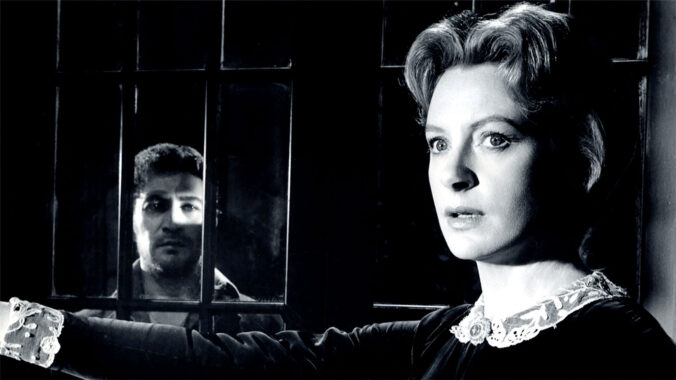
Director Jack Clayton avoids cheap scares. Instead, he lets silence and stillness work on you until a sudden figure in a window or a whisper in the dark lands like a thunderclap. His staging is deliberate: characters are positioned like pieces on a board, with distance and movement telling you just as much as the dialogue. The effect is slow-burning dread that never quite gives you release.

The black-and-white photography by Freddie Francis is breathtaking. He plays with overexposed whites, deep shadows, and reflections so that even a bright garden feels uncanny. Ghostly shapes seem to appear naturally in the frame, with no special effects needed. Wide shots capture everything in sharp focus, forcing you to wonder if that shadow in the corner is real or just your imagination. This isn’t just pretty camerawork, it’s cinematography designed to make you doubt your own eyes.

Deborah Kerr is the movie’s anchor. She plays the governess with total conviction, which is scarier than if she’d gone for hysteria. You believe she cares for the children, but her intensity makes you worry she’s also dangerous. Kerr was older than the governess in the book, which works brilliantly, as she feels like someone who has kept her emotions bottled up for years, now cracking under the strain. The final scenes wouldn’t hit nearly as hard without her layered performance.

Literary critic Tzvetan Todorov defined the “fantastic” as that moment when you can’t decide if something is supernatural or just psychological, and you’re stuck in that hesitation. The Innocents is a textbook case. Every ghost sighting can be explained naturally, and every “rational” explanation leaves room for the uncanny. The film never tips its hand, and that’s why it lingers so powerfully.

The Turn of the Screw has been filmed many times, but most versions stumble by taking too firm a stance one way or the other. Some make it a straight ghost story, others a psychological breakdown. A few are handsome productions, but none capture the same knife-edge uncertainty. The 2020 film The Turning tried but felt contrived. Probably the closest spiritual successor isn’t even an adaptation: Alejandro Amenábar’s The Others (2001), which gets the atmosphere and ambiguity right (up until the final reveal).

The Nightcomers (Michael Winner, 1972), intended as a prequel, demonstrates precisely how to ruin this kind of story. By providing us with an explicit backstory about Quint and Miss Jessel (with Marlon Brando as Quint), it explains what James and Clayton wisely left ambiguous. Instead of mystery, we get tawdry melodrama. The children’s corruption is spelled out, and the air of dread collapses into cliché. In trying to “fill in the blanks”, the movie drains away all the power of the original.

Mike Flanagan’s Netflix miniseries The Haunting of Bly Manor combines James’s story with other works of his, reframing it as a tale of love, grief, and memory. It’s beautifully acted and emotionally satisfying, but it isn’t The Innocents. Where Clayton’s film keeps you trapped in doubt, Bly Manor builds a mythology of ghosts and explains how they work. It goes for catharsis instead of unease. As a result, it’s touching but far less haunting.

Final word: The Innocents remains the gold standard. Capote’s sly script, Clayton’s restrained direction, Francis’s brilliant visuals, and Kerr’s magnetic performance combine to make a film that never gives you an answer. It’s that refusal to resolve the mystery that makes it unforgettable.

© 2026 Zander Dulac

Theme by Anders NorenUp ↑