I have enjoyed an uncountable number of hours playing Dungeons & Dragons (D&D), and many of them being the Game Master (GM). I particularly find pleasure in being the GM for a group of people who are playing D&D for the very first time. Guiding new players into the game, helping them create and grow the characters, sharing with them the magic of discovering new worlds, all this is a reward in itself. I often use the official starting adventures published by Wizards of the Coast, Lost Mine of Phandelver (from the the 5th Edition Starter Set) and Dragon of Icespire Peak (from the 5th Edition Essentials Kit). They are both good, but they can be improved with a few tweaks (something to be expected from good GMs), and I do that by merging the two into one single adventure.
Merging Lost Mine of Phandelver (LMoP) and Dragon of Icespire Peak (DoIP) into one single adventure is an idea that pops up naturally, because both stories are set in the same geographical area (southeast of the city of Neverwinter, close to the Sword Mountains) and both adventures were designed for characters of the same level (1–5 suggested on LMoP and 1–6 suggested on DoIP).
I begin the campaign with the LMoP adventure. The party can follow the initial plot, dealing with the goblin ambush, finding Sildar Hallwinter, and discovering the Black Spider’s involvement with the Wave Echo Cave. I particularly enjoy that very first fight, the goblin ambush on the road to Phandalin. It’s the first time the players experience combat and start to learn how their individual abilities can interact and collaborate into achieving victory. Well, it’s also funny when things go wrong. Even though those goblins are just a few weak foes, that first encounter requires some thought for a party of level 1 characters. I’ve seen one group of adventurers be totally wiped out by the little critters, thanks to some bad planning and a few unlucky dice throws. After some laughs, the players rerolled their characters and did a much better job the second time around.
When the party reaches Phandalin and starts exploring the village and the surrounding areas, I introduce hooks and rumors related to the troubles in the region described in DoIP. I emphasize the growing threat of the white dragon, Cryovain, and the cultists. Phandalin becomes the central hub for both campaigns. NPCs such as Sildar Hallwinter and Harbin Wester can provide information about the increasing danger in the region, tying the two plots together. Side quests from both campaigns become seamlessly incorporated into the storyline. This can involve encounters with the dragon cultists and their activities, as well as additional threats in the wilderness. In case the players don’t show enough initiative to follow those clues by themselves, Daran Edermath can provide missions for the party guiding them to those locations.
I let them explore and accumulate experience with the side quests, and eventually give them information about one person who knew the location of Cragmaw Castle (that’s where they need to go to rescue Gundren Rockseeker, their original employer and owner of the mine of Phandelver). It’s a druid named Reidoth, usually found in the area around Thundertree, a ruined village East of Neverwinter. That’s where the party will encounter their first dragon, and it’s where I apply my own patch to fix one thing that I consider a problem.
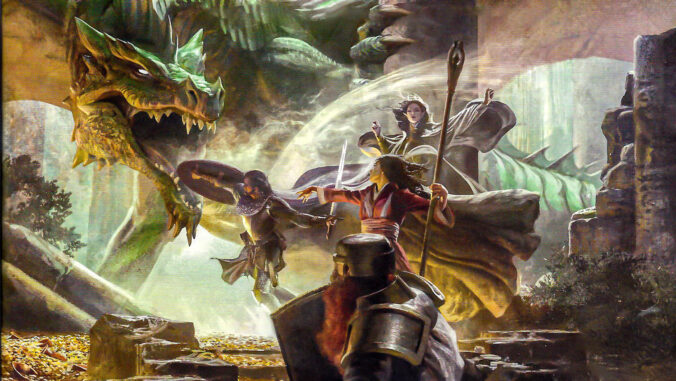
There’s a young green dragon called Venomfang living in a tower in Thundertree. Apparently, the game designers put it there as an example of how not every monster should be fought and how not every problem should be solved by force. The players could avoid the dragon or could try to negotiate with it. But my experience is that every newbie just wants to fight the dragon. It’s their first one and they want to be heroes (and also collect the dragon’s loot). Even the illustration on the cover of LMoP shows a party of adventurers fighting a green dragon. This is a young green dragon with 136 hit points and armor class 18, which makes three attacks per turn (one with its bite and two with its claws) and exhales poisonous gas in a 30-foot cone. Also, once you engage into a fight there is no way to flee, because Venomfang has a flying speed of 80 feet, plus blindsight, darkvision, and a passive perception of 17. Experienced players may manage to defeat it with some luck, but it’s too much for a party of low level newbies. And while your players may laugh at being vanquished by weak goblins in their very first fight in the game, it’s no fun to see a TPK (total party kill) this far into the adventure. So I give them a little help. Reidoth, the druid, gives all of them potions of poison resistance (those are good for an hour, enough time to fight the dragon) and offers support during the combat (he won’t attack the dragon but will cast healing spells from the background). This gives them a chance of defeating the dragon and finding among the loot the Dragon Slayer Sword (+1 bonus to attack and damage rolls, plus extra 3d6 damage to dragons), which will be of great value in the fight against Cryovain, the dragon of Icespire Peak (Reidoth won’t be there to help them).
Once the players are through all (or most of) the side quests, I like to combine the climactic encounters from both adventures into a single, epic finale. Wave Echo Cave (which is the final challenge in LMoP) and Icespire Hold (which is the final challenge in DoIP) are not too far from each other, so I establish that there is a tunnel connecting both locations. After the party enters one of these locations, I create some event that blocks their exit through the same route and leaves them with the other location as the only way out. This creates a large and challenging final dungeon to be explored, but at this point the characters should be at least level 6 (with the two campaigns combined, there are more side quests and therefore more experience points to be collected). The party eventually discovers that the Black Spider (from LMoP) and the dragon cultists (from DoIP) are working together to harness the power within Wave Echo Cave for a dark purpose.
I’ve GMed Lost Mine of Phandelver and Dragon of Icespire Peak merged together like this many times with first-time players, and we all had much fun with it. The sense of accomplishment and the bonds formed during these initial adventures make it a truly rewarding experience for both the players and the GM.