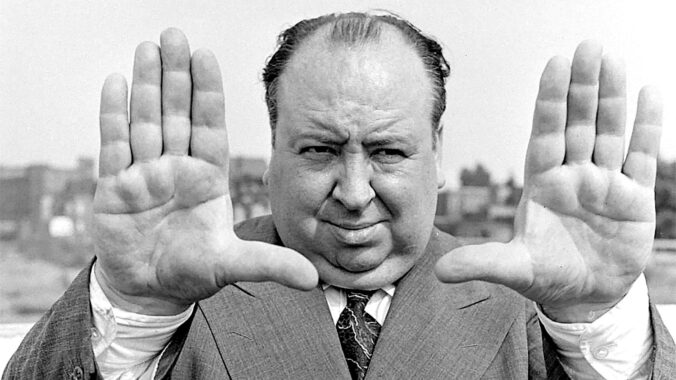
By the early 1960s, Alfred Hitchcock had become something almost unprecedented in cinema. He was no longer simply one of Hollywood’s great directors. He had become a language.
The previous decade had produced an astonishing succession of masterpieces. Rear Window, To Catch a Thief, The Wrong Man, Vertigo, North by Northwest, Psycho. And then, in 1963, The Birds. Few filmmakers have ever dominated a decade so completely or so consistently reinvented themselves while doing it.
The result was that Hitchcock’s influence escaped the confines of his own films. Directors no longer needed to imitate individual scenes. They had begun to absorb the underlying grammar of Hitchcock’s cinema: the innocent protagonist caught in extraordinary circumstances, the glamorous but ambiguous heroine, conspiracies hidden beneath respectable institutions, humor coexisting with danger, public spaces transformed into arenas of suspense.
By 1963, Hollywood no longer needed Hitchcock to make Hitchcockian films. That same year produced two remarkable examples: Stanley Donen’s Charade and Mark Robson’s The Prize. Neither is directed by Hitchcock. Yet both feel unmistakably as though they belong to his cinematic universe. Not because they imitate him. Because they speak his language.
Charade: The Elegant Hitchcock
If Hitchcock had ever directed a romantic comedy, it might have looked something like Charade. The similarities begin immediately. Audrey Hepburn’s Regina Lampert finds herself pursued after her husband’s mysterious death, surrounded by men whose identities constantly shift. Cary Grant appears as the charming stranger who may or may not be trustworthy. Paris becomes not merely a location but an active participant in the narrative, just as the French Riviera had in To Catch a Thief or Mount Rushmore in North by Northwest.
The ingredients are unmistakably Hitchcockian: dubious identities, hidden money, multiple villains, witty dialogue, flirtation under pressure, and a heroine forced to navigate a conspiracy she barely understands. Most importantly, Charade understands one of Hitchcock’s greatest lessons: suspense works best when accompanied by pleasure. The film never forgets to entertain. The romance, the humor and the mystery reinforce rather than interrupt one another.
Yet Charade is not a Hitchcock film. Stanley Donen’s background in musicals gives the picture a buoyancy that Hitchcock rarely pursued. The film is lighter on psychological tension and heavier on charm. Hitchcock often delighted in making his protagonists uncomfortable. Donen seems more interested in making the audience smile.
The violence, too, carries a different emotional weight. Even when bodies accumulate, Charade never quite abandons its playful tone. Hitchcock’s best thrillers often contain a streak of cruelty beneath the elegance. Donen replaces that cruelty with sophistication. The result is perhaps the most affectionate Hitchcock film Hitchcock never directed.
The Prize: The Clockwork Hitchcock
If Charade borrows Hitchcock’s elegance, The Prize borrows his machinery. The resemblance begins even before the opening credits finish. The screenplay comes from Ernest Lehman, who had already written North by Northwest. George Tomasini, Hitchcock’s editor on Rear Window, Vertigo, North by Northwest, Psycho, and The Birds, edits the film. Leo G. Carroll, one of Hitchcock’s most familiar supporting actors, appears once again as an authority figure. Paul Newman steps into a role that could easily have been played by Cary Grant a few years earlier: intelligent, ironic, skeptical, and gradually pulled into an international conspiracy.
The story follows Andrew Craig, an American Nobel Prize winner who discovers that one of the laureates has apparently been replaced by an impostor. Like Roger Thornhill before him, Craig is an ordinary civilian forced to investigate extraordinary events because nobody else believes him.
Everything unfolds according to Hitchcock’s narrative architecture. There are chases through foreign cities. Respectable institutions conceal sinister intentions. Beautiful women become allies while remaining slightly mysterious. Suspense grows not through explosions but through uncertainty.
Unlike many films labelled Hitchcockian, The Prize does not merely imitate Hitchcock’s surface features. It reproduces his narrative rhythm. Every revelation creates a new question. Every moment of danger is balanced by humor. Every apparent solution opens another mystery.
Where the film differs from Hitchcock is equally revealing. Mark Robson is less interested in reducing a story to its purest dramatic line. His films tend to allow secondary characters and subplots more breathing room. The Prize occasionally becomes more sprawling than Hitchcock would probably have permitted. The Nobel Prize setting is explored with genuine curiosity rather than serving simply as a backdrop for suspense.
Yet that generosity gives the film its own identity. If Hitchcock’s thrillers often resemble finely tuned clocks, The Prize feels more like a lively city whose conspiracies happen to intersect. It is not an imitation of Hitchcock. It is a conversation with Hitchcock.
When Hitchcock Is Not There
It is tempting to judge every Hitchcock-inspired film against Vertigo or North by Northwest. That misses the more interesting point. The existence of Charade and The Prize demonstrates something remarkable about Hitchcock’s place in film history. By the early 1960s, his influence had become independent of his own filmography. Other accomplished directors could adopt his storytelling principles without becoming mere imitators. Stanley Donen translated Hitchcock into the language of romantic adventure. Mark Robson translated him into the language of political conspiracy. Neither abandoned their own personalities in the process.
Ironically, Hitchcock himself was moving in a different direction. After The Birds, he would make Marnie, Torn Curtain, Topaz, and Frenzy, films that experimented with psychology, espionage, and violence in ways quite unlike the polished thrillers that had made his reputation. While Hollywood was learning how to make Hitchcockian films, Hitchcock was already searching for something else. Perhaps that is the clearest sign of genuine artistic influence. The imitators preserve the language. The master keeps inventing new words.