Page 9 of 9

GMing D&D: Lost Mine of Phandelver and Dragon of Icespire Peak

I have enjoyed an uncountable number of hours playing Dungeons & Dragons (D&D), and many of them being the Game Master (GM). I particularly find pleasure in being the GM for a group of people who are playing D&D for the very first time. Guiding new players into the game, helping them create and grow the characters, sharing with them the magic of discovering new worlds, all this is a reward in itself. I often use the official starting adventures published by Wizards of the Coast, Lost Mine of Phandelver (from the the 5th Edition Starter Set) and Dragon of Icespire Peak (from the 5th Edition Essentials Kit). They are both good, but they can be improved with a few tweaks (something to be expected from good GMs), and I do that by merging the two into one single adventure.

Merging Lost Mine of Phandelver (LMoP) and Dragon of Icespire Peak (DoIP) into one single adventure is an idea that pops up naturally, because both stories are set in the same geographical area (southeast of the city of Neverwinter, close to the Sword Mountains) and both adventures were designed for characters of the same level (1–5 suggested on LMoP and 1–6 suggested on DoIP).

I begin the campaign with the LMoP adventure. The party can follow the initial plot, dealing with the goblin ambush, finding Sildar Hallwinter, and discovering the Black Spider’s involvement with the Wave Echo Cave. I particularly enjoy that very first fight, the goblin ambush on the road to Phandalin. It’s the first time the players experience combat and start to learn how their individual abilities can interact and collaborate into achieving victory. Well, it’s also funny when things go wrong. Even though those goblins are just a few weak foes, that first encounter requires some thought for a party of level 1 characters. I’ve seen one group of adventurers be totally wiped out by the little critters, thanks to some bad planning and a few unlucky dice throws. After some laughs, the players rerolled their characters and did a much better job the second time around.

When the party reaches Phandalin and starts exploring the village and the surrounding areas, I introduce hooks and rumors related to the troubles in the region described in DoIP. I emphasize the growing threat of the white dragon, Cryovain, and the cultists. Phandalin becomes the central hub for both campaigns. NPCs such as Sildar Hallwinter and Harbin Wester can provide information about the increasing danger in the region, tying the two plots together. Side quests from both campaigns become seamlessly incorporated into the storyline. This can involve encounters with the dragon cultists and their activities, as well as additional threats in the wilderness. In case the players don’t show enough initiative to follow those clues by themselves, Daran Edermath can provide missions for the party guiding them to those locations.

I let them explore and accumulate experience with the side quests, and eventually give them information about one person who knew the location of Cragmaw Castle (that’s where they need to go to rescue Gundren Rockseeker, their original employer and owner of the mine of Phandelver). It’s a druid named Reidoth, usually found in the area around Thundertree, a ruined village East of Neverwinter. That’s where the party will encounter their first dragon, and it’s where I apply my own patch to fix one thing that I consider a problem.

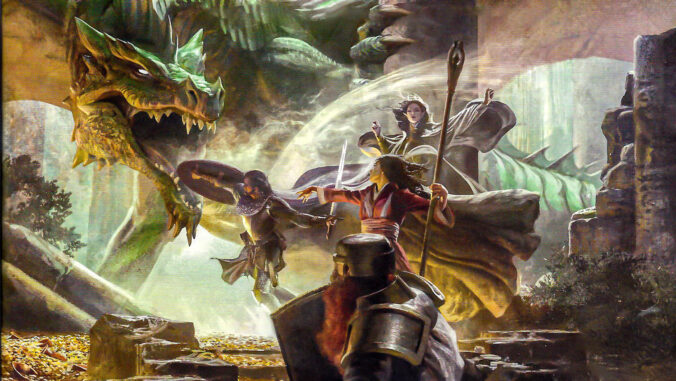
There’s a young green dragon called Venomfang living in a tower in Thundertree. Apparently, the game designers put it there as an example of how not every monster should be fought and how not every problem should be solved by force. The players could avoid the dragon or could try to negotiate with it. But my experience is that every newbie just wants to fight the dragon. It’s their first one and they want to be heroes (and also collect the dragon’s loot). Even the illustration on the cover of LMoP shows a party of adventurers fighting a green dragon. This is a young green dragon with 136 hit points and armor class 18, which makes three attacks per turn (one with its bite and two with its claws) and exhales poisonous gas in a 30-foot cone. Also, once you engage into a fight there is no way to flee, because Venomfang has a flying speed of 80 feet, plus blindsight, darkvision, and a passive perception of 17. Experienced players may manage to defeat it with some luck, but it’s too much for a party of low level newbies. And while your players may laugh at being vanquished by weak goblins in their very first fight in the game, it’s no fun to see a TPK (total party kill) this far into the adventure. So I give them a little help. Reidoth, the druid, gives all of them potions of poison resistance (those are good for an hour, enough time to fight the dragon) and offers support during the combat (he won’t attack the dragon but will cast healing spells from the background). This gives them a chance of defeating the dragon and finding among the loot the Dragon Slayer Sword (+1 bonus to attack and damage rolls, plus extra 3d6 damage to dragons), which will be of great value in the fight against Cryovain, the dragon of Icespire Peak (Reidoth won’t be there to help them).

Once the players are through all (or most of) the side quests, I like to combine the climactic encounters from both adventures into a single, epic finale. Wave Echo Cave (which is the final challenge in LMoP) and Icespire Hold (which is the final challenge in DoIP) are not too far from each other, so I establish that there is a tunnel connecting both locations. After the party enters one of these locations, I create some event that blocks their exit through the same route and leaves them with the other location as the only way out. This creates a large and challenging final dungeon to be explored, but at this point the characters should be at least level 6 (with the two campaigns combined, there are more side quests and therefore more experience points to be collected). The party eventually discovers that the Black Spider (from LMoP) and the dragon cultists (from DoIP) are working together to harness the power within Wave Echo Cave for a dark purpose.

I’ve GMed Lost Mine of Phandelver and Dragon of Icespire Peak merged together like this many times with first-time players, and we all had much fun with it. The sense of accomplishment and the bonds formed during these initial adventures make it a truly rewarding experience for both the players and the GM.
Favorite Movies 1991-2000

In chronological order, only one movie per director.

  • Silence of the Lambs (Jonathan Demme, 1991)
  • Delicatessen (Marc Caro & Jean-Pierre Jeunet, 1991)
  • Pulp Fiction (Quentin Tarantino, 1994)
  • The Usual Suspects (Bryan Singer, 1995)
  • Things to Do in Denver When You’re Dead (Gary Fleder, 1995)
  • Twelve Monkeys (Terry Gilliam, 1995)
  • Fargo (Joel Coen, 1996)
  • Contact (Robert Zemeckis, 1997)
  • A Simple Plan (Sam Raimi, 1998)
  • Fight Club (David Fincher, 1999)
  • The Matrix (Andy Wachowski & Larry Wachowski, 1999)
  • Being John Malkovich (Spike Jonze, 1999)
  • Todo sobre mi Madre (Pedro Almodóvar, 1999)
  • Nueve Reinas (Fabián Bielinsky, 2000)
  • Memento (Christopher Nolan, 2000)

Learning to play chess: my first five games

So, I put my plan in motion and began playing at chess.com. I started unrated and had to play five games to get my first rating.

In the first game I got a victory by resignation on the 16th move, after my white knight forked the black king and queen. But the game review said I played with only 69.5 accuracy. I guess it didn’t like me taking too long to check mate. Despite that, it said I played two great moves. Estimated 900 rating for this game. Opponent from: Philippines. Opening: Ruy López, Morphy Defense, Deferred Schliemann Defense (I wish I knew that’s what I was playing).

The second game, playing with the black pieces, I won by checkmate on the 43rd move. This time I had a much better accuracy, 83.0. Estimated 1350 rating for this game. Opponent from: India. Opening: Queen’s Pawn , 1 … c6.

The third game, playing with the black pieces again, I won by resignation on the 25th move, after my knight forked the king and a rook. My accuracy here was 76.5. Estimated 1200 rating for this game. Opponent from: Indonesia. Opening: King’s Pawn, Leonardis Variation.

I won the fourth game with the white pieces on the 48th move, by checkmate. There was a moment where I thought I was lost, but I managed to play a discovered attack on the black queen with check (a great move, said the computer) and that turned the game around. My accuracy here was 73.3. Estimated 1200 rating for this game. Opponent from: Brazil. Opening: Colle System (I learned that from Rey Enigma on YouTube).

The fifth game, with the black pieces, I won on the 20th move by resignation, after my opponent miscalculated an exchange of pieces and emerged with one piece less than me. My accuracy was the highest so far, 82.8. Estimated 1550 rating for this game. Opponent from: USA. Opening: Queen’s Pawn, Chigorin Variation.

So, after five games, I have a rating. To my surprise it’s 1264, beyond my realistic goal of 1000 and my optimistic goal of 1200. But I don’t think it will be so easy from now on, as I will keep getting stronger opponents. I expect my rating to stand around this level or even go down, because soon I will find players who will defeated me. I’m curious to see when I will encounter this brick wall.

Favorite Movies 1981-1990

In chronological order, only one movie per director.

  • Body Heat (Lawrence Kasdan, 1981)
  • The Postman Always Rings Twice (Bob Rafelson, 1981)
  • Raiders of the Lost Ark (Steven Spielberg, 1981)
  • Blade Runner (Ridley Scott, 1982)
  • Storia di Ordinaria Follia (Marco Ferreri, 1982)
  • Amadeus (Milos Forman, 1984)
  • Greystoke: The Legend of Tarzan, Lord of the Apes (Hugh Hudson, 1984)
  • The Terminator (James Cameron, 1984)
  • Ran (Akira Kurosawa, 1985)
  • The Decline of the American Empire (Denys Arcand, 1986)
  • House of Games (David Mamet, 1987)
  • Mujeres al Borde de un Ataque de Nervios (Pedro Almodóvar, 1988)
  • Farewell to the King (John Milius, 1989)
  • The War of the Roses (Danny DeVito, 1989)
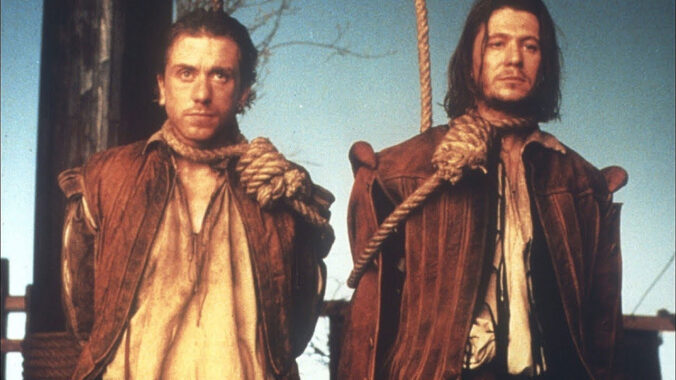
  • Rosencrantz and Guildenstern Are Dead (Tom Stoppard, 1990)
  • Misery (Rob Reiner, 1990)

Watching the same gunfight in seven different ways

Sometimes I get obsessed with a theme and dive into a marathon of movies and/or books about it. This week it was the famous Gunfight at the O.K. Corral. It all started because I read the book Tombstone – Wyatt Earp, the O.K. Corral, and the Vendetta Ride, by Sean McLachlan. It’s a straightforward account of the gunfight and the events leading to it and spreading from it. That got me thinking about all the movies I had seen that misrepresented the episode, so I decided to watch them again.

I couldn’t find Law and Order (Edward L. Cahn, 1932) or Frontier Marshal (Allan Dwan, 1939), so I started my marathon with Tombstone, the Town Too Tough to Die (William C. McGann, 1942). It’s a simplistic tale where Wyatt Earp (Richard Dix) and his friends are all good and courageous and Curly Bill Brocious (Edgar Buchanan) and his band of bandits are all bad and mischievous. No room for subtleties here. And then there is Johnny Duane (Don Castle) – is he a replacement for Johnny Ringo? -, a bad boy who is actually a good boy, so Wyatt Earp is determined to bring him to the light side of the force. Doc Holliday (Kent Taylor) looks pretty healthy, no signs of tuberculosis. The actual gunfight at the O.K. Corral is handled poorly, and with almost no importance in the plot.

The next one was My Darling Clementine (John Ford, 1946). Despite all the critical acclaim, to me it’s the worst movie made about the Gunfight at the O.K. Corral. Yes, it’s a well told story (probably the reason people like Akira Kurosawa or Sam Peckinpah listed it as one of their favorite movies), but it’s not even close to what happened (the reason it displeased me so much). It starts with Wyatt Earp, played by Henry Fonda, taking a herd of cows to California with his brothers, and he only stops at Tombstone because his cows were stolen and his younger brother was killed. (In fact, the Earp brothers went to Tombstone following a plan to invest in many businesses there and become rich, and there was no cattle involved. Also, they took their wives, which don’t show up in the movie. Also, James Earp was not the younger brother and he wasn’t murdered in Tombstone but died of natural causes many years later in California). Then Wyatt Earp meets Doc Holliday, poorly played by Victor Mature, for the first time in Tombstone. (In fact, they were already friends at that point.) This Doc is not a gambler, doesn’t travel with a prostitute, looks very robust for someone suffering from tuberculosis, and doesn’t even have a mustache. Then there’s the love interest, Clementine Carter (Cathy Downs), who used to be Doc’s girl. She’s not the real Doc’s Big Nose Kate and she’s not the real Wyatt’s Josephine Marcus, just a made up character. To make it more dramatic John Ford makes the fight at the O.K. Corral happen at sunrise. (In fact, it happened at 3 PM.) On one side, Wyatt Earp, Morgan Earp, and Doc Holliday. Virgil Earp is missing because he had been killed earlier. (In fact, Virgil was in the fight, wasn’t killed before or during the fight, and survived even when he was shot later. Also, Virgil was the older brother, and not Morgan like in the movie.) On the other side, Old Man Clanton and his sons. (In fact, the cowboys on the other side were Billy Claiborne, brothers Ike and Billy Clanton, and brothers Tom and Frank McLaury. Old Man Clanton had been killed in another incident a couple of months earlier.) The fight lasts a few minutes, with both sides shooting at each other from afar. (In fact, the fight only lasted 30 seconds and they were fairly close to each other.) And Doc Holliday gets shot and dies. (No, no, no, he wasn’t shot in the fight and died six years later in a hospital bed.) If that’s the story you want to tell, tell it without using the names of people from a different story. I don’t care if it’s John Ford, his movie is ridiculous.

The third movie was Gunfight at the O.K. Corral (John Sturges, 1957). This Doc Holliday, played by Kirk Douglas, sports a mustache (a small one, but much better than no mustache) and has a love-hate relationship with Big Nose Kate, played by Jo Van Fleet. But Wyatt Earp, played by Burt Lancaster, has no mustache. Any non-mustachioed Wyatt Earp has zero credibility. DeForest Kelley (yes, that DeForest Kelley, aka Dr. Leonard Bones McCoy) plays Morgan Earp, also without a mustache. A fun fact is that years later in the sixth episode of the third season of Star Trek, Spectre of the Gun, DeForest Kelley, as Bones, would be involved in a re-enactment of the Gunfight at the O.K. Corral. I also find it interesting how the bromance between Earp and Doc seems very suggestive of a platonic homoerotic attraction between the two. But the movie takes too many liberties with the facts. For example, like in My Darling Clementine, they make James Earp a younger brother (he was actually an older brother) and get him killed to serve as an excuse for the fight at the O.K. Corral (James actually lived until 1926). Also like in the John Ford movie, they schedule the shootout for sunrise (actually, it was at 3 PM). And the fight itself is convoluted, with all the gunmen spread out, and even has a wagon on fire (it was actually at close quarters and over in 30 seconds). In any case, even with the incongruences, Gunfight at the O.K. Corral is a better movie than My Darling Clementine.

John Sturges liked this theme so much he returned to it ten years later in Hour of the Gun (John Sturges, 1967). This time he added some more historical accuracy, and the opening states that “This picture is based on Fact. This is the way it happened.” Well, almost. There are still several liberties, like how some of Earp’s antagonists died. They also add a train station at Tombstone, which is completely anachronistic. But it’s good that Sturges decided to correct the falsehoods of his previous movie. However, this is not a remake, it’s a sequel, starting right with the shootout and following it with the trial and acquittal of Doc and the Earps, and then the revenge section fills most of the movie. James Garner, with a mustache, is Wyatt Earp. Jason Robards, with a mustache, is Doc Holliday. Curiously, almost all the women seem to have disappeared from Arizona, as this is a movie about men, for men, and the director only shows men.

The fifth movie was Doc (Frank Perry, 1971). Not a bad idea to tell the same story with Doc Holliday as the protagonist. Stacy Keach is good in the role, as is Faye Dunaway as Big Nose Kate. Harris Yulin lacks charisma to be a good Wyatt Earp, but perhaps that’s part of the plan. The movie has a very 70s vibe, with too much talk and a few artsy-fartsy moments. The imbroglio with Ike Clanton doesn’t follow the historical facts at all, and is just played as a personal conflict. And Ike Clanton beating up Wyatt Earp in a fist fight seems very out of character for both men. Good effort, but still inadequate results.

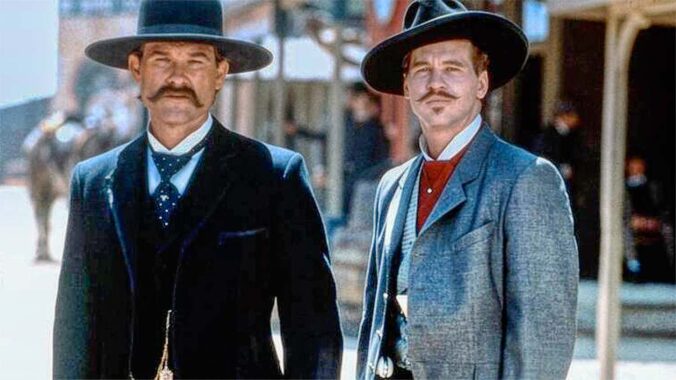
We had to wait over twenty years to get a good movie about the famous Gunfight at the O.K. Corral (which actually didn’t happen at the corral but nearby): Tombstone (George P. Cosmatos, 1993). Unlike other attempts, this film strikes a remarkable balance between cinematic entertainment and historical accuracy. While there are still some liberties taken for dramatic effect (which is part of cinematic narrative), it manages to capture the essence of the events surrounding the legendary gunfight more faithfully than its counterparts, and distinguishes itself by weaving a compelling narrative while maintaining a level of authenticity that remains true to the spirit of the historical events. It not only serves as an engaging piece of entertainment but also as a more credible and respectful representation of the iconic showdown. Kurt Russell, with a magnificent mustache, plays a solid Wyatt Earp. Val Kilmer, in the best role of his life as Doc Holliday, captures the character’s complexities and showcases his wit, charm, and inner turmoil with remarkable skill. Plus Sam Elliott (king of mustaches) and Bill Paxton as the other Earp brothers, and Powers Boothe and Michael Biehn as the villainous Curly Bill Brocius and Johnny Ringo. Tombstone is easily the best movie made about this theme.

The seventh and last movie in my marathon was Wyatt Earp (Lawrence Kasdan, 1994). Kevin Costner as Wyatt Earp, with an underpowered mustache. The story starts with Wyatt Earp as a kid, which gives some background to the character but also makes for the least interesting part of a very long movie. For the first hour (the whole thing is over three hours) he doesn’t even become a lawman. Dennis Quaid does a good Doc Holliday, but it lacks the finesse shown by Val Kilmer in Tombstone. Well, I can’t say it’s a bad movie or too far from historical fact, it’s just too long and too slow to be really engaging.

And that was my obsession for this week. Onwards to the next one.

Favorite Movies 1960-1980

In chronological order, only one movie per director.

  • La Dolce Vita (Federico Fellini, 1960)
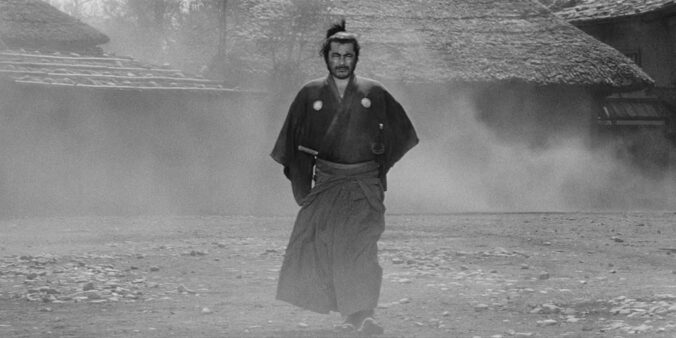
  • Yojimbo (Akira Kurosawa, 1961)
  • L’Année dernière à Marienbad (Alain Resnais, 1961)
  • What Ever Happened to Baby Jane? (Robert Aldrich, 1962)
  • The Exterminating Angel (Luis Buñuel, 1962)
  • Le Samouraï (Jean-Pierre Melville, 1967)
  • Rosemary’s Baby (Roman Polanski, 1968)
  • Planet of the Apes (Franklin J. Schaffner, 1968)
  • Z (Costa-Gavras, 1969)
  • The Godfather (Francis Ford Coppola, 1972)
  • La Planète Sauvage (René Laloux, 1973)
  • The Man Who Would Be King (John Huston, 1975)
  • One Flew Over the Cuckoo’s Nest (Milos Forman, 1975)
  • All That Jazz (Bob Fosse, 1979)
  • Life of Brian (Terry Jones, 1979)

Learning to play chess: the plan

It would be an exaggeration to say that I know how to play chess. Yes, when I was a kid I learned how to move the pieces and also a few basic principles (control the center, develop knights before bishops, etc). That doesn’t entitle me to say that I am a chess player. But one of my projects for 2024 (yes, I have many projects) is to properly learn how to play chess.

I have a plan. I will start by creating an account on chess.com. Then, before playing any real games, I will study all their tutorials and practice a bit against the computer. Only after all that I will start playing against other players, and analyzing my games in the hope of learning from my mistakes. I will play rapid games, ten minutes for each player, which I think is a good time control for a beginner like me. Their system pairs players of similar levels, so I believe I will advance fast through the rankings at the beginning, until I reach my real level. Then I will start getting paired against players who are a bit stronger than me, and that’s when I will have to get used to losing more than winning.

I’ve established a quantifiable goal for this project. Actually, two goals. One realistic and one optimistic. According to the International Chess Federation (FIDE), the best players in the world, usually called super grand masters, have a rating above 2700. On December 2023, only 35 people in the whole world were part of that elite group. And only one was above the 2800 mark. That’s Norwegian GM Magnus Carlsen, possibly the best player of all time. The ratings at chess.com are a bit above the FIDE ratings, so I will round up the top rating to 3000 (for someone like me, 2700 is as unattainable as 3000) and use that number as a reference for my goals. The realistic goal is to reach one third of that mark, a rating of 1000. That would make me comfortable saying I know how to play chess. The optimistic goal is to reach 40% of that mark, a rating of 1200. Anything beyond that would require an enormous effort and may not even be possible. But it’s good to have goals.

Newer posts »

© 2026 Zander Dulac

Theme by Anders NorenUp ↑