- Jurassic Park (1990), by Michael Crichton
- A Fire Upon the Deep (1992), by Vernor Vinge
- Doomsday Book (1992), by Connie Willis
- Snow Crash (1992), by Neal Stephenson
- The Children of Men (1992), by P.D. James
In chronological order.

I just saw the new Guardian’s 100 Best Novels of All Time list, created by “170 authors, critics and academics from around the world”, and I was appalled.
The top of the list leans heavily toward what might be called “prestige seriousness”: books that are endlessly taught, endlessly written about, and endlessly admired partly because admiring them signals cultural literacy. So you get the almost ritual elevation of Pride and Prejudice, Anna Karenina, and In Search of Lost Time near the summit. Now, are these important novels? Obviously. But “important” and “greatest reading experiences for actual human beings” are not the same thing. Lists like this often confuse influence, academic prestige, and emotional obligation with vitality. There is a certain kind of literary culture that treats admitting boredom with Proust as if one had confessed to kicking puppies.
The Virginia Woolf saturation is another example: five novels. That is not an accident. It reflects institutional taste. Mrs Dalloway and To the Lighthouse are understandable inclusions, but at some point representation becomes canon maintenance. Woolf is one of those writers whom critics adore discussing almost more than readers enjoy reading. Her importance to literary modernism is unquestionable, but five slots out of a hundred is excessive unless the goal is specifically “the history of high modernist prose technique”.
Tolstoy gets the same treatment. One can defend War and Peace and even perhaps Anna Karenina as monumental works, but when authors start receiving multiple guaranteed spots, the list stops feeling exploratory and starts feeling bureaucratic. It becomes less “the best novels” and more “approved monuments”.
Then there is Jane Austen, with a near-sacred aura surrounding her. She often benefits from a kind of critical inflation in which elegance, irony, and social observation are treated as inherently superior to ambition, imagination, or emotional scale. Pride and Prejudice could be considered well written, even charming and sharp, but it’s basically a story where the heroes are women whose main concern in life is to marry rich men. Does that deserve perpetual placement above wildly more ambitious works from world literature?
The Marilynne Robinson inclusion is almost comically predictable for this sort of list. Robinson occupies a very specific niche in Anglo-American literary culture: quiet, contemplative, Protestant-inflected seriousness written in pristine prose. Critics adore that combination. But outside literary circles, her cultural footprint is tiny compared to many omitted authors. When you see Robinson included while someone like Umberto Eco is absent, you can practically hear the seminar room humming in the background.
The Ernst Hemingway placement is especially revealing. Only one book, and low on the list, suggests a contemporary discomfort with old-school masculine prose and direct emotional architecture. He used to be unavoidable in these canons. Now he feels almost grudgingly retained, like an aging rock band reluctantly invited to the festival because the audience would riot otherwise.
Meanwhile, the omissions are honestly more interesting than the inclusions. No Paul Auster? That is bizarre for a list supposedly interested in literary innovation and postmodern identity games. No Ian McEwan? One can argue about individual novels, but Atonement alone has had enormous literary and cultural impact. No Kurt Vonnegut is another symptom of the list’s discomfort with humor, satire, and speculative fiction. Literary institutions often say they value imagination, but when voting time comes, realism and solemnity dominate. No Jack Kerouac is another classic establishment move. The Beats remain oddly suspect to elite literary culture because spontaneity, looseness, and countercultural energy age badly in academic environments that privilege polish and interpretability. And no Somerset Maugham hurts because he represents something modern literary criticism undervalues: readability. Maugham was one of the great storytellers of the 20th century. But “beautifully constructed and compulsively readable” now counts for less than “structurally interrogates memory and identity through fragmented temporality”.
No Umberto Eco is absurd. The Name of the Rose alone bridges literary fiction, historical fiction, semiotics, detective fiction, philosophy, and popular readability better than half the list combined. No Julio Cortázar and therefore no Hopscotch? That is one of the great modern novels about structure and reader participation. But Latin American literature in English-language canons often gets reduced to the obligatory García Márquez checkpoint. And the absence of Machado de Assis is honestly indefensible if the list pretends global scope. The Posthumous Memoirs of Brás Cubas anticipated modern metafiction decades before many Europeans supposedly invented it. Likewise, no Eça de Queirós means an entire literary tradition barely registers. The Maias is easily worthy of consideration.
No J.R.R. Tolkien is maybe the single clearest sign of bias. One can dislike fantasy, but excluding The Lord of the Rings from any serious “greatest novels” conversation is like discussing cinema without mentioning Kurosawa because samurai movies are “genre”. Tolkien shaped modern storytelling more than many of the approved literary names on the list.
And then, where is Les Misérables? If readability, emotional force, social ambition, historical sweep, and cultural influence matter, its omission is astonishing.
Contemporary literary institutions tend to overvalue books that align with current ideological and aesthetic priorities while undervaluing writers who were massively important to actual readers across generations. These lists often mistake “books that are rewarding to study” for “books that fully justify the existence of the novel as an art form”. Those are not identical categories. A novel can be technically revolutionary and emotionally inert. Another can be messy, uneven, melodramatic, yet unforgettable.
The funniest thing is that the Guardian itself admits the whole enterprise is subjective and argumentative. Which is true. These lists are less maps of literary greatness than x-rays of institutional taste.
In case the list disappears from its original place, I’ll leave a copy here for reference: 100 My Ántonia, 99 The Go-Between, 98 The Road, 97 Catch-22, 96 Pedro Páramo, 95 The Return of the Native, 94 The Known World, 93 Invisible Cities, 92 Sentimental Education, 91 Life and Fate, 90 Jacob’s Room, 89 The Left Hand of Darkness, 88 Ragtime, 87 The Line of Beauty, 86 The Turn of the Screw, 85 The Vegetarian, 84 The Talented Mr Ripley, 83 A Farewell to Arms, 82 The End of the Affair, 81 Buddenbrooks, 80 Rebecca, 79 Go Tell It on the Mountain, 78 A House for Mr Biswas, 77 The Rainbow, 76 Dracula, 75 The Bluest Eye, 74 Nervous Conditions, 73 Austerlitz, 72 Our Mutual Friend, 71 Kindred, 70 Jude the Obscure, 69 Crime and Punishment, 68 Blood Meridian, 67 The Man Without Qualities, 66 The Master and Margarita, 65 The Color Purple, 64 The Good Soldier, 63 White Teeth, 62 Half of a Yellow Sun, 61 The Rings of Saturn, 60 Howards End, 59 Never Let Me Go, 58 Disgrace, 57 The Sound and the Fury, 56 Mansfield Park, 55 The Waves, 54 Orlando, 53 The Transit of Venus, 52 The Golden Bowl, 51 My Brilliant Friend, 50 Wide Sargasso Sea, 49 A Fine Balance, 48 The Metamorphosis, 47 Vanity Fair, 46 The Leopard, 45 The Golden Notebook, 44 Giovanni’s Room, 43 Housekeeping, 42 The Magic Mountain, 41 Heart of Darkness, 40 Song of Solomon, 39 Their Eyes Were Watching God, 38 The Age of Innocence, 37 Invisible Man, 36 The Handmaid’s Tale, 35 Great Expectations, 34 Wolf Hall, 33 David Copperfield, 32 The God of Small Things, 31 The Prime of Miss Jean Brodie, 30 Frankenstein, 29 Pale Fire, 28 The Brothers Karamazov, 27 The Trial, 26 Don Quixote, 25 Lolita, 24 The Remains of the Day, 23 Midnight’s Children, 22 Things Fall Apart, 21 The Portrait of a Lady, 20 Wuthering Heights, 19 The Life and Opinions of Tristram Shandy, Gentleman, 18 Persuasion, 17 One Hundred Years of Solitude, 16 Nineteen Eighty-Four, 15 Moby-Dick, 14 Mrs Dalloway, 13 Emma, 12 Bleak House, 11 The Great Gatsby, 10 Madame Bovary, 09 Pride and Prejudice, 08 Jane Eyre, 07 War and Peace, 06 Anna Karenina, 05 In Search of Lost Time, 04 To the Lighthouse, 03 Ulysses, 02 Beloved, 01 Middlemarch.
In chronological order.
There is a particular kind of American fantasy that rolls into town on squeaky wheels: a carnival, a circus, a sideshow. It promises wonder, then quietly reorders your soul. Charles G. Finney’s The Circus of Dr. Lao (1935) drops a surreal menagerie into a dusty Arizona town. Ray Bradbury’s Something Wicked This Way Comes (1962) delivers a traveling nightmare to a small town in Illinois, baiting people with the one thing they want most.
The enduring appeal of these fantasies becomes even more apparent when examining their film adaptations, which reveal as much about Hollywood as about the books themselves. George Pal’s 7 Faces of Dr. Lao (1964) turns Finney’s sharp, episodic satire into a warm(ish) fantasy Western built around a tour-de-force gimmick performance, while Jack Clayton’s Something Wicked This Way Comes (1983) becomes a beautifully moody, famously troubled production even though Bradbury wrote the screenplay himself.
Finney’s The Circus of Dr. Lao is compact, strange, and structured like a chain of encounters. The circus arrives in Abalone, Arizona, and townspeople wander through attractions that feel less like entertainment than moral or existential stress tests. The creatures aren’t just monsters, they are arguments in costume. The book even caps itself with an appendix-style catalogue that snarks, clarifies, and undercuts, as if the novel can’t resist heckling its own myth-making.
Bradbury’s Something Wicked This Way Comes is not episodic but a continuous, intensifying narrative centered on Jim Nightshade and Will Halloway. They confront a carnival led by Mr. Dark, who exploits longings, especially fear of aging, regret, and loneliness.
Where Finney’s prose often feels like a clever blade, Bradbury’s feels like autumn air. It’s lyrical, nostalgic, and then suddenly freezing. Even the premise carries a thematic engine: the carnival doesn’t merely frighten you, it customizes itself to whatever soft spot you refuse to admit you have.
Both novels use “the show” as a delivery system for temptation and revelation. But Finney’s circus is a surreal civic audit (the town is measured, found wanting, and left with consequences that feel harshly cosmic), while Bradbury’s carnival is intimate and psychological (it’s about the moment childhood ends, and the first time you realize adults are just kids with heavier masks).
George Pal’s 7 Faces of Dr. Lao (1964) is explicitly based on Finney’s novel, but it only follows it in the loosest sense: it keeps the basic situation (a magical circus transforms a town) while changing and simplifying much of what makes the book so wonderfully abrasive. The most obvious pivot is the movie’s central hook: Tony Randall plays Dr. Lao and a roster of other figures (the faces), turning the story into a showcase of performance and transformation. The film also adds a more conventional, external conflict, an outright land/railroad-related swindle subplot, to give the town a plot in the Hollywood sense, not just a series of encounters. And then there’s the craft: the movie is famous for its makeup and effects. Makeup artist William Tuttle received a special Academy Award for this work, even though makeup was not an official Oscar category at that time. But the adaptation also drags a cultural problem into the spotlight. The film’s version of Dr. Lao (a Chinese character played by a non-Asian actor) sits in the long, ugly history of Hollywood “yellowface”, which changes the flavor of the story in a way the book doesn’t require.
On paper, the Something Wicked This Way Comes (1983) adaptation sounds like the dream scenario: Bradbury wrote the screenplay for the film version of his own novel. In practice, it became a case study in how films get transformed into a different creature. Both AFI’s production history and widely repeated accounts point to the same core reality. The movie had a turbulent development and a troubled production, with studio intervention after test screenings. After test screenings, Disney sidelined the director, replaced the editorial and music choices, and undertook extensive changes. And yet, when the film works, it works because it honors Bradbury’s mood: the autumnal dread, the hush before the scream, the sense that the fun of a carnival is just a mask with something hungry behind it. The casting helps: Jonathan Pryce’s Mr. Dark is an elegant menace, and Jason Robards brings gravity to the father figure who, in Bradbury, functions as the story’s moral counterweight.
The contrast between novel and film is especially sharp in Pal’s movie, which treats Dr. Lao as a premise rather than a structure. The novel’s episodic cruelty and meta-textual bite (including that catalogue appendix) are difficult to translate directly, so the film makes a pragmatic decision: give the audience a throughline (a town conflict) and a spectacle engine (Randall’s transformations).
Bradbury’s novel is already cinematic in the way it builds dread. But the film version ends up fighting two impulses: to preserve Bradbury’s lyric melancholy and moral seriousness, and to package the darkness in a Disney-friendly vessel. The production history matters here. It explains why many viewers report a movie with moments of genuine power, but with seams visible from reworking and reshaping.
Taken together, these two carnival stories map a fascinating spectrum of American fantasy, both on the page and on the screen. Finney gives you a surreal, satirical circus that exposes a town’s smallness with almost mythic indifference. Bradbury gives you a dark fairytale of adolescence, in which evil is less a monster than a transaction. “I’ll give you what you want, and take what you are.” And their adaptations remind you of a final truth: when Hollywood buys a ticket to a strange show, it often tries to rewrite the act. Sometimes that produces a charming new performance (7 Faces of Dr. Lao). Sometimes it produces a beautiful, bruised artifact that still smells like autumn lightning (Something Wicked This Way Comes).
In chronological order.
Between 1965 and 1967, British cinema produced an unlikely espionage trilogy centered on an unglamorous, bespectacled intelligence officer named Harry Palmer. Adapted from Len Deighton’s novels and starring a then-young Michael Caine, these films (The Ipcress File, Funeral in Berlin, and Billion Dollar Brain) were conceived as a realistic alternative to the wildly successful James Bond franchise. Yet within just three years, the series evolved from sharp anti-Bond realism to stylistic excess, reflecting both the creative volatility of 1960s British cinema and the limits of translating Deighton’s dry, ironic prose into spectacle.
Len Deighton’s 1962 novel The Ipcress File was a sardonic, semi-bureaucratic take on the spy genre, closer in tone to John le Carré’s The Spy Who Came in from the Cold than to Ian Fleming’s glamorous world of tuxedos and martinis. Its narrator, a nameless intelligence officer reporting through official documents and memos, is cynical, wry, and deeply aware of the absurdities of Cold War espionage.
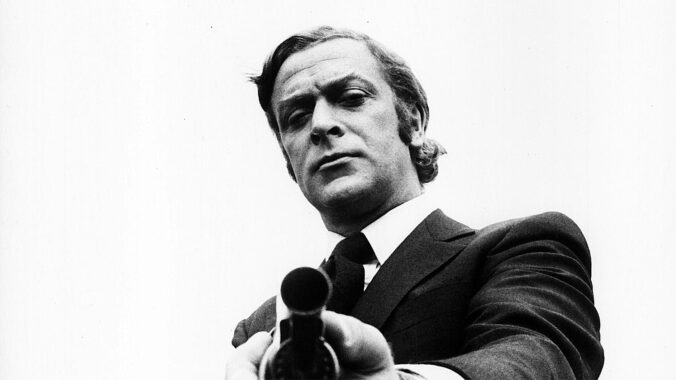
When the story reached the screen, with The Ipcress File (Sidney J. Furie, 1965), the transformation was substantial. The film, produced by Harry Saltzman (who was also one of the producers behind the Bond series), necessarily reimagined the anonymous protagonist as a third-person character: Harry Palmer. The name, chosen for its ordinariness, suited the film’s anti-heroic tone. Unlike Bond, Palmer is underpaid, under-appreciated, and perpetually irritated by paperwork. He cooks gourmet meals in his small London flat, wears thick-rimmed glasses, and navigates an intelligence service riddled with office politics and procedural tedium.
Caine’s performance as Palmer cemented his early stardom. He embodied a new kind of British masculinity (working-class, witty, confident) perfectly suited to the mid-60s mod aesthetic. His Palmer was as stylish as he was cynical, but never suave in the Bond sense. His sharp suits and clipped humor projected competence without glamour. He was, in short, the spy as civil servant.
Though conceived as a counter-Bond project, The Ipcress File shared significant DNA with the 007 franchise. Saltzman’s involvement brought the production team of Ken Adam (production design) and John Barry (score), both Bond veterans. Yet director Sidney J. Furie went in the opposite visual direction: claustrophobic compositions, oblique camera angles, and a palette of grey offices and shadowy corridors. Instead of Monte Carlo casinos, we get fluorescent lights and filing cabinets. The effect was startlingly modern, even subversive, a film that made the world of espionage look not exciting but exhausting.
Critics quickly noted that The Ipcress File‘s world resembled le Carré’s bureaucratic labyrinths more than Fleming’s fantasies. The film’s story of kidnapped scientists, brainwashing, and double agents is told through meetings, memos, and missed lunch breaks. Even the climax, an experimental brainwashing sequence that fractures Palmer’s sense of reality, feels psychologically invasive rather than heroic. Deighton’s grim wit survived the translation: in Palmer’s world, the greatest danger isn’t the enemy, but the incompetence of your own superiors.
A year later came Funeral in Berlin (Guy Hamilton, 1966), widely regarded as the best of the series. The tone is more controlled, the world more vivid, and the moral ambiguities more pronounced. This time, Palmer is sent to Berlin to arrange the defection of a Soviet colonel, and, of course, nothing goes according to plan.
Curiously, the filmmakers skipped Deighton’s second novel, Horse Under Water, set mainly in Portugal, moving directly to his third, Funeral in Berlin. The official reason was logistical: the story’s underwater sequences were expensive to film. But in retrospect, the decision made artistic sense. Berlin, divided by the Wall, was a perfect stage for Cold War intrigue. The city’s atmosphere of constant surveillance and simmering paranoia provided precisely the kind of authenticity that the Bond series avoided.
A significant asset to the film was Oskar Homolka as Colonel Stok, the weary, sardonic KGB officer who seems as trapped by bureaucracy as Palmer himself. Homolka’s performance gives the film its heart, a sense that espionage, for all its cynicism, still involves ordinary human beings caught between absurd systems. The scenes at Checkpoint Charlie and along the Wall exude a documentary realism that anchors the plot’s twists in genuine geopolitical tension.
Ironically, Funeral in Berlin was directed by Guy Hamilton, who had helmed Goldfinger (1964) and would go on to direct three more Bond films (Diamonds Are Forever, Live and Let Die, The Man with the Golden Gun). Yet Hamilton’s approach here is far more restrained. Gone are the gadgets and explosions. In their place, shadows, dossiers, and double-crosses. The result is a taut, sophisticated spy film, perhaps the most authentic cinematic embodiment of Deighton’s world.
Where The Ipcress File was innovative, Funeral in Berlin was masterful. Precise, tense, and steeped in the melancholy of divided Europe.
Then came Billion Dollar Brain (Ken Russell, 1967) and the spell broke. It’s the film that effectively destroyed the franchise. Where the previous entries were grounded, Billion Dollar Brain veered into farce. The opening credits sequence mimicked Bond’s stylized montages, complete with silhouettes and swirling graphics, an ironic move for a series originally designed as the anti-Bond. Palmer, once the sardonic clerk-spy, now found himself in a world of computer-controlled espionage, private armies, and megalomaniacal generals. The novel’s already complex plot about a right-wing Texas tycoon and an anti-Soviet conspiracy was rendered on screen as convoluted, incoherent, and often unintentionally comic.
Ken Russell, later famous for his flamboyant, operatic style (Women in Love, The Music Lovers,The Devils), was an ill-matched choice for this material. His taste for surrealism and exaggeration clashed with Deighton’s dry wit and realism. What had been a series about bureaucratic absurdity became a carnival of absurd set pieces, exploding ice floes, cartoonish villains, and a plot that collapsed under its own eccentricity.
Adding to the film’s oddities was an early Donald Sutherland cameo (blink and you’ll miss it), one of many pointless flourishes in a movie that seemed determined to squander its tone. The cold, ironic edge of The Ipcress File had dissolved into psychedelic nonsense. The climax, involving a private army storming across a frozen sea, plays like self-parody. By the end, even Caine’s Palmer seems bewildered, as if the actor himself realized the character’s credibility had melted away.
Audiences agreed. Billion Dollar Brain underperformed, and no further theatrical films followed. Palmer would reappear decades later in low-budget television movies, but the cultural moment had passed. The trilogy had begun as the thinking man’s answer to Bond and ended as a confused imitation of him.
Taken together, the three films trace an unintended arc, not only of a character but of a cinematic era. The Ipcress File captured the post-Suez, post-imperial malaise of Britain: espionage as office work, heroism as endurance. Funeral in Berlin perfected the formula, locating human tragedy amid ideological walls. Billion Dollar Brain succumbed to the late-sixties’ obsession with style over substance, collapsing under its own excess.
Harry Palmer began as the antithesis of James Bond, ordinary, sardonic, bespectacled, and ended, fittingly, as a relic of a world that no longer knew what to do with ordinary spies. The bureaucrat had outlived his moment, but for a brief, brilliant time, he made espionage feel real.
© 2026 Zander Dulac
Theme by Anders Noren — Up ↑