Tag: books (Page 2 of 3)

Two Dark Carnivals, Two Very Different Kinds of Magic

There is a particular kind of American fantasy that rolls into town on squeaky wheels: a carnival, a circus, a sideshow. It promises wonder, then quietly reorders your soul. Charles G. Finney’s The Circus of Dr. Lao (1935) drops a surreal menagerie into a dusty Arizona town. Ray Bradbury’s Something Wicked This Way Comes (1962) delivers a traveling nightmare to a small town in Illinois, baiting people with the one thing they want most.

The enduring appeal of these fantasies becomes even more apparent when examining their film adaptations, which reveal as much about Hollywood as about the books themselves. George Pal’s 7 Faces of Dr. Lao (1964) turns Finney’s sharp, episodic satire into a warm(ish) fantasy Western built around a tour-de-force gimmick performance, while Jack Clayton’s Something Wicked This Way Comes (1983) becomes a beautifully moody, famously troubled production even though Bradbury wrote the screenplay himself.

Finney’s The Circus of Dr. Lao is compact, strange, and structured like a chain of encounters. The circus arrives in Abalone, Arizona, and townspeople wander through attractions that feel less like entertainment than moral or existential stress tests. The creatures aren’t just monsters, they are arguments in costume. The book even caps itself with an appendix-style catalogue that snarks, clarifies, and undercuts, as if the novel can’t resist heckling its own myth-making.

Bradbury’s Something Wicked This Way Comes is not episodic but a continuous, intensifying narrative centered on Jim Nightshade and Will Halloway. They confront a carnival led by Mr. Dark, who exploits longings, especially fear of aging, regret, and loneliness.

Where Finney’s prose often feels like a clever blade, Bradbury’s feels like autumn air. It’s lyrical, nostalgic, and then suddenly freezing. Even the premise carries a thematic engine: the carnival doesn’t merely frighten you, it customizes itself to whatever soft spot you refuse to admit you have.

Both novels use “the show” as a delivery system for temptation and revelation. But Finney’s circus is a surreal civic audit (the town is measured, found wanting, and left with consequences that feel harshly cosmic), while Bradbury’s carnival is intimate and psychological (it’s about the moment childhood ends, and the first time you realize adults are just kids with heavier masks).

George Pal’s 7 Faces of Dr. Lao (1964) is explicitly based on Finney’s novel, but it only follows it in the loosest sense: it keeps the basic situation (a magical circus transforms a town) while changing and simplifying much of what makes the book so wonderfully abrasive. The most obvious pivot is the movie’s central hook: Tony Randall plays Dr. Lao and a roster of other figures (the faces), turning the story into a showcase of performance and transformation. The film also adds a more conventional, external conflict, an outright land/railroad-related swindle subplot, to give the town a plot in the Hollywood sense, not just a series of encounters. And then there’s the craft: the movie is famous for its makeup and effects. Makeup artist William Tuttle received a special Academy Award for this work, even though makeup was not an official Oscar category at that time. But the adaptation also drags a cultural problem into the spotlight. The film’s version of Dr. Lao (a Chinese character played by a non-Asian actor) sits in the long, ugly history of Hollywood “yellowface”, which changes the flavor of the story in a way the book doesn’t require.

On paper, the Something Wicked This Way Comes (1983) adaptation sounds like the dream scenario: Bradbury wrote the screenplay for the film version of his own novel. In practice, it became a case study in how films get transformed into a different creature. Both AFI’s production history and widely repeated accounts point to the same core reality. The movie had a turbulent development and a troubled production, with studio intervention after test screenings. After test screenings, Disney sidelined the director, replaced the editorial and music choices, and undertook extensive changes. And yet, when the film works, it works because it honors Bradbury’s mood: the autumnal dread, the hush before the scream, the sense that the fun of a carnival is just a mask with something hungry behind it. The casting helps: Jonathan Pryce’s Mr. Dark is an elegant menace, and Jason Robards brings gravity to the father figure who, in Bradbury, functions as the story’s moral counterweight.

The contrast between novel and film is especially sharp in Pal’s movie, which treats Dr. Lao as a premise rather than a structure. The novel’s episodic cruelty and meta-textual bite (including that catalogue appendix) are difficult to translate directly, so the film makes a pragmatic decision: give the audience a throughline (a town conflict) and a spectacle engine (Randall’s transformations).

Bradbury’s novel is already cinematic in the way it builds dread. But the film version ends up fighting two impulses: to preserve Bradbury’s lyric melancholy and moral seriousness, and to package the darkness in a Disney-friendly vessel. The production history matters here. It explains why many viewers report a movie with moments of genuine power, but with seams visible from reworking and reshaping.

Taken together, these two carnival stories map a fascinating spectrum of American fantasy, both on the page and on the screen. Finney gives you a surreal, satirical circus that exposes a town’s smallness with almost mythic indifference. Bradbury gives you a dark fairytale of adolescence, in which evil is less a monster than a transaction. “I’ll give you what you want, and take what you are.” And their adaptations remind you of a final truth: when Hollywood buys a ticket to a strange show, it often tries to rewrite the act. Sometimes that produces a charming new performance (7 Faces of Dr. Lao). Sometimes it produces a beautiful, bruised artifact that still smells like autumn lightning (Something Wicked This Way Comes).

Favorite Science Fiction Novels, 19th century

  • Frankenstein (1818), by Mary Shelley
  • The Narrative of Arthur Gordon Pym of Nantucket (1838), by E.A. Poe
  • Twenty Thousand Leagues Under the Seas (1869), by Jules Verne
  • Strange Case of Dr Jekyll and Mr Hyde (1886), by R.L. Stevenson
  • The Time Machine (1895), by H.G. Wells

In chronological order.

The Harry Palmer Trilogy

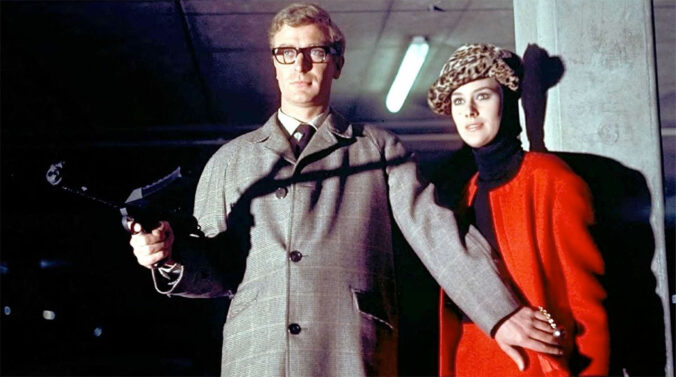
Between 1965 and 1967, British cinema produced an unlikely espionage trilogy centered on an unglamorous, bespectacled intelligence officer named Harry Palmer. Adapted from Len Deighton’s novels and starring a then-young Michael Caine, these films (The Ipcress File, Funeral in Berlin, and Billion Dollar Brain) were conceived as a realistic alternative to the wildly successful James Bond franchise. Yet within just three years, the series evolved from sharp anti-Bond realism to stylistic excess, reflecting both the creative volatility of 1960s British cinema and the limits of translating Deighton’s dry, ironic prose into spectacle.

Len Deighton’s 1962 novel The Ipcress File was a sardonic, semi-bureaucratic take on the spy genre, closer in tone to John le Carré’s The Spy Who Came in from the Cold than to Ian Fleming’s glamorous world of tuxedos and martinis. Its narrator, a nameless intelligence officer reporting through official documents and memos, is cynical, wry, and deeply aware of the absurdities of Cold War espionage.

When the story reached the screen, with The Ipcress File (Sidney J. Furie, 1965), the transformation was substantial. The film, produced by Harry Saltzman (who was also one of the producers behind the Bond series), necessarily reimagined the anonymous protagonist as a third-person character: Harry Palmer. The name, chosen for its ordinariness, suited the film’s anti-heroic tone. Unlike Bond, Palmer is underpaid, under-appreciated, and perpetually irritated by paperwork. He cooks gourmet meals in his small London flat, wears thick-rimmed glasses, and navigates an intelligence service riddled with office politics and procedural tedium.

Caine’s performance as Palmer cemented his early stardom. He embodied a new kind of British masculinity (working-class, witty, confident) perfectly suited to the mid-60s mod aesthetic. His Palmer was as stylish as he was cynical, but never suave in the Bond sense. His sharp suits and clipped humor projected competence without glamour. He was, in short, the spy as civil servant.

Though conceived as a counter-Bond project, The Ipcress File shared significant DNA with the 007 franchise. Saltzman’s involvement brought the production team of Ken Adam (production design) and John Barry (score), both Bond veterans. Yet director Sidney J. Furie went in the opposite visual direction: claustrophobic compositions, oblique camera angles, and a palette of grey offices and shadowy corridors. Instead of Monte Carlo casinos, we get fluorescent lights and filing cabinets. The effect was startlingly modern, even subversive, a film that made the world of espionage look not exciting but exhausting.

Critics quickly noted that The Ipcress File‘s world resembled le Carré’s bureaucratic labyrinths more than Fleming’s fantasies. The film’s story of kidnapped scientists, brainwashing, and double agents is told through meetings, memos, and missed lunch breaks. Even the climax, an experimental brainwashing sequence that fractures Palmer’s sense of reality, feels psychologically invasive rather than heroic. Deighton’s grim wit survived the translation: in Palmer’s world, the greatest danger isn’t the enemy, but the incompetence of your own superiors.

A year later came Funeral in Berlin (Guy Hamilton, 1966), widely regarded as the best of the series. The tone is more controlled, the world more vivid, and the moral ambiguities more pronounced. This time, Palmer is sent to Berlin to arrange the defection of a Soviet colonel, and, of course, nothing goes according to plan.

Curiously, the filmmakers skipped Deighton’s second novel, Horse Under Water, set mainly in Portugal, moving directly to his third, Funeral in Berlin. The official reason was logistical: the story’s underwater sequences were expensive to film. But in retrospect, the decision made artistic sense. Berlin, divided by the Wall, was a perfect stage for Cold War intrigue. The city’s atmosphere of constant surveillance and simmering paranoia provided precisely the kind of authenticity that the Bond series avoided.

A significant asset to the film was Oskar Homolka as Colonel Stok, the weary, sardonic KGB officer who seems as trapped by bureaucracy as Palmer himself. Homolka’s performance gives the film its heart, a sense that espionage, for all its cynicism, still involves ordinary human beings caught between absurd systems. The scenes at Checkpoint Charlie and along the Wall exude a documentary realism that anchors the plot’s twists in genuine geopolitical tension.

Ironically, Funeral in Berlin was directed by Guy Hamilton, who had helmed Goldfinger (1964) and would go on to direct three more Bond films (Diamonds Are Forever, Live and Let Die, The Man with the Golden Gun). Yet Hamilton’s approach here is far more restrained. Gone are the gadgets and explosions. In their place, shadows, dossiers, and double-crosses. The result is a taut, sophisticated spy film, perhaps the most authentic cinematic embodiment of Deighton’s world.

Where The Ipcress File was innovative, Funeral in Berlin was masterful. Precise, tense, and steeped in the melancholy of divided Europe.

Then came Billion Dollar Brain (Ken Russell, 1967) and the spell broke. It’s the film that effectively destroyed the franchise. Where the previous entries were grounded, Billion Dollar Brain veered into farce. The opening credits sequence mimicked Bond’s stylized montages, complete with silhouettes and swirling graphics, an ironic move for a series originally designed as the anti-Bond. Palmer, once the sardonic clerk-spy, now found himself in a world of computer-controlled espionage, private armies, and megalomaniacal generals. The novel’s already complex plot about a right-wing Texas tycoon and an anti-Soviet conspiracy was rendered on screen as convoluted, incoherent, and often unintentionally comic.

Ken Russell, later famous for his flamboyant, operatic style (Women in Love, The Music Lovers,The Devils), was an ill-matched choice for this material. His taste for surrealism and exaggeration clashed with Deighton’s dry wit and realism. What had been a series about bureaucratic absurdity became a carnival of absurd set pieces, exploding ice floes, cartoonish villains, and a plot that collapsed under its own eccentricity.

Adding to the film’s oddities was an early Donald Sutherland cameo (blink and you’ll miss it), one of many pointless flourishes in a movie that seemed determined to squander its tone. The cold, ironic edge of The Ipcress File had dissolved into psychedelic nonsense. The climax, involving a private army storming across a frozen sea, plays like self-parody. By the end, even Caine’s Palmer seems bewildered, as if the actor himself realized the character’s credibility had melted away.

Audiences agreed. Billion Dollar Brain underperformed, and no further theatrical films followed. Palmer would reappear decades later in low-budget television movies, but the cultural moment had passed. The trilogy had begun as the thinking man’s answer to Bond and ended as a confused imitation of him.

Taken together, the three films trace an unintended arc, not only of a character but of a cinematic era. The Ipcress File captured the post-Suez, post-imperial malaise of Britain: espionage as office work, heroism as endurance. Funeral in Berlin perfected the formula, locating human tragedy amid ideological walls. Billion Dollar Brain succumbed to the late-sixties’ obsession with style over substance, collapsing under its own excess.

Harry Palmer began as the antithesis of James Bond, ordinary, sardonic, bespectacled, and ended, fittingly, as a relic of a world that no longer knew what to do with ordinary spies. The bureaucrat had outlived his moment, but for a brief, brilliant time, he made espionage feel real.

Favorite Horror Novels, 21th century

  • House of Leaves (2000), by Mark Z. Danielewski
  • Let the Right One In (2004), by John Ajvide Lindqvist
  • Haunted (2005), by Chuck Palahniuk
  • Cold Skin (2005), by Albert Sanchez Pinol
  • The Ruins (2006), by Scott Smith
  • The Terror (2007), by Dan Simmons
  • Bird Box (2014), by Josh Malerman
  • Tender Is the Flesh (2017), by Agustina Bazterrica

Four Mutinies on the Bounty

Few sea stories have captured the public imagination like the Mutiny on the Bounty. In April 1789, a group of sailors on HMS Bounty, led by the young master’s mate Fletcher Christian, seized the ship from the irascible Lieutenant William Bligh and cast him and his loyalists adrift. The mutineers would scatter across the Pacific, hiding on Tahiti or disappearing into the isolation of Pitcairn Island, while Bligh undertook one of the most astonishing open-boat voyages in maritime history. Because the surviving accounts sharply contradict one another, the tale was destined to become a battleground of interpretation: a perfect canvas for novelists and filmmakers to project questions of leadership, justice, rebellion, and mythmaking.

Charles Nordhoff and James Norman Hall’s 1932 novel Mutiny on the Bounty (part one of their Bounty Trilogy) is the definitive popular version of the story. Written in the style of 19th-century nautical fiction, it features a fictional narrator (Roger Byam), partly inspired by the real midshipman Peter Heywood. The authors weave together Bligh’s official logs, court-martial transcripts, and the memoirs of Heywood and James Morrison, shaping them into a straightforward moral narrative: Bligh as a tyrant whose cruelty pushes decent men to revolt, and Christian as a tragic, reluctant rebel crushed by the consequences of his actions.

The novel is dramatically compelling, richly detailed, and hugely influential. But it is also selective. Nordhoff and Hall harmonize conflicting testimonies to create a coherent story, smoothing away ambiguity. Their Bligh is harsher than many historians now judge him to have been, and their Christian is more romantic, more tortured, and more heroic than the fragmentary historical record supports. As narrative art, the novel is excellent. As history, it is debatable.

Frank Lloyd’s 1935 movie adaptation, Mutiny on the Bounty, starring Clark Gable as Christian and Charles Laughton as Bligh, cemented the legend for generations. It takes Nordhoff and Hall’s interpretation and intensifies everything for cinematic effect. Bligh becomes a nearly cartoonish sadist, sneering, petty, and addicted to cruelty. Christian emerges as a dashing moral hero, a man driven to mutiny by compassion. The Tahitian interlude becomes a romantic Eden corrupted by Bligh’s tyranny.

It is gorgeously shot in black and white, dramatically rousing, and acted with enormous flair, but it veers the farthest from history. Bligh’s strictness, while real, is exaggerated into villainy. Christian’s internal struggle is rewritten into clean melodrama. Still, for classic Hollywood storytelling, it is a hit. The film’s cultural impact was such that, for decades, its version of events was the only version.

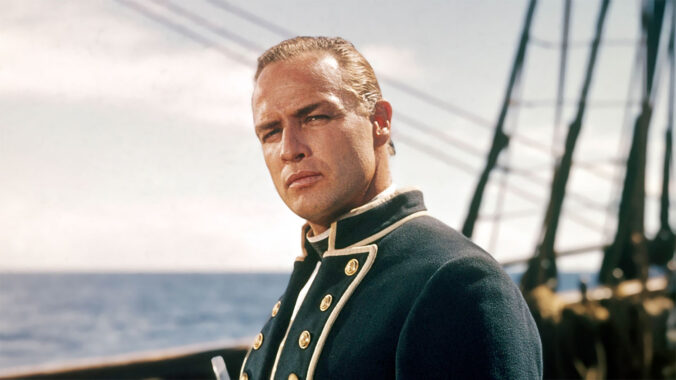
Lewis Milestone’s 1962 Mutiny on the Bounty remake, with Marlon Brando as Christian and Trevor Howard as Bligh, arrives with big CinemaScope prestige but a strangely diffused point of view. Brando’s Christian is whimsical, ironic, and detached, a proto-counterculture figure who seems less tortured than bored. Howard’s Bligh is more controlled than Laughton’s but still rigidly villainous, echoing the novel’s version more than historical analysis. The film leans heavily into Tahiti as an exotic paradise, extending the love story but weakening narrative momentum.

The result is handsome, intermittently fascinating, but tonally inconsistent. Brando’s eccentric performance, though engaging, sometimes pulls the story toward satire, while the script seeks to retain classic moral seriousness. It neither fully humanizes Bligh nor fully dramatizes the mutiny as a tragic inevitability. Historically, it remains in the same mythic register as the 1935 film, but without its sharp dramatic spine.

Roger Donaldson’s 1984 film, The Bounty, starring Mel Gibson as Christian and Anthony Hopkins as Bligh, marks the first major adaptation to challenge the established myth. Drawing on more recent scholarship and using Bligh’s own writings as inspiration, it reframes the mutiny as a clash of flawed personalities rather than a simple tale of tyranny.

Hopkins’s Bligh is not sadistic but disciplined, overbearing, ambitious, and socially insecure. He is capable of kindness but blind to how his rigidity alienates his crew. Gibson’s Christian is not a born revolutionary but an inexperienced young officer emotionally overwhelmed by conflict and guilt. The film foregrounds Bligh’s astonishing 3,600-mile open-boat journey with rare accuracy. Tahiti is portrayed not as Eden but as a complex society whose allure and cultural differences unsettle the crew’s discipline.

This version incorporates contradictions rather than ironing them out. It acknowledges that the mutineers gave wildly inconsistent explanations, that Bligh’s harshness was real but within the norms of the era, and that Christian’s motives remain opaque. As storytelling, it is more muted, less swashbuckling, but also far more psychologically credible. And, unfortunately, not as interesting.

The truth of the Mutiny on the Bounty lies somewhere between heroism and dysfunction, and between Bligh’s defensiveness and the mutineers’ self-justification. Modern historians tend to see the mutiny as the product of cumulative interpersonal friction, culture shock in Tahiti, Bligh’s abrasive management, and Christian’s psychological instability. This messy human drama resists clean moral binaries.

The saga of the Bounty endures precisely because it resists definitive interpretation. The 1932 novel shaped the mythic template: Bligh the tyrant, Christian the reluctant rebel. The 1935 film amplified this into an iconic melodrama. The 1962 film embellished it with Hollywood exoticism and Brando’s idiosyncrasies. The 1984 film challenged it with a more balanced, psychologically layered approach. Each version reflects the concerns of its era: authoritarian villains in the 1930s, romantic individualism in the 1960s, and distrust of simple moral narratives in the 1980s.

Favorite Horror Novels, 20th century

  • The Haunting of Hill House (1959), by Shirley Jackson
  • Something Wicked This Way Comes (1962), by Ray Bradbury
  • Rosemary’s Baby (1967), by Ira Levin
  • Hell House (1971), by Richard Matheson
  • The Mist (1980), by Stephen King
  • The Cellar (1980), by Richard Laymon

Favorite Horror Novels, 18th/19th century

  • History of the Caliph Vathek (1786), by William Beckford
  • The Monk (1796), by Matthew Gregory Lewis
  • Frankenstein (1818), by Mary Shelley
  • Melmoth the Wanderer (1820), by Charles Maturin
  • Varney, the Vampire (1847), by Thomas Prest
  • Carmilla (1872), by Sheridan Le Fanu
  • Strange Case of Dr Jekyll and Mr Hyde (1886), by Robert Louis Stevenson
  • The Picture of Dorian Gray (1890), by Oscar Wilde
  • Dracula (1897), by Bram Stoker
  • The Turn of the Screw (1898), by Henry James

Manchurian Candidates

Richard Condon’s The Manchurian Candidate is one of the defining Cold War thrillers of American literature. Published in 1959, it captures a world of paranoia, espionage, and ideological extremism at the height of the Red Scare. The novel follows Sergeant Raymond Shaw, a decorated Korean War veteran who, unbeknownst to himself, has been brainwashed by Communist agents into becoming an unwitting assassin. The real tragedy (and brilliance) of Condon’s construction is that Shaw’s mother, Eleanor Iselin, is the true villain: an ambitious, ruthless woman who manipulates both her son and her husband, Senator John Iselin, a demagogic McCarthy caricature, to seize political power.

Condon’s prose is cynical and darkly humorous. His world is one where politics is theatre, patriotism a mask for greed, and psychological control the ultimate weapon. The book’s central concept, the creation of a sleeper assassin through brainwashing, tapped directly into Cold War fears about Communist mind control and the fragility of individual will. It is both satire and nightmare, a vision of America’s self-destruction through hysteria and manipulation. The novel’s mix of political cynicism, psychological horror, and sexual tension (especially the quasi-incestuous relationship between Shaw and his mother) gives it a lingering unease that transcends its pulp roots.

John Frankenheimer’s The Manchurian Candidate (1962), starring Frank Sinatra, Laurence Harvey, and Angela Lansbury, was the first screen adaptation of the novel, and is remarkably faithful in tone to Condon’s original, even as it alters several key details. The setting remains within the Cold War, with the Communist conspiracy intact, but Frankenheimer reshapes the story for cinematic clarity and impact.

The film drops much of Condon’s verbose narration and focuses on stark, paranoid visuals and taut performances. Laurence Harvey’s Raymond Shaw is a more tragic, wounded figure than in the book, while Angela Lansbury’s portrayal of Eleanor Iselin is chilling, a manipulative political matriarch who weaponizes maternal affection for control. Her relationship with Shaw remains disturbing, though Frankenheimer’s film makes it more symbolic than explicit.

The satire of McCarthyism is sharpened: Senator Iselin becomes an obvious buffoon, his hysteria exploited by his wife for her own Machiavellian ambitions. The eerie brainwashing sequences, shot with dreamlike cross-cutting between a genteel ladies’ tea and a Communist demonstration, remain some of the most haunting scenes in American cinema in the sixties. Frankenheimer’s film ends on a tragic note, with Shaw breaking free of his conditioning just long enough to stop the assassination but sacrificing himself in the process, a finale that feels more moral and cathartic than Condon’s more cynical ending. The movie is both a product and a critique of its time, when Americans feared both Communist infiltration and their own government’s capacity for manipulation.

Jonathan Demme’s 2004 remake reimagines The Manchurian Candidate for a post–Cold War, post–Gulf War world of corporate power and digital control. The Communist brainwashers are gone. In their place stands Manchurian Global, a multinational conglomerate symbolizing the new face of power: corporate, financial, and global rather than ideological.

Here, the soldiers were captured during the Gulf War, and the brainwashing is achieved not through crude psychological techniques but through biotechnology and microchip implants. The shift mirrors the new century’s fears: not of Communist ideology, but of corporate totalitarianism, surveillance, and technological control. Raymond Shaw (Liev Schreiber) is now a congressman and war hero groomed for the vice presidency, while Denzel Washington’s character (renamed Major Ben Marco) becomes the paranoid veteran uncovering the truth. Meryl Streep’s Eleanor Shaw is modeled less on McCarthy-era figures than on modern political dynasties, her mix of maternal warmth and icy calculation evokes Hillary Clinton as filtered through Lady Macbeth.

The 2004 version trades Cold War dread for corporate conspiracy and biotechnology anxiety. It is slickly directed and well-acted, but its atmosphere of dread feels more diffuse. The brainwashing, once shocking, now feels metaphorical: a commentary on media control, marketing, and mass manipulation. Yet it lacks the biting satire of the novel or the surreal power of Frankenheimer’s film. Its conclusion, in which the brainwashing plot is uncovered by the authorities but kept secret from the public, attempts some sort of closure but can feel naive at certain points, and never reaches the tragic resonance of 1962’s climax.

As a story, the novel remains the most conceptually rich and biting. It captures the spirit of Cold War cynicism with vicious humor and invention. But Frankenheimer’s 1962 adaptation is the most engaging and entertaining, a perfect marriage of paranoia, late noir aesthetics, and tragedy. Its sharp political satire and unforgettable performances give it enduring power.

Dickens, Poe, and the Impressively Large Raven

In one of my weekend trips to Philadelphia, I went to the Parkway Central Library to visit Grip. If you are a reader of Charles Dickens or Edgar Allan Poe you may know a thing or two about him.

In 1941, Charles Dickens published the novel Barnaby Rudge, which had been serialized in the same year in his own weekly periodical Master Humphrey’s Clock. As a companion to the title character, Dickens added a large and talkative raven called Grip. His idea, expressed in a letter to a friend, was to make the bird “immeasurably more knowing” than the protagonist. Grip is often described in the book with almost human attributes, like when he is listening to a conversation “with a polite attention and a most extraordinary appearance of comprehending every word, to all they had said up to this point; turning his head from one to the other, as if his office were to judge between them, and it were of the very last importance that he should not lose a word”. One of my favorite bits offers an amusing account of his movements: “he fluttered to the floor, and went to Barnaby — not in a hop, or walk, or run, but in a pace like that of a very particular gentleman with exceedingly tight boots on, trying to walk fast over loose pebbles”.

Dickens explains in the preface to Barnaby Rudge that Grip was a composite of two ravens that he had owned. The first one lived in the stable and terrorized the dog, often stealing his dinner. Unfortunately, when the stable was being painted, he also decided to steal and eat the paint. He died of lead poisoning. Hearing of this sad loss, a friend sent another raven to Dickens, this one “older and more gifted”. The second bird also made the stable his home but habitually explored a larger area. “Once, I met him unexpectedly, about half-a-mile from my house, walking down the middle of a public street, attended by a pretty large crowd, and spontaneously exhibiting the whole of his accomplishments.” He died after three years or so, and since then Dickens was, to use his own word, ravenless.

Both ravens were called Grip, so it’s unclear which one Dickens decided to have stuffed and mounted in a somewhat grandiose display box. Saved for posterity in taxidermic splendor, Grip was auctioned after the author’s death and changed hands a few times before taking residence in Philadelphia.

It was a cold Saturday morning when I took the elevator to the almost empty third floor of the Parkway Central Library. The security guard was getting ready to eat his breakfast burrito and ushered me in with a nod of this head. I traveled the L-shaped corridor of the Rare Books Department, surrounded by old volumes locked behind the glass doors and observed by a few solemn statues: two versions of Johannes Gutenberg, with and without his hat, and a magnificently bearded Charles Dickens at age fifty-seven. Around the corner, at the end of the hall, there he was, Grip, surprisingly large and ominously black. The bird is, indeed, impressive, and suggests, even in death, the imposing presence it may have had in life.

Grip is in an elaborate glass and wood box, which was placed inside another glass box. This arrangement creates a system of unwanted reflections, frustrating to casual photographers. The kind librarian who was on early duty that day saw me struggling to get a good angle and, unable to help me solve that particular problem, decided to offer me something else. She unlocked the Elkins Room and invited me to spend some time there.

William McIntire Elkins was a collector of rare books with a particular predilection for Dickens. He bequeathed his collection to the Free Library of Philadelphia, and when he died in 1947 his whole reading room, complete with books and shelves, tapestries and chandeliers, and even a fireplace, was moved to the Parkway Central Library. One of the most precious objects in this beautiful personal library is the writing table used by Charles Dickens from 1837 up to his death in 1870. There it was, small but elegant. On the worn surface, as if to leave no doubt who it had belonged to, the initials C.D. roughly chiseled by the author himself.

But back to Grip. I don’t think I have ever seen a raven that big, stuffed or not. It’s fun to imagine how meeting a live bird of that size, moving and talking, would have been an impressive experience. It captivated Dickens’s imagination and, via the printed page, reached another author on the other side of the ocean, Edgar Allan Poe.

Grip may not be the direct inspiration for The Raven, one of the most famous poems in the English language (and other languages as well, translated to French by Charles Baudelaire and by Stéphane Mallarmé, and to Portuguese by by Machado de Assis and by Fernando Pessoa, just to mention a few respected names) but it certainly had some influence over Edgar Allan Poe.

Poe was not only familiar with Barnaby Rudge but also wrote a full review of the book for Graham’s Magazine in 1842. “The raven, too, intensely amusing as it is, might have been made, more than we now see it, a portion of the conception of the fantastic Barnaby.” Apparently, Poe would have preferred a stronger connection between Grip and Barnaby. “Each might have differed remarkably from the other. Yet between them there might have been wrought an analogical resemblance, and, although each might have existed apart, they might have formed together a whole which would have been imperfect in the absence of either.” Poe’s The Raven was published in 1845.

At certain point in Barnaby Rudge, two characters are talking about the raven. One of them asks “What was that? Him tapping at the door?”, while the other responds “It was in the street, I think. Hark! Yes. There again! ‘Tis some one knocking softly at the shutter.” And in the first few verses of The Raven we can find “While I nodded, nearly napping, suddenly there came a tapping, / As of some one gently rapping, rapping at my chamber door. / ’Tis some visitor, I muttered, tapping at my chamber door— / Only this and nothing more.” Inspiration? Coincidence? Unrelated?

The Raven is one of the most celebrated literary pieces in history, and inspired all kinds of homages, from Freddie Mercury singing Nevermore to Bart Simpson transmuted into a raven in Treehouse of Horror, and not forgetting, of course, the Baltimore Ravens, Super Bowl champions of 2000 and 2012. One of my favorite weird connections is Paul Gauguin’s painting Nevermore, a reclined female nude with a raven in the background next to the word “nevermore”. For some obscure reason, Gauguin denied the obvious association with Poe’s poem and claimed he meant the raven to be just a symbol for the devil. Curiously, the first time Grip appears in Barnaby Rudge he seems to enjoy repeating “I’m a devil, I’m a devil, I’m a devil. Hurrah!”

Dickens fan, or Poe fan, or just curious to see an impressively large stuffed raven? Go to Philadelphia and visit Grip. He’s a devil.

Gilgamesh, Picard, and the Guy Who Killed Captain Marvel

I hadn’t been intrigued about The Epic of Gilgamesh, the ancient epic poem from Mesopotamia, until the coincidence of seeing, only a few weeks apart, this story featured in both a Star Trek episode and a graphic novel by Jim Starlin.

In Darmok, the second episode of the fifth season of Star Trek: The Next Generation, first televised in 1991, Captain Picard (Patrick Stewart) gets stranded on a planet with Dathon (Paul Winfield), a Tamarian captain. They have trouble communicating with each other because the Tamarian language is based on references to their history and mythology in an allegorical format that could not be captured by the universal translator technology commonly used in similar situations. Picard realizes their communication needs to rely on mutual knowledge of legends and tries to understand Dathon’s storytelling and tell him stories from Earth’s mythology. And the tale he chooses to narrate is the one about Gilgamesh and Enkidu, first fighting against each other and later fighting together against a common enemy. It’s a good representation of the adventures of the two captains on that hostile planet, the same as Dathon’s story about Tamarian heroes Darmok and Jalad.

Darmok is the kind of episode that makes Star Trek: The Next Generation such a compelling television series. It’s about solving problems with your brain rather than your muscles, and it’s about the power of communication. As the good captain says, “In my experience, communication is a matter of patience and imagination. I would like to believe that these are qualities that we have in sufficient measure.” (Jean-Luc Picard is, of course, the best captain in the Star Trek universe. But that’s a story for another time.)

Gilgamesh II was published a couple of years before this episode of Star Trek, but I only found it in a bookstore a few weeks after watching Darmok. The author’s name immediately made me interested in the graphic novel. Among his many feats, Jim Starlin co-created Shang-Chi, aka the Master of Kung Fu, one of my favorite heroes as a kid, and authored a graphic novel that shook up the universe of superheroes in the early eighties, The Death of Captain Marvel. In the four 48-page issues of Gilgamesh II, Starlin reimagines the Mesopotamian story as a science-fiction tale, with the two heroes presented as extraterrestrials living in a future Earth.

Starlin doesn’t deviate much from the original plot and doesn’t add any deep reflections on the ancient tale. Instead, he offers a version of what the story of Gilgamesh could have been if created as a contemporary graphic novel. Or, more specifically, as a graphic novel from the eighties, infused with superhero lore (the arrival of Gilgamesh’s capsule on Earth is basically a retelling of Superman’s origin story) and complete with passages about sex and drugs (checking the box for “this is not your old childish comic book, this stuff is for adults”) and greedy corporations destroying the environment (checking the box for “hey, we have a political message too”).

With Gilgamesh references flying at me from both the tv screen and the pages of graphic novels, I decided it was time to read the real thing. Not the original clay tablets written in cuneiform from around 2000 BCE (that exist in several versions, from which the combined fragments form the version we have translated to contemporary languages), but as an English adaptation. For the record, the first time I read The Epic of Gilgamesh, a long time ago, it was in a translation by archeologist Nancy K. Sandars, and the second time, more recently, in the translation by Andrew George, professor of Babylonian at the University of London.

The Epic of Gilgamesh can be read just as a story of adventure. It has a larger-than-life hero (literally), monumental fights against monsters (with impressive names like Humbaba, the giant guardian of the Cedar Forest, and Gugalanna, the Great Bull of Heaven), death and distress, and a journey of self-discovery. But for me what makes it more engrossing is the abundance of themes that would later be reused, redeveloped and reimagined, again and again, in narratives from different cultures. In Gilgamesh, we can see hints of Achilles and Odysseus, and these heroes share several similar episodes. There are even homologous metaphors about a lion and its missing cubs used for grieving the deaths of Patroclus in the Iliad and Enkidu in The Epic of Gilgamesh. And, of course, multiple elements from The Epic of Gilgamesh reappear in the Bible, from Enkidu being created from clay by the goddess Aruru and living in the woods with the animals until seduced by a woman and taken away from there (which may seem somewhat similar to Adam’s origin story in the Book of Genesis) to the story of a great flood told to Gilgamesh by the immortal Utnapishti (which is so close to the biblical story of Noah’s ark that it’s unlikely it wasn’t its source of inspiration). And for someone willing to stretch the comparisons a bit more, we could even point to a bit of Hegelian dialectic in the story: Gilgamesh, the king of Uruk oppressing his people, stands as the thesis that gives rise to a reaction; Enkidu, the wild man sent by the gods to stop him, serves as the antithesis that opposes the thesis; and the battle between the two resolves the tension and generates the team of heroes as the synthesis.

At the end of his saga, Gilgamesh goes on a journey searching for immortality and learns that this is something he cannot have. But even though he didn’t get eternal life in the physical sense The Epic of Gilgamesh has kept his name alive for thousands of years, and his thematically rich adventures keep influencing our storytelling.

« Older posts Newer posts »

© 2026 Zander Dulac

Theme by Anders NorenUp ↑