Tag: graphic novels (Page 1 of 2)

The First Creepy

In the late 1950s, American horror comics were effectively dead, or so it seemed. The moral panic that followed the publication of Seduction of the Innocent and the subsequent creation of the Comics Code Authority had wiped out the most creative and subversive publishers of the previous decade, most notably EC Comics. The lurid, poetic, and morally cruel horror stories of Tales from the Crypt, The Vault of Horror, and The Haunt of Fear vanished almost overnight, taking with them an entire generation of writers and artists who had perfected the form.

One man saw opportunity where others saw only a graveyard. James Warren, head of Warren Publishing, had already achieved unexpected success with Famous Monsters of Filmland. That magazine, launched in 1958 and edited by Forrest J Ackerman, proved that there was a large, underserved audience hungry for horror, not just in sanitized, Code-approved form, but in its full gothic, macabre glory. Importantly, Famous Monsters was not a comic book. It was a magazine.
That distinction mattered enormously. Magazines were exempt from the Comics Code. They could depict horror, death, irony, and moral ambiguity without oversight. Warren realized that by publishing a horror comic in magazine format, he could revive EC’s spirit without running afoul of censorship. It was a bold gamble, but one rooted in a shrewd understanding of both the law and the audience.

To make this new venture viable, Warren needed more than a loophole, he required talent. And the talent was waiting. Many of the finest creators from EC had been underemployed or forced into other genres since the collapse of the horror market. Creepy would become their refuge. Writers like Archie Goodwin, whose elegant, economical scripts would soon define the magazine’s tone, and artists such as Joe Orlando, Jack Davis, Reed Crandall, and Frank Frazetta found themselves reunited in spirit, if not in name, with the EC tradition.

The magazine format itself shaped what Creepy would become. Larger pages allowed for more ambitious layouts and more breathing room in the artwork. Black-and-white printing, often seen as a limitation, turned out to be a strength. Freed from the garish color separations of 1950s comics, artists leaned into atmosphere: heavy shadows, stark contrasts, and finely modulated grays. Horror in Creepy was no longer about shock alone: it was about mood, dread, and inevitability. The influence of classic illustration, pulp magazines, and even film noir is visible on nearly every page.

In short, Creepy was not conceived as a nostalgic revival but as an evolution. It took the narrative cruelty and ironic sting of EC horror, stripped away the juvenile trappings of the comic book format, and re-presented it as something more sophisticated.

When Creepy #1 hit newsstands in early 1964, it announced itself in a way that was, at first glance, almost perverse. Instead of murky shadows, dripping blood, or gothic decay, the cover was bright. Loud, even. On a vivid yellow background, a drawing of almost comical monsters crowded around Uncle Creepy, the host, while he reads from the magazine itself. For something explicitly designed to resurrect serious horror comics, this seemed like a contradiction.

The cover, illustrated by Jack Davis, was a calculated piece of misdirection. Warren Publishing understood the visual language of newsstands. Horror magazines competed for attention against lurid detective pulps, glossy movie magazines, and sensationalist tabloids. A dark, understated cover would have vanished in the visual noise. The shock of color was not a betrayal of horror but a hook: it forced the eye to stop, then invited the reader to discover that the interior was something very different indeed. There was also precedent. EC Comics, for all their macabre sophistication, often used bright, almost cheerful colors on their covers to heighten the contrast between appearance and content. Creepy #1 follows that logic, signaling continuity with EC while updating it for a magazine audience that was older, savvier, and less patient with subtlety on a crowded rack.

Opening the magazine reinforced this dual strategy. The inside front cover introduced Uncle Creepy, the magazine’s host and narrator, rendered against another unexpectedly bright background. Like EC’s Crypt Keeper, Vault Keeper, and the Old Witch before him, Uncle Creepy was a master of ceremonies, a knowing guide through tales of doom and irony. But where EC’s hosts reveled in puns and gallows humor, Uncle Creepy struck a slightly different tone: less manic, more sardonic, more amused than gleeful.

Uncle Creepy was not merely an homage, he was a statement of intent. His presence anchored the magazine in the EC tradition while establishing Creepy as a curated experience rather than a random anthology. Each story was not just presented but introduced, framed by a voice that understood the mechanics of horror (with a disturbing sense of humor) and shared a conspiratorial relationship with the reader. This was horror as performance, with the reader invited backstage.

Visually, the contrast between the cover and the interior could not have been sharper. Once past the opening pages, the magazine plunged into dense black-and-white artwork: heavy shadows, meticulous linework, and a deliberate pacing that trusted the reader’s imagination. The large format allowed for dramatic splash pages and carefully composed panels, while the absence of color pushed artists to emphasize texture, lighting, and facial expression. The result felt closer to classic illustration or cinematic storyboarding than to conventional comic books.

This dissonance, between the lurid, almost playful exterior and the somber, controlled interior, became one of Creepy‘s defining traits. The magazine lured readers in with spectacle, then rewarded them with atmosphere. It was an editorial sleight of hand that worked precisely because it respected its audience’s intelligence. Creepy #1 was saying, in effect: we know what you expect from horror, and we are going to give you something better.

What ultimately justified Warren’s gamble was not the format, the hosts, or the marketing, but the material itself. Creepy #1 does not feel like a tentative experiment. It reads like a confident declaration that serious horror comics were not only viable again, but capable of artistic ambition beyond anything attempted in the 1950s. Each story, while uneven in impact, contributes to that claim. Creepy would show better stories over the years, but this first batch established the foundations for both the writing and the art.

Voodoo, with art by Joe Orlando and story credited to Russ Jones and Bill Pearson (Jones had a history of attaching his name to things he did not create, and his authorship here is contested), opens the magazine with a statement of intent. It draws on colonial anxieties and Western fears of the exotic in a way that is very much of its time, yet unusually restrained. Rather than reveling in caricature, the story uses voodoo as an atmosphere, an unseen, inevitable force that punishes arrogance and exploitation. Orlando’s shadows are oppressive, his compositions deliberate, and his faces expressive without becoming grotesque. The horror is not flashy, it creeps in slowly, accumulating dread rather than delivering shock. As an opening piece, Voodoo reassures the reader that Creepy is not interested in cheap thrills, it wants to unsettle.

H2O World shifts from occult horror to speculative fiction, immediately broadening Creepy’s scope. Larry Ivie’s script explores a familiar EC-style irony: humanity has evolved beyond war, but it’s destined to repeat the same mistakes. The real star is Al Williamson. His clean, almost classical linework gives the alien world a sense of solidity and plausibility. His precision makes the story feel less like fantasy and more like speculative fiction, and the stark black-and-white art enhances the sense of isolation and inevitability. It is horror by implication rather than monstrosity.

Vampires Fly at Dusk, written by Archie Goodwin, is emblematic, from its vampire theme to the ironic twist at the end. Reed Crandall’s classy art, with beautiful hatching, demonstrates perfectly how the intelligent use of black-and-white pencil and ink is well suited to the genre.

Werewolf is historically and artistically pivotal. It is the final multi-page comic-book story illustrated by Frank Frazetta, who would soon become the definitive fantasy cover artist of the late 20th century. The story itself, by Larry Ivie, is spare and almost mythic, focusing less on plot than on mood and transformation. Frazetta’s art dominates every page. His figures feel sculpted rather than drawn, his use of black space heavy and tactile. The werewolf is not merely a monster but an embodiment of primal violence and fatalism. Even by modern standards, the imagery feels powerful.

Bewitched returns to psychological horror, centering on obsession, manipulation, and self-delusion. Larry Ivie’s script is economical, almost cruel in its withholding of sympathy from its protagonist. Gray Morrow brings a sleek, modern sensibility to the story. His figures are elegant, his compositions clean, and his women particularly expressive. The horror here is internal rather than supernatural, and Morrow’s polished style reinforces that shift.

Success Story is the issue’s sharpest satire. A thinly veiled attack on Don Sherwood and his notorious use of ghost writers and ghost artists, most famously in Dan Flagg, the story skewers narcissism and exploitation with barely disguised contempt. Goodwin’s script is biting, and Al Williamson matches it with sleek, cinematic visuals. Williamson’s mastery of pacing and facial expression makes the satire sting. The supernatural element feels almost secondary, the real horror is professional cynicism and moral emptiness. Curiously, Williamson drew the characters to resemble himself, Archie Goodwin, and artist Angelo Torres.

Closing the issue, Pursuit of the Vampire, written by Archie Goodwin and illustrated by Angelo Torres, feels like a deliberate echo of classic EC morality tales. The hunter and the hunted blur, and the story builds toward an ending that feels less like a twist than an unavoidable reckoning. Torres’s art follows a similar style to Reed Crandall in Vampires Fly at Dusk, almost as if vampires attract dark shadows and beautiful hatching.

Taken together, the stories of Creepy #1 form an astonishingly cohesive debut. There is a range (occult, science fiction, satire, gothic), but also a consistent intelligence and confidence. This was not a revival act, tentatively feeling its way forward. It was a statement. If Creepy #1 had failed, it would today be remembered as a curious footnote: a brave but doomed attempt to revive a form that history had already buried. Instead, it succeeded, and in doing so, reshaped the landscape of American horror comics for more than two decades.

Yet More Dungeons & Dragons Superheroes

Some people asked me if all my superhero conversions to Dungeons & Dragons were from Marvel characters. Well, here is a batch of DC characters adapted to the world of Faerûn.

Batman
Race: Human
Class: Rogue (Inquisitive) / Monk (Shadow)

  • Batman’s defining trait is that he is only human. No divine blood, no arcane mutation, just discipline, preparation, and will. In D&D terms, humans best represent relentless self-perfection and adaptability. His legend is built, not inherited.
  • Inquisitive Rogue represents investigation, deduction, and battlefield awareness.
  • Way of Shadow Monk provides stealth, sudden mobility, and fear-based presence.
  • Special ability: Prepared for Everything – once per long rest, Batman may declare that he anticipated a specific threat, gaining advantage on all rolls against it for one encounter.
Green Arrow
Race: Half-Elf
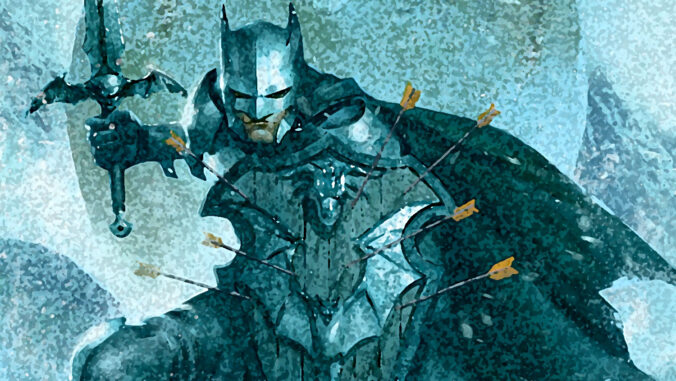
Class: Ranger (Hunter) / Fighter (Battle Master)

  • Half-elves bridge civilization and wilderness, nobility and exile. Green Arrow’s identity as both privileged aristocrat and hardened survivor fits this duality perfectly.
  • Ranger grants tracking, survival, and precision archery.
  • Battle Master Fighter allows trick shots, disarming strikes, and battlefield control.
  • Special Ability: Trick Shot Arsenal – once per turn, he may apply a maneuver effect to a ranged attack without expending superiority dice (limited uses per rest), representing specialized arrows.

The Flash
Race: Air Genasi
Class: Monk (Way of the Open Hand)

  • Air Genasi embody speed, motion, and elemental wind. Flash’s powers become a mystical attunement to the Plane of Air, not temporal science.
  • Monks already operate beyond normal physical limits. Open Hand emphasizes speed, control, and battlefield repositioning without overt magic. Ki becomes velocity mastery.
  • Special Ability: Blinkstep – he may move through enemy spaces without provoking opportunity attacks and can take the Dash action as a bonus action every round, flavored as near-teleportation.

Catwoman
Race: Tabaxi
Class: Rogue (Thief)

  • Tabaxi are natural climbers, agile, curious, and feline in demeanor.
  • Thief Rogues excel at climbing, stealing, infiltration, and improvisation. Catwoman avoids combat when possible and escapes when necessary — she survives by skill, not force.
  • Special Ability: Cat’s Escape – once per short rest, she may disengage, dash, and hide in a single turn, even in plain sight, representing uncanny agility and misdirection.

Wonder Woman
Race: Aasimar (Protector)
Class: Paladin (Oath of Glory)

  • Wonder Woman is explicitly divine-touched. Aasimar provide celestial heritage without full godhood, preserving her role as both champion and bridge between worlds.
  • Oath of Glory champions heroism, strength, and inspiration. She is not a crusader or zealot, she is a living ideal. Her combat prowess and moral clarity are inseparable.
  • Special Ability: Lasso of Sacred Truth – a divine relic that compels honesty and restrains foes. Mechanically, creatures restrained by the lasso cannot lie or benefit from illusion effects.

Green Lantern
Race: Elf (High or Astral)
Class: Paladin (Oath of the Watchers)

  • Elves embody discipline, focus, and long-term commitment. Their calm emotional control contrasts perfectly with the raw willpower required of a Green Lantern analogue.
  • Watchers Paladins defend reality itself from extraplanar threats. Their power is fueled by vigilance and resolve, a perfect analog for will-powered constructs.
  • Special Ability: Ring of Living Light – a sentient relic that creates spectral constructs (weapons, barriers, tools) limited only by the wielder’s concentration and imagination. Constructs vanish if the wielder’s concentration falters.

Dungeons & Dragons Supervillains

In my last batch of Dungeons & Dragons superheroes, I included one supervillain. Here are a few more, for your roleplaying adventures.

Magneto
Race: Mountain Dwarf (Arcane-Touched)
Class: Wizard (Graviturgy or Transmutation)

  • Dwarves are intrinsically tied to metal, stone, and craftsmanship.
  • Graviturgy represents attraction, repulsion, and control of mass, a good mechanical translation of magnetism without modern physics.
  • Transmutation reinforces his ability to reshape metal, weapons, and terrain.
  • Wizardry also emphasizes Magneto’s intellect, planning, and ideological certainty rather than brute force.
  • Signature ability: Metal Dominion – can disarm entire armies by wrenching steel from their hands.

Loki
Race: Changeling or Eladrin
Class: Warlock (Archfey) / Bard (College of Whispers)

  • Changelings embody literal shapeshifting, while Eladrin represent emotional transformation and Fey capriciousness.
  • Both races reinforce Loki’s role as someone who cannot be pinned down, physically or morally, and whose very nature is instability.
  • Archfey warlocks gain power from ancient, inscrutable entities, perfect for a trickster godling bound to higher Fey courts.
  • College of Whispers allows Loki to weaponize secrets, fear, and narrative manipulation rather than direct confrontation.
  • Signature ability: Silver Tongue – deals psychic damage through whispered lies.

Red Skull
Race: Undead (Revenant or Lich-bound Human)
Class: Oathbreaker Paladin / Death Cleric

  • Red Skull represents the death of humanity in service of ideology. Making him undead externalizes that transformation: his ideals outlived his flesh.
  • A revenant fits his relentless obsession.
  • A lich-bound human fits his use of forbidden relics to transcend mortality without becoming fully independent.
  • Oathbreaker reflects betrayal of moral law, while Death Cleric reinforces his use of necromancy, relic worship, and cult leadership.
  • Signature ability: Aura of Zealotry – allies cannot be frightened or charmed.

Green Goblin
Race: Goblin (Alchemically Altered)
Class: Artificer (Alchemist) / Rogue (Arcane Trickster)

  • Goblins already embody chaos, cunning, and volatility. By enhancing one through alchemical mutation, the Green Goblin becomes a what-if brilliant goblin amplified past sanity.
  • Alchemist artificers create volatile elixirs, mutagens, and bombs. Goblin magic distilled into science-adjacent fantasy.
  • Rogue levels emphasize mobility, cruelty, and surprise attacks.
  • Arcane Trickster adds illusion and misdirection, reinforcing his love of spectacle and psychological warfare.
  • Signature ability: Mad Elixirs – explosive potions, mutagens, fear toxins.

Doctor Octopus
Race: Human
Class: Wizard (Conjuration) / Artificer (Battle Smith)

  • A brilliant arcanist whose body was permanently fused with four sentient arcane constructs, originally designed to aid research in dangerous planar breaches.
  • Conjuration governs control, summoning, and battlefield manipulation, ideal for autonomous arcane limbs.
  • Battle Smith allows intelligent constructs and mechanical companions that blur the line between tool and partner.
  • Signature ability: Arcane Limbs – autonomous grappling arms with limited sentience.

More Dungeons & Dragons Superheroes

For those who enjoyed my medieval D&D superheroes (and asked for more), here is a new batch, around the Fantastic Four theme.

Invisible Woman
Race: High Elf
Class: Wizard (Abjuration)

  • Abjurers create protective shields, perfect analog to Sue’s forcefields.
  • High Elves have innate magical talent.
  • Her invisibility is classic arcane magic, but flavored as bending light via abjuration barriers.
  • Signature ability: Veil Dome – a nearly transparent arcane sphere that blocks damage, mimicking the classic force bubble.

Mister Fantastic
Race: Simic Hybrid or Changeling
Class: Wizard (Transmutation)

  • Simic Hybrids allow biomagical adaptations. Changelings allow body reshaping. Either fits.
  • Transmutation magic fits his scientific, experimental nature.
  • His stretchiness is a result of alchemically altered flesh by years of magical experimentation.
  • Signature ability: Elastic Form – cast Alter Self with extended reach and grappling capabilities.

Human Torch
Race: Fire Genasi
Class: Sorcerer (Draconic Bloodline – Red Dragon)

  • Fire Genasi literally manifest fire from their bodies.
  • Draconic bloodline gives elemental resistance and enhances fire spells.
  • Flying when aflame is flavored as pyrokinetic propulsion mixed with sorcerous wings.
  • Signature ability: Blazing Nova – a detonation of fire surrounding him, like Human Torch’s flame-on burst.

Thing
Race: Earth Genasi
Class: Fighter (Rune Knight)

  • Earth Genasi already look rocky and sturdy, Ben Grimm in D&D form.
  • Rune Knight gives growth (Giant’s Might), strength boosts, and protective runes.
  • His transformation comes from a botched giants’ rune rite, leaving him permanently stone-skinned.
  • Signature ability: Stonebreaker Mode – activate Giant’s Might and Stone’s Endurance for immense physical dominance.

Doctor Doom
Race: Human (Variant or Standard)
Class: Wizard (School of War Magic) / Artificer (Armorer)

  • War Magic Wizard reflects Doom’s combat-ready spellcasting, tactical brilliance, and refusal to be caught unprepared.
  • Armorer Artificer represents his iconic enchanted armor, not a gadget, but a runic exosuit powered by bound elementals and arcane sigils.
  • Signature ability: Iron Will of Doom – advantage on all saving throws against charm, fear, and domination effects. Doom’s mind does not bend.

Silver Surfer
Race: Astral Elf
Class: Paladin (Oath of the Watchers)

  • Astral Elves come from the Astral Sea, a perfect cosmic origin.
  • Watchers Paladins defend the world from extraplanar threats, just like Norrin Radd defending the universe.
  • His surfboard becomes a living astral construct that allows hovering and planar travel.
  • Signature ability: Astral Glide – move by riding a star-light platform, functionally similar to Fly.

Should I publish more characters?

Dungeons & Dragons Superheroes

I recently played in a short Dungeons & Dragons campaign in which all the characters had to be inspired by classic superheroes, adapted to the medieval fantasy world of Faerûn. I liked the idea so much that I ended up creating a whole list of characters, and having much fun with it. Here are a few of them. The best part is that, if you don’t like my versions of these super-adventurers, you can just create your own.

Spider-Man
Race: Wood Elf
Class: Monk (Open Hand) with a 1–3 level dip in Rogue (Scout)

  • Wood elves have the agility, speed, and keen senses that parallel Spider-Man’s reflexes.
  • Monk gives him Quickened Movement, Unarmored Defense, and high mobility, perfect for wall-running, leaping, tumbling through enemies.
  • Open Hand techniques mimic web-trip, push, and stun effects.
  • Rogue (Scout) represents his urban acrobatics, ambush instincts, and mobility in the alleyways of a fantasy city.
  • His webbing becomes Ki-infused silk ropes produced by magical spiders he once saved in an elven ruin.
  • Signature ability: Silk Line Step – spend 1 Ki to lash a spectral silk line onto a surface and pull yourself as if casting Misty Step.

Wolverine
Race: Mountain Dwarf
Class: Barbarian (Zealot)

  • Dwarves are hardy, stubborn, and famously difficult to kill, perfect for Wolverine.
  • Zealot’s damage resistance and “nearly impossible to kill” nature works like a healing factor.
  • His claws become black-iron dwarven claw bracers, forged as a hereditary weapon.
  • Berserker rage mimics Wolverine’s ferocity.
  • Signature ability: Blackclaw Frenzy – rage activates his ancestral magic, causing the claws to extend and glow with runic fire.

Captain America
Race: Variant Human
Class: Paladin (Devotion)

  • Devotion Paladins embody justice, righteousness, courage.
  • Shield mastery parallels Cap’s iconic combat style.
  • His shield is a blessed relic of a bygone holy order, magically returning to his hand once per round.
  • The super soldier serum is replaced with a divine ritual granting enhanced physical ability.
  • Signature ability: Aegis Throw – throw the shield as a ranged spell attack that ricochets between enemies via divine light.

Iron Man
Race: Rock Gnome
Class: Artificer (Armorer)

  • Artificers literally build magical suits of armor, exactly like Tony Stark but medieval.
  • Rock gnomes have tinkering instincts and a talent for small, intricate mechanisms.
  • His arc reactor becomes a bound elemental shard powering the armor.
  • The suit can switch between Guardian (tank) and Infiltrator (ranged) modes.
  • Signature ability: Elemental Heart Beam – a lightning spell cast through the suit’s chest-crystal.

Hulk
Race: Goliath
Class: Barbarian (Berserker) with 1–2 Druid levels

  • The Hulk is a rage-fueled transformation, and Barbarians already do that.
  • Goliaths are huge, muscular, and tied to elemental/giant heritage.
  • The Druid twist: his rage is a giant-spirit possession, not radiation.
  • His Hulk form is simply his rage pushing him into magically-enhanced size and strength (like Enlarge).
  • Signature ability: Fury of the Mountain King – while raging, he grows a size category and deals extra bludgeoning damage.

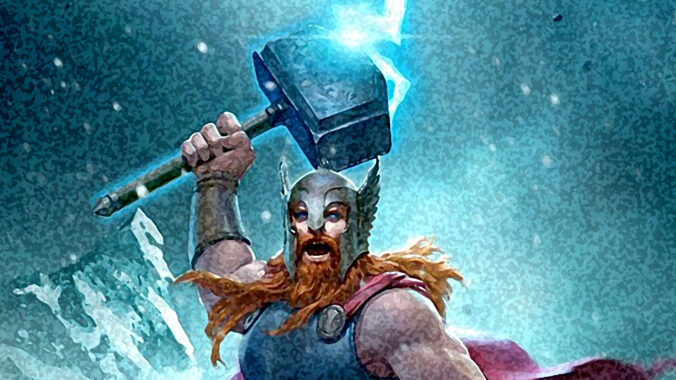
Thor
Race: Protector Aasimar
Class: Cleric (Tempest)

  • Tempest Clerics literally channel thunder, lightning, and divine storms.
  • Aasimar fits the demigod archetype.
  • His hammer is a sentient storm-spirit weapon, not a piece of technology.
  • Divine retribution mimics Mjolnir’s lightning strikes.
  • Signature ability: Stormcaller’s Leap – teleport short distances in a burst of lightning (mechanically: Thunder Step).

Doctor Strange
Race: Human
Class: Wizard (Order of Scribes)

  • Strange is a scholar-mage first and foremost.
  • Scribes Wizards manipulate spellbooks, alter spells on the fly, and conjure spectral script, very Strange-like.
  • His Eye of Agamotto becomes an Ancient Glyph Key, a relic from an extinct wizard order that bends time and space.
  • Signature ability: Many-Gated Mirror – cast Misty Step, Dimension Door, or Arcane Gate through floating runic portals.

I hope you enjoy these medieval superheroes (perhaps even play some of them). I may publish more characters later.

Three Dredds

I’ve recently had the chance to see two movies I had never seen, Judge Dredd (Danny Cannon, 1995) and Dredd (Pete Travis, 2012). They are both adaptations of the comic strip Judge Dredd, but they differ significantly from each other.

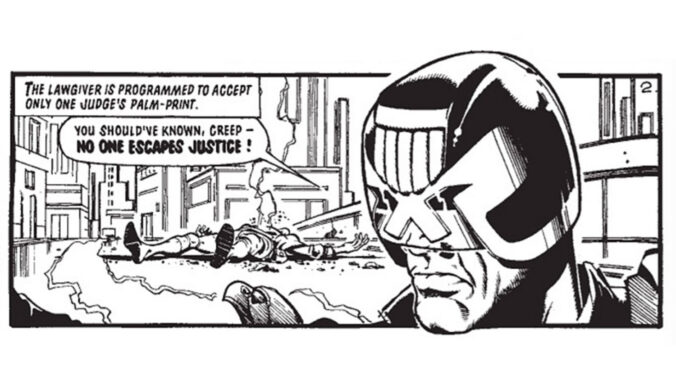
Judge Dredd first appeared in 1977 in 2000 AD, a British weekly anthology comic, created by writer John Wagner and artist Carlos Ezquerra. The strip was a reaction against both American superhero excess and the bleak prospects of late-20th-century urban life. The setting, Mega-City One, was a sprawling dystopian metropolis stretching along the American eastern seaboard, plagued by crime, unemployment, and social decay.

Dredd himself was conceived as the ultimate law enforcer: judge, jury, and executioner rolled into one. He wore a militaristic uniform with oversized pauldrons, hid his face behind a helmet, and spoke in terse, authoritarian commands. The character was never meant to be a hero in the traditional sense. Instead, the comics satirized authoritarianism, policing, and state power. The world of Judge Dredd is one in which the law is absolute but also absurd, reflecting anxieties about fascism, militarization, and the erosion of civil liberties.

A key point is that Wagner and Ezquerra didn’t present Dredd as purely admirable or purely villainous. He was both protector and oppressor, embodying the contradictions of a society that sacrifices freedom for security. This ambivalence made the strip unique: readers could cheer for Dredd’s brutal efficiency one moment and recoil at his inhumanity the next.

The first significant attempt to bring the character to the screen was the 1995 film, Judge Dredd, directed by Danny Cannon and starring Sylvester Stallone. Hollywood, however, took significant liberties, as it often does. The movie largely abandoned the satirical edge of the comics in favor of a more conventional action hero flick.

Two controversial choices defined this adaptation. First, Stallone removed the helmet for much of the film, undermining one of the character’s essential traits. In the comics, Dredd’s facelessness symbolizes his role as an impersonal instrument of the law. By showing his face, the movie personalized him, trying to turn him into a sympathetic action hero. And then there’s the tone shift. Instead of a biting critique of authoritarian justice, the film leaned on big explosions and campy humor. Rob Schneider’s annoying comic-relief sidekick, created just for the movie, epitomized this tonal mismatch.

The socio-political undertones were diluted. The movie glossed over issues like corruption and cloning, instead favoring an individualistic narrative where Stallone’s Dredd proves his innocence and defeats his evil twin. Rather than questioning the legitimacy of a justice system where one man can sentence citizens on the spot, the film framed Dredd as a misunderstood hero whose authoritarian streak was simply misapplied by others.

This 1995 version attempted to graft the DNA of Judge Dredd onto the template of a mid-90s blockbuster, featuring big sets, one-liners, and uncritical thinking. The satire and ambiguity of the source material were sacrificed in favor of marketable heroics.

Seventeen years later, Pete Travis’s Dredd, with Karl Urban in the title role, corrected many of its predecessor’s missteps. Urban kept the helmet on throughout, preserving the character’s anonymity and symbolism. The tone was stripped down, brutal, and unflinching, definitely closer to the original grim satire.

The film centers on a single day in Mega-City One, with Dredd and rookie Judge Anderson (this character exists in the comics, but is far from being a rookie) trapped in a mega-block under siege by a drug lord, Ma-Ma. The plot is minimalist, almost claustrophobic, but it highlights key elements of the Dredd mythos.

It’s about the system, not the man. Dredd is not a maverick but an avatar of institutional justice. He doesn’t question the system, he enforces it ruthlessly. His humanity is glimpsed only in subtle ways, primarily through his mentorship of Anderson.

Violence is part of the routine. The film portrays violence with a grim realism. The saturation of slow-motion drug sequences contrasts with Dredd’s mechanical efficiency, underscoring the dehumanizing effects of both crime and policing.

There’s always socio-political commentary. While not overtly satirical, the film critiques a society where entire populations are warehoused in high-rise blocks, policed by authoritarian judges. Anderson’s psychic empathy provides a faint counterweight, reminding viewers that the Judges’ system is ultimately inhuman.

Unlike the 1995 movie, Dredd doesn’t try to make its protagonist lovable. He is the law, nothing more, nothing less. The world here is bleak but consistent: when society collapses, authoritarianism fills the vacuum, but at the cost of individuality and compassion.

I found it interesting to compare specific details in the two adaptations, such as Dredd’s uniform and the depictions of Mega-City One. Stalone wears what appears to be a spandex or Lycra bodysuit, which is remarkably close to what we see in the comics. However, on screen, the costumes look theatrical, flashy, and even campy. Instead of intimidating authoritarian uniforms, they read like superhero cosplay. Urban wears leather and Kevlar-style armor, designed to resemble real-world riot gear combined with tactical SWAT outfits. They kept the helmet, badge, shoulder armor, and overall silhouette, but toned down the bright colors and cartoon exaggerations. Boots and gloves are black, the eagle is muted bronze instead of blaring gold, and the armor looks worn and functional. Not comic-accurate in color or extravagance, but they’re far more convincing in a live-action dystopia. We see the same contrast with the environment. The 1995 Mega-City One is highly futuristic, neon-lit, vertical, like Blade Runner on steroids. Numerous CGI cityscapes, flying vehicles, and giant billboards. It looks like an over-designed movie set rather than a chaotic, lived-in society. The 2012 Mega-City One is a grittier, more grounded interpretation. From afar, it appears as a sprawl of crumbling modern cities, with mega-blocks rising like concrete fortresses amid a sea of urban decay. On the ground, it resembles Detroit or Baltimore with added dystopian rot: graffiti, gang-ruled projects, bleak streets. This nails the tone of Mega-City One as a decayed, crime-ridden society on the brink of collapse.

In conclusion, the 1995 movie incorporates some authentic details (clone origin, Rico, Fargo, Mega-City One, Cursed Earth), but reshapes them into a Hollywood-friendly narrative: the wrongly accused hero, the evil twin, the wise mentor, and the comic-relief sidekick. The comics were far more satirical, cynical, and episodic, whereas the movie attempted to mold Dredd into the conventional blockbuster protagonist. The 2012 Dredd doesn’t try to adapt any single classic storyline, instead it condenses the world’s essence into a tight, brutal scenario. It’s more faithful in spirit than the 1995 film because it retains the helmet, the authoritarian tone, and the oppressive city, but it strips away the comic’s satirical absurdity in favor of realism.

Favorite Comic Strips

  • Calvin and Hobbes (Bill Watterson)
  • Dilbert (Scott Adams)
  • Doonesbury (Garry Trudeau)
  • Li’l Abner (Al Capp)
  • FoxTrot (Bill Amend)
  • Mafalda (Quino)
  • Pearls Before Swine (Stephan Pastis)
  • Piratas do Tietê (Laerte)
  • Pogo (Walt Kelly)
  • xkcd (Randall Munroe)

In alphabetical order.

Favorite 2010s Graphic Narrative

  • Daytripper (2010), by Fábio Moon and Gabriel Bá
  • Saga (2012), by Brian K. Vaughan and Fiona Staples
  • Black Science (2013), by Rick Remender and Matteo Scalera
  • East of West (2013), by Jonathan Hickman and Nick Dragotta
  • Bodies (2014), by Si Spencer and several artists
  • Manifest Destiny (2014), by Chris Dingess and Matthew Roberts
  • Black Hammer (2016), by Jeff Lemire and Dean Ormston
  • Curse Words (2018), by Charles Soule and Ryan Browne

In chronological order of first publication.

Favorite 2000s Graphic Narrative

  • Blacksad (2000), by Juan Díaz Canalès and Juanjo Guarnido
  • Y: The Last Man (2002), by Brian K. Vaughan and Pia Guerra
  • The Walking Dead (2003), by Robert Kirkman and Tony Moore
  • All-Star Superman (2005), by Grant Morrison and Frank Quitely
  • Fell (2005), by Warren Ellis and Ben Templesmith
  • Mouse Guard (2006), by David Petersen
  • Criminal (2006), by Ed Brubaker and Sean Phillips
  • The Umbrella Academy (2007), by Gerard Way and Gabriel Bá
  • Locke & Key (2008), by Joe Hill and Gabriel Rodríguez
  • Asterios Polyp (2009), by David Mazzuchelli

In chronological order of first publication.

Favorite 1990s Graphic Narrative

  • Sin City (1991), by Frank Miller
  • Bone (1991), by Jeff Smith
  • Hellboy (1993), by Mike Mignola
  • Strangers in Paradise (1993), by Terry Moore,
  • Les Mondes d’Aldébaran (1994), by Leo
  • Preacher (1995), by Garth Ennis and Steve Dillon
  • Batman: The Long Halloween (1996), by Jeph Loeb and Tim Sale
  • Transmetropolitan (1997), by Warren Ellis and Darick Robertson
  • Road to Perdition (1998), by Max Allan Collins and Richard Piers Rayner
  • The League of Extraordinary Gentlemen (1999), by Alan Moore and Kevin O’Neill

In chronological order of first publication.

« Older posts

© 2026 Zander Dulac

Theme by Anders NorenUp ↑