I hadn’t been intrigued about The Epic of Gilgamesh, the ancient epic poem from Mesopotamia, until the coincidence of seeing, only a few weeks apart, this story featured in both a Star Trek episode and a graphic novel by Jim Starlin.
In Darmok, the second episode of the fifth season of Star Trek: The Next Generation, first televised in 1991, Captain Picard (Patrick Stewart) gets stranded on a planet with Dathon (Paul Winfield), a Tamarian captain. They have trouble communicating with each other because the Tamarian language is based on references to their history and mythology in an allegorical format that could not be captured by the universal translator technology commonly used in similar situations. Picard realizes their communication needs to rely on mutual knowledge of legends and tries to understand Dathon’s storytelling and tell him stories from Earth’s mythology. And the tale he chooses to narrate is the one about Gilgamesh and Enkidu, first fighting against each other and later fighting together against a common enemy. It’s a good representation of the adventures of the two captains on that hostile planet, the same as Dathon’s story about Tamarian heroes Darmok and Jalad.
Darmok is the kind of episode that makes Star Trek: The Next Generation such a compelling television series. It’s about solving problems with your brain rather than your muscles, and it’s about the power of communication. As the good captain says, “In my experience, communication is a matter of patience and imagination. I would like to believe that these are qualities that we have in sufficient measure.” (Jean-Luc Picard is, of course, the best captain in the Star Trek universe. But that’s a story for another time.)
Gilgamesh II was published a couple of years before this episode of Star Trek, but I only found it in a bookstore a few weeks after watching Darmok. The author’s name immediately made me interested in the graphic novel. Among his many feats, Jim Starlin co-created Shang-Chi, aka the Master of Kung Fu, one of my favorite heroes as a kid, and authored a graphic novel that shook up the universe of superheroes in the early eighties, The Death of Captain Marvel. In the four 48-page issues of Gilgamesh II, Starlin reimagines the Mesopotamian story as a science-fiction tale, with the two heroes presented as extraterrestrials living in a future Earth.
Starlin doesn’t deviate much from the original plot and doesn’t add any deep reflections on the ancient tale. Instead, he offers a version of what the story of Gilgamesh could have been if created as a contemporary graphic novel. Or, more specifically, as a graphic novel from the eighties, infused with superhero lore (the arrival of Gilgamesh’s capsule on Earth is basically a retelling of Superman’s origin story) and complete with passages about sex and drugs (checking the box for “this is not your old childish comic book, this stuff is for adults”) and greedy corporations destroying the environment (checking the box for “hey, we have a political message too”).
With Gilgamesh references flying at me from both the tv screen and the pages of graphic novels, I decided it was time to read the real thing. Not the original clay tablets written in cuneiform from around 2000 BCE (that exist in several versions, from which the combined fragments form the version we have translated to contemporary languages), but as an English adaptation. For the record, the first time I read The Epic of Gilgamesh, a long time ago, it was in a translation by archeologist Nancy K. Sandars, and the second time, more recently, in the translation by Andrew George, professor of Babylonian at the University of London.
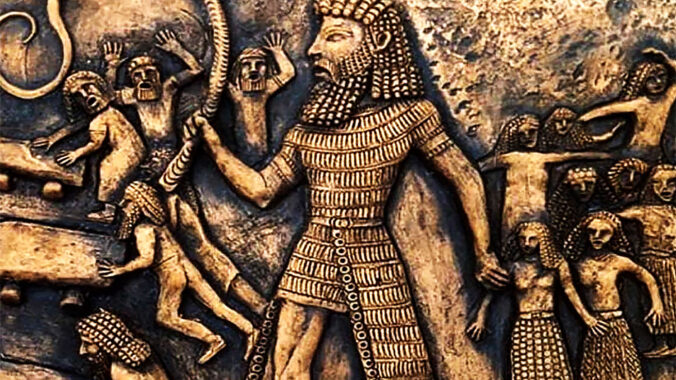
The Epic of Gilgamesh can be read just as a story of adventure. It has a larger-than-life hero (literally), monumental fights against monsters (with impressive names like Humbaba, the giant guardian of the Cedar Forest, and Gugalanna, the Great Bull of Heaven), death and distress, and a journey of self-discovery. But for me what makes it more engrossing is the abundance of themes that would later be reused, redeveloped and reimagined, again and again, in narratives from different cultures. In Gilgamesh, we can see hints of Achilles and Odysseus, and these heroes share several similar episodes. There are even homologous metaphors about a lion and its missing cubs used for grieving the deaths of Patroclus in the Iliad and Enkidu in The Epic of Gilgamesh. And, of course, multiple elements from The Epic of Gilgamesh reappear in the Bible, from Enkidu being created from clay by the goddess Aruru and living in the woods with the animals until seduced by a woman and taken away from there (which may seem somewhat similar to Adam’s origin story in the Book of Genesis) to the story of a great flood told to Gilgamesh by the immortal Utnapishti (which is so close to the biblical story of Noah’s ark that it’s unlikely it wasn’t its source of inspiration). And for someone willing to stretch the comparisons a bit more, we could even point to a bit of Hegelian dialectic in the story: Gilgamesh, the king of Uruk oppressing his people, stands as the thesis that gives rise to a reaction; Enkidu, the wild man sent by the gods to stop him, serves as the antithesis that opposes the thesis; and the battle between the two resolves the tension and generates the team of heroes as the synthesis.
At the end of his saga, Gilgamesh goes on a journey searching for immortality and learns that this is something he cannot have. But even though he didn’t get eternal life in the physical sense The Epic of Gilgamesh has kept his name alive for thousands of years, and his thematically rich adventures keep influencing our storytelling.