Few sea stories have captured the public imagination like the Mutiny on the Bounty. In April 1789, a group of sailors on HMS Bounty, led by the young master’s mate Fletcher Christian, seized the ship from the irascible Lieutenant William Bligh and cast him and his loyalists adrift. The mutineers would scatter across the Pacific, hiding on Tahiti or disappearing into the isolation of Pitcairn Island, while Bligh undertook one of the most astonishing open-boat voyages in maritime history. Because the surviving accounts sharply contradict one another, the tale was destined to become a battleground of interpretation: a perfect canvas for novelists and filmmakers to project questions of leadership, justice, rebellion, and mythmaking.
Charles Nordhoff and James Norman Hall’s 1932 novel Mutiny on the Bounty (part one of their Bounty Trilogy) is the definitive popular version of the story. Written in the style of 19th-century nautical fiction, it features a fictional narrator (Roger Byam), partly inspired by the real midshipman Peter Heywood. The authors weave together Bligh’s official logs, court-martial transcripts, and the memoirs of Heywood and James Morrison, shaping them into a straightforward moral narrative: Bligh as a tyrant whose cruelty pushes decent men to revolt, and Christian as a tragic, reluctant rebel crushed by the consequences of his actions.
The novel is dramatically compelling, richly detailed, and hugely influential. But it is also selective. Nordhoff and Hall harmonize conflicting testimonies to create a coherent story, smoothing away ambiguity. Their Bligh is harsher than many historians now judge him to have been, and their Christian is more romantic, more tortured, and more heroic than the fragmentary historical record supports. As narrative art, the novel is excellent. As history, it is debatable.
Frank Lloyd’s 1935 movie adaptation, Mutiny on the Bounty, starring Clark Gable as Christian and Charles Laughton as Bligh, cemented the legend for generations. It takes Nordhoff and Hall’s interpretation and intensifies everything for cinematic effect. Bligh becomes a nearly cartoonish sadist, sneering, petty, and addicted to cruelty. Christian emerges as a dashing moral hero, a man driven to mutiny by compassion. The Tahitian interlude becomes a romantic Eden corrupted by Bligh’s tyranny.
It is gorgeously shot in black and white, dramatically rousing, and acted with enormous flair, but it veers the farthest from history. Bligh’s strictness, while real, is exaggerated into villainy. Christian’s internal struggle is rewritten into clean melodrama. Still, for classic Hollywood storytelling, it is a hit. The film’s cultural impact was such that, for decades, its version of events was the only version.
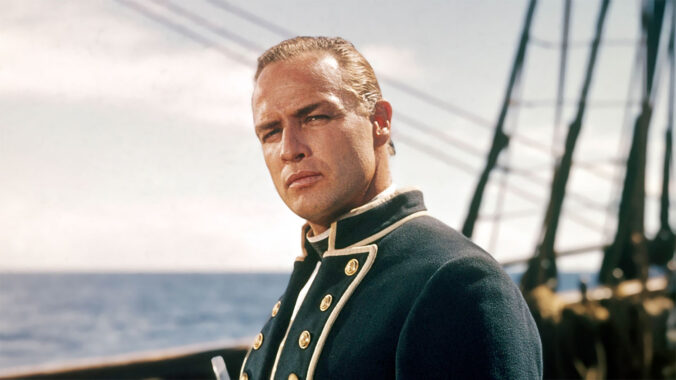
Lewis Milestone’s 1962 Mutiny on the Bounty remake, with Marlon Brando as Christian and Trevor Howard as Bligh, arrives with big CinemaScope prestige but a strangely diffused point of view. Brando’s Christian is whimsical, ironic, and detached, a proto-counterculture figure who seems less tortured than bored. Howard’s Bligh is more controlled than Laughton’s but still rigidly villainous, echoing the novel’s version more than historical analysis. The film leans heavily into Tahiti as an exotic paradise, extending the love story but weakening narrative momentum.
The result is handsome, intermittently fascinating, but tonally inconsistent. Brando’s eccentric performance, though engaging, sometimes pulls the story toward satire, while the script seeks to retain classic moral seriousness. It neither fully humanizes Bligh nor fully dramatizes the mutiny as a tragic inevitability. Historically, it remains in the same mythic register as the 1935 film, but without its sharp dramatic spine.
Roger Donaldson’s 1984 film, The Bounty, starring Mel Gibson as Christian and Anthony Hopkins as Bligh, marks the first major adaptation to challenge the established myth. Drawing on more recent scholarship and using Bligh’s own writings as inspiration, it reframes the mutiny as a clash of flawed personalities rather than a simple tale of tyranny.
Hopkins’s Bligh is not sadistic but disciplined, overbearing, ambitious, and socially insecure. He is capable of kindness but blind to how his rigidity alienates his crew. Gibson’s Christian is not a born revolutionary but an inexperienced young officer emotionally overwhelmed by conflict and guilt. The film foregrounds Bligh’s astonishing 3,600-mile open-boat journey with rare accuracy. Tahiti is portrayed not as Eden but as a complex society whose allure and cultural differences unsettle the crew’s discipline.
This version incorporates contradictions rather than ironing them out. It acknowledges that the mutineers gave wildly inconsistent explanations, that Bligh’s harshness was real but within the norms of the era, and that Christian’s motives remain opaque. As storytelling, it is more muted, less swashbuckling, but also far more psychologically credible. And, unfortunately, not as interesting.
The truth of the Mutiny on the Bounty lies somewhere between heroism and dysfunction, and between Bligh’s defensiveness and the mutineers’ self-justification. Modern historians tend to see the mutiny as the product of cumulative interpersonal friction, culture shock in Tahiti, Bligh’s abrasive management, and Christian’s psychological instability. This messy human drama resists clean moral binaries.
The saga of the Bounty endures precisely because it resists definitive interpretation. The 1932 novel shaped the mythic template: Bligh the tyrant, Christian the reluctant rebel. The 1935 film amplified this into an iconic melodrama. The 1962 film embellished it with Hollywood exoticism and Brando’s idiosyncrasies. The 1984 film challenged it with a more balanced, psychologically layered approach. Each version reflects the concerns of its era: authoritarian villains in the 1930s, romantic individualism in the 1960s, and distrust of simple moral narratives in the 1980s.