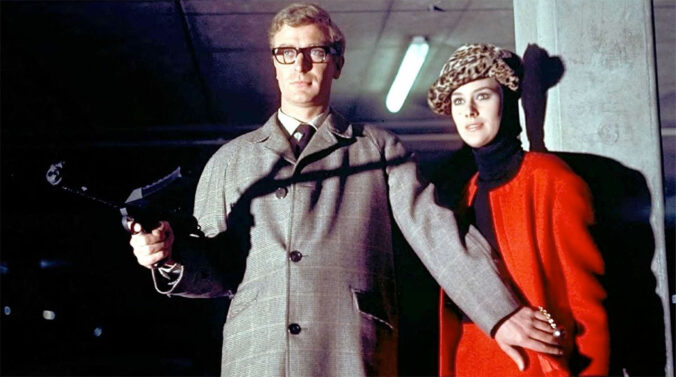
Between 1965 and 1967, British cinema produced an unlikely espionage trilogy centered on an unglamorous, bespectacled intelligence officer named Harry Palmer. Adapted from Len Deighton’s novels and starring a then-young Michael Caine, these films (The Ipcress File, Funeral in Berlin, and Billion Dollar Brain) were conceived as a realistic alternative to the wildly successful James Bond franchise. Yet within just three years, the series evolved from sharp anti-Bond realism to stylistic excess, reflecting both the creative volatility of 1960s British cinema and the limits of translating Deighton’s dry, ironic prose into spectacle.
Len Deighton’s 1962 novel The Ipcress File was a sardonic, semi-bureaucratic take on the spy genre, closer in tone to John le Carré’s The Spy Who Came in from the Cold than to Ian Fleming’s glamorous world of tuxedos and martinis. Its narrator, a nameless intelligence officer reporting through official documents and memos, is cynical, wry, and deeply aware of the absurdities of Cold War espionage.
When the story reached the screen, with The Ipcress File (Sidney J. Furie, 1965), the transformation was substantial. The film, produced by Harry Saltzman (who was also one of the producers behind the Bond series), necessarily reimagined the anonymous protagonist as a third-person character: Harry Palmer. The name, chosen for its ordinariness, suited the film’s anti-heroic tone. Unlike Bond, Palmer is underpaid, under-appreciated, and perpetually irritated by paperwork. He cooks gourmet meals in his small London flat, wears thick-rimmed glasses, and navigates an intelligence service riddled with office politics and procedural tedium.
Caine’s performance as Palmer cemented his early stardom. He embodied a new kind of British masculinity (working-class, witty, confident) perfectly suited to the mid-60s mod aesthetic. His Palmer was as stylish as he was cynical, but never suave in the Bond sense. His sharp suits and clipped humor projected competence without glamour. He was, in short, the spy as civil servant.
Though conceived as a counter-Bond project, The Ipcress File shared significant DNA with the 007 franchise. Saltzman’s involvement brought the production team of Ken Adam (production design) and John Barry (score), both Bond veterans. Yet director Sidney J. Furie went in the opposite visual direction: claustrophobic compositions, oblique camera angles, and a palette of grey offices and shadowy corridors. Instead of Monte Carlo casinos, we get fluorescent lights and filing cabinets. The effect was startlingly modern, even subversive, a film that made the world of espionage look not exciting but exhausting.
Critics quickly noted that The Ipcress File‘s world resembled le Carré’s bureaucratic labyrinths more than Fleming’s fantasies. The film’s story of kidnapped scientists, brainwashing, and double agents is told through meetings, memos, and missed lunch breaks. Even the climax, an experimental brainwashing sequence that fractures Palmer’s sense of reality, feels psychologically invasive rather than heroic. Deighton’s grim wit survived the translation: in Palmer’s world, the greatest danger isn’t the enemy, but the incompetence of your own superiors.
A year later came Funeral in Berlin (Guy Hamilton, 1966), widely regarded as the best of the series. The tone is more controlled, the world more vivid, and the moral ambiguities more pronounced. This time, Palmer is sent to Berlin to arrange the defection of a Soviet colonel, and, of course, nothing goes according to plan.
Curiously, the filmmakers skipped Deighton’s second novel, Horse Under Water, set mainly in Portugal, moving directly to his third, Funeral in Berlin. The official reason was logistical: the story’s underwater sequences were expensive to film. But in retrospect, the decision made artistic sense. Berlin, divided by the Wall, was a perfect stage for Cold War intrigue. The city’s atmosphere of constant surveillance and simmering paranoia provided precisely the kind of authenticity that the Bond series avoided.
A significant asset to the film was Oskar Homolka as Colonel Stok, the weary, sardonic KGB officer who seems as trapped by bureaucracy as Palmer himself. Homolka’s performance gives the film its heart, a sense that espionage, for all its cynicism, still involves ordinary human beings caught between absurd systems. The scenes at Checkpoint Charlie and along the Wall exude a documentary realism that anchors the plot’s twists in genuine geopolitical tension.
Ironically, Funeral in Berlin was directed by Guy Hamilton, who had helmed Goldfinger (1964) and would go on to direct three more Bond films (Diamonds Are Forever, Live and Let Die, The Man with the Golden Gun). Yet Hamilton’s approach here is far more restrained. Gone are the gadgets and explosions. In their place, shadows, dossiers, and double-crosses. The result is a taut, sophisticated spy film, perhaps the most authentic cinematic embodiment of Deighton’s world.
Where The Ipcress File was innovative, Funeral in Berlin was masterful. Precise, tense, and steeped in the melancholy of divided Europe.
Then came Billion Dollar Brain (Ken Russell, 1967) and the spell broke. It’s the film that effectively destroyed the franchise. Where the previous entries were grounded, Billion Dollar Brain veered into farce. The opening credits sequence mimicked Bond’s stylized montages, complete with silhouettes and swirling graphics, an ironic move for a series originally designed as the anti-Bond. Palmer, once the sardonic clerk-spy, now found himself in a world of computer-controlled espionage, private armies, and megalomaniacal generals. The novel’s already complex plot about a right-wing Texas tycoon and an anti-Soviet conspiracy was rendered on screen as convoluted, incoherent, and often unintentionally comic.
Ken Russell, later famous for his flamboyant, operatic style (Women in Love, The Music Lovers,The Devils), was an ill-matched choice for this material. His taste for surrealism and exaggeration clashed with Deighton’s dry wit and realism. What had been a series about bureaucratic absurdity became a carnival of absurd set pieces, exploding ice floes, cartoonish villains, and a plot that collapsed under its own eccentricity.
Adding to the film’s oddities was an early Donald Sutherland cameo (blink and you’ll miss it), one of many pointless flourishes in a movie that seemed determined to squander its tone. The cold, ironic edge of The Ipcress File had dissolved into psychedelic nonsense. The climax, involving a private army storming across a frozen sea, plays like self-parody. By the end, even Caine’s Palmer seems bewildered, as if the actor himself realized the character’s credibility had melted away.
Audiences agreed. Billion Dollar Brain underperformed, and no further theatrical films followed. Palmer would reappear decades later in low-budget television movies, but the cultural moment had passed. The trilogy had begun as the thinking man’s answer to Bond and ended as a confused imitation of him.
Taken together, the three films trace an unintended arc, not only of a character but of a cinematic era. The Ipcress File captured the post-Suez, post-imperial malaise of Britain: espionage as office work, heroism as endurance. Funeral in Berlin perfected the formula, locating human tragedy amid ideological walls. Billion Dollar Brain succumbed to the late-sixties’ obsession with style over substance, collapsing under its own excess.
Harry Palmer began as the antithesis of James Bond, ordinary, sardonic, bespectacled, and ended, fittingly, as a relic of a world that no longer knew what to do with ordinary spies. The bureaucrat had outlived his moment, but for a brief, brilliant time, he made espionage feel real.