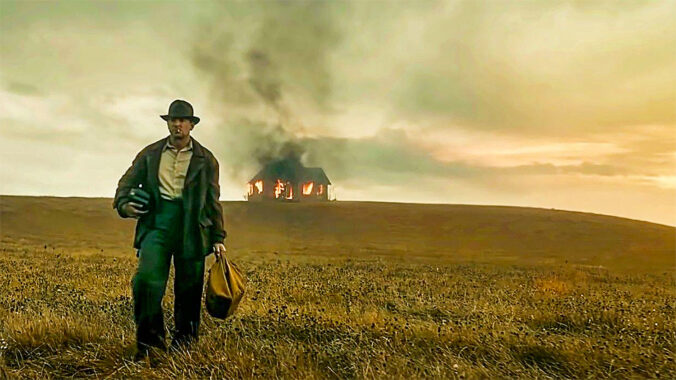
The life of William Lindsay Gresham reads like a prelude to the novel that would define him. Before becoming a writer of dark Americana, he was a man drawn to causes, extremes, and self-destruction. In the late 1930s, he volunteered to fight for the Republican side in the Spanish Civil War, joining the International Brigades. He saw the collapse of that cause firsthand. It left its mark politically, psychologically, and spiritually.
Back in the USA, Gresham struggled. He attempted suicide more than once. His personal life was not steady. He married the poet Joy Davidman, a brilliant and restless figure in her own right. Their marriage did not last. Davidman would later become known for her relationship with C.S. Lewis, while Gresham drifted further into alcoholism and instability.
Out of this turmoil came Nightmare Alley (1946), a novel that seemed to arrive fully formed, with a confidence and darkness that had few parallels in American fiction at the time. It did not fit comfortably into any category. It had elements of pulp, of noir, of psychological case study, even of allegory, but it resisted reduction.
Gresham never again produced a work of comparable power. His later books faded into obscurity. His health deteriorated: alcoholism, tuberculosis, and cancer compounded each other. In 1962, facing a terminal diagnosis and mounting despair, he checked into a hotel in New York and took his own life.
Before doing so, he had printed business cards. They read, simply: “No Address. No Phone. No Business. No Money. Retired.” It was less a joke than a final gesture. Dry, bitter, and entirely in keeping with the man.
Nightmare Alley follows Stanton Carlisle, a drifter who rises from carnival roustabout to celebrated mentalist, only to fall into degradation as a “geek”, the lowest form of sideshow performer, reduced to biting the heads off chickens for spectacle. The arc is simple. The execution is not.
Part of the novel’s power lies in how convincingly grounded it is. Gresham had done extensive research into carnival life, spiritualism, and fraudulent mentalism. The mechanics of deception, coded language, cold reading, and staged séances, are described with clinical precision. There is nothing supernatural here. Every illusion is explained.
And yet the novel never feels merely realistic. It operates simultaneously as a symbolic descent. Stanton’s rise is not just social or financial. It is metaphysical. He convinces himself that he is more than a fraud, that he can manipulate not just people but fate itself. His downfall, then, becomes inevitable, not as punishment, but as exposure.
The world of the novel is distinctly American, rooted in the 1940s fascination with spiritualism, self-invention, and the promise of reinvention after the Depression and the war. But its themes extend beyond that context. The hunger for belief, the ease of self-delusion, and the thin line between performance and identity are not tied to a specific era.
What, then, is Nightmare Alley? It can be read as noir, with its moral ambiguity and fatalistic trajectory. It can be read as existentialist, in its portrayal of a man constructing meaning only to find it hollow. It can also be read, more simply, as a deeply cynical view of human nature, one in which the desire to be deceived is as strong as the desire to deceive. The novel resists classification because it is doing all of these things at once.
The first film adaptation, Nightmare Alley (Edmund Goulding, 1947), is a fascinating object. It is both faithful and compromised, daring and restrained.
Casting Tyrone Power as Stanton Carlisle was, at the time, a departure. Power was known for romantic leads and swashbucklers. Here, he plays a manipulator and a fraud, charting a descent that his screen persona had not previously suggested. The performance works precisely because of that contrast: the charm is credible, and so is the corruption.
Visually and thematically, the film draws on earlier traditions. One can see echoes of Paul Leni’s The Man Who Laughs in its expressionist touches, and of Tod Browning’s Freaks in its depiction of carnival life not as spectacle alone, but as a closed, precarious community with its own rules and hierarchies.
Within the broader tradition of film noir, Nightmare Alley occupies an unusual place. It lacks the urban setting typically associated with noir, at least in its first half, but it shares the genre’s fatalism and moral darkness. Stanton is not undone by a femme fatale alone, he is undone by himself.
The film’s greatest weakness is also its most discussed feature: the ending imposed by producer Darryl F. Zanuck. Where the novel concludes with a devastating circularity (Stanton becoming the very geek he once pitied), the film softens the blow. It introduces a note of redemption, or at least the possibility of it, that feels unearned and tonally inconsistent. The result is a film that approaches greatness but stops short of it, constrained by the expectations of its time.
The screen retelling, also called Nightmare Alley (Guillermo del Toro, 2021), moves beyond simply remaking the 1947 film. Instead, it returns to the novel and reinterprets it with a contemporary sensibility.
From the outset, the film is more expansive. The carnival sequences are longer, more detailed, and more tactile. Del Toro lingers over textures (wood, canvas, mud, flesh) that ground the story physically while reinforcing its thematic weight. The world feels inhabited, not stylized.
The casting is precise. Bradley Cooper brings a controlled intensity to Stanton, suggesting both ambition and fragility. Cate Blanchett, as Dr. Lilith Ritter, is not merely a noir archetype but a fully realized counterforce: cool, analytical, and ultimately more dangerous than Stanton because she understands the game more completely.
What distinguishes this adaptation is its willingness to embrace the full darkness of the source material. There is no imposed consolation. The narrative is allowed to complete its arc, and the final transformation of Stanton is rendered with a clarity and inevitability that the 1947 film avoided.
At the same time, del Toro introduces his own sensibility. There is a heightened attention to trauma, particularly in Stanton’s backstory, which reframes his rise not just as ambition but as escape. The film is more explicitly psychological, less interested in deception as technique and more in deception as identity.
It preserves what matters, the structure, the themes, the ending, while expanding the emotional and visual range of the story. In that sense, it does not replace the earlier film so much as complete it.
Nightmare Alley endures because it refuses comfort. In Gresham’s life, in his novel, and in its adaptations, there is a consistent refusal to soften the fall. The story insists that the distance between success and ruin is not as great as it appears, and that, under the right circumstances, anyone might find themselves at the bottom of the alley.