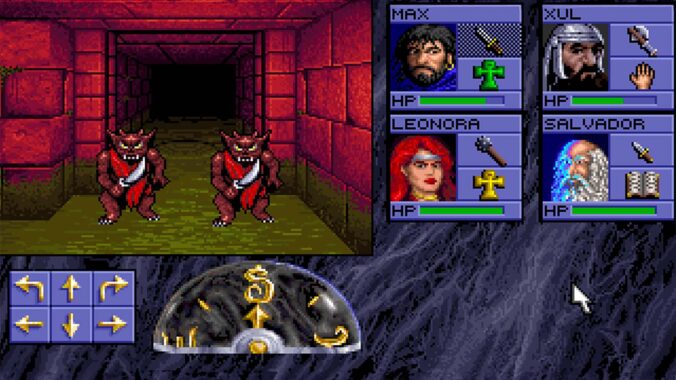
Eye of the Beholder (SSI, 1991) was the first computer game that I felt represented the spirit of the tabletop Dungeons & Dragons (which, at the time, was in its AD&D 2nd Edition). Another advantage for me was that the story happened beneath the city of Waterdeep, a famous location for fans of Dungeons & Dragons. Khelben Arunsun, one of the Lords of Waterdeep, tasks our group of adventurers to go investigate what’s wrong in the city sewers, and that’s just the beginning of a large dungeon expedition.
The game was somewhat similar to the first The Bard’s Tale but it looked much better. Objects in your inventory were represented by images rather than just text. Music and sounds were more realistic. Mouse support made it easier to play. And, although the continuous time combat was not as pleasing as the turn based mode of The Bard’s Tale, the whole experience was much more engrossing. Having recently played The Bard’s Tale, one single feature (or lack of it) by itself makes the game much more pleasurable in comparison: there is no need to carry torches or to spend mana points casting light, as the dungeons are naturally lit. In contrast, while in The Bard’s Tale food was not a consideration, in Eye of the Beholder you have to carry rations and make sure your characters don’t starve.
Mapping the dungeons on graph paper was part of the experience of playing a CRPG at the time. But trying to play that way in 2024, after decades of games with an automapping feature, was just too irksome. Fortunately, I found an application called The All-Seeing Eye, which adds automapping to the Eye of the Beholder series. It only works on Windows systems, but it was well worth temporarily switching from my new cool Mac to my crappy old PC just to enjoy the game with maps.
Eye of the Beholder is not as demanding as The Bard’s Tale can be, but it’s not an easy game. The mindflayers on level 11 are particularly nasty, because they can simply paralyze the whole party and then attack until everyone is dead. Fortunately, the Kenku level offers an opportunity for grinding, as the Kenkus will continually respawn, so you can reach the mindflayers with a robust party.
My team was formed by Max (human male paladin), Xul (dwarf male fighter/thief), Leonora (human female cleric), and Salvador (human male mage). The names are inspired by surrealist painters. They all start at level 3. Thanks to all the grinding in the Kenku level, and also by not accepting extra members to share the experience points, my party finished the game around level 8, more specifically Max at level 8, Xul at level 7/9, Leonora at level 8, and Salvador at level 8. Killing the beholder Xanathar, the last monster, required a lot of maneuvering and the use of a trap conveniently located nearby.
Eye of the Beholder II: The Legend of Darkmoon (SSI, 1991) uses basically the same engine from the previous game, with prettier art. After defeating Xanathar in the first adventure, our mission now is to investigate the Darkmoon temple and find the scout sent by Khelben Arunsun earlier. The threat is much worse this time. While the big boss in the first game was a beholder, the villain here is Dran Draggore, a dragon in human form who was using Xanathar as a pawn in his own plans and now has an army of many creatures, including several beholders.
Even with all the grinding in the previous game, my team didn’t seem overpowered at all. But the equipment they brought was good, even better than anything found in the first phases here. Fighting the multiple beholders in the Silver Tower can be quite annoying, because they have the ability to simply kill a party member with a single attack. Find two or three beholders together and you will be reloading your game. My party for the second game: Max (human male paladin, level 8, imported from EOB1), Xul (dwarf male fighter/thief, level 7/9, imported from EOB1), Leonora (human female cleric, level 8, imported from EOB1), Salvador (human male mage, level 8, imported from EOB1), San-Raal (elf male mage level 8, rescued from the catacombs), Calandra (human female fighter, level 9, rescued from the catacombs and tagging along just until the party finds her replacement), and Tanglor (half-elf male fighter/cleric, rescued from the Silver Tower and replacing Calandra because a second cleric is more useful than a third fighter).
There’s much more respawning in this game than in the previous one, so grinding for more experience is not a problem. With a bit of patience, I managed to win the final fight against Dran Draggore, who actually has to be defeated twice, first in his human form and then as a dragon. I had much fun playing these two games, and it was particularly nice to be able to import my characters from the first to the second game. It’s a feature that I learned to appreciate with Eye of the Beholder.
But then there was Eye of the Beholder III: Assault on Myth Drannor (SSI, 1993). Big disappointment. The storyline is generic and uninspired. The gameplay is monotonous and repetitive. Even the graphics are inferior in comparison with the previous two games. I’m not sure why they didn’t have Westwood Associates developing the game like they did with the first two, and instead used a new team to deliver this fiasco. I played it for a while but got too bored to continue. On to the next game…