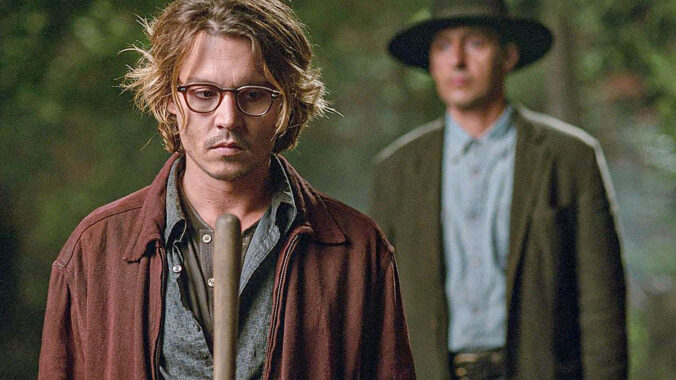
There’s a very specific narrative hook that shows up only occasionally in film: a writer comes into possession of a manuscript that is not theirs, and decides to pass it off as their own. It’s a narrow premise, almost schematic. Yet across three films, A Murder of Crows (Rowdy Herrington, 1998), The Words (Lee Sternthal & Brian Klugman, 2012), and Secret Window (David Koepp, 2004), it opens into three distinct genres: thriller, drama, and psychological horror.
The divergence doesn’t come from the setup. In all three cases, the situation is similar enough: a struggling or compromised writer faces a moment of temptation, and a text appears that could change everything. What differs is not the act itself, but how each protagonist responds to it and how the film chooses to interpret that response.
In A Murder of Crows, the reaction is pragmatic, almost opportunistic. The protagonist treats the manuscript less as a moral problem and more as a solution to a stalled life. The tone that follows is accordingly external. The story looks outward, toward consequences that take the form of pursuit, exposure, and danger. The question is not “should he have done it?” but “what will happen now that he has?” The film aligns itself with the mechanics of a thriller: escalation, suspicion, and the constant sense that something is closing in. Authorship becomes a liability, a trigger for events that move faster than the protagonist can control.
The Words approaches the same decision from the opposite direction. Here, the act is less impulsive than quietly rationalized. The protagonist is aware, perhaps too aware, of what he is doing, and the film lingers on that awareness. Instead of building outward momentum, it turns inward, toward reflection and consequence over time. The tension is not driven by immediate danger but by the slow accumulation of moral weight. Recognition, success, and admiration all arrive, but they are never uncomplicated. The premise becomes a vehicle for examining ambition, insecurity, and the cost of becoming the person you wanted to be under false pretenses. If A Murder of Crows asks what happens when you get away with it, The Words asks whether “getting away with it” is even possible.
Then Secret Window takes the same premise and bends it into something less stable. The protagonist’s reaction is not clearly opportunistic or reflective: it is defensive, even evasive. The accusation of theft, when it appears, is treated not as a legal or ethical dispute but as something more personal, more intrusive. The film doesn’t expand outward like a thriller, nor does it settle into introspection like a drama. Instead, it destabilizes the ground beneath the protagonist. Certainty erodes. The question of authorship, who wrote what, and who has the right to claim it, becomes entangled with identity itself. The premise is no longer just about taking a story, it is about whether the boundaries of the self can hold. In that sense, the film naturally slips into psychological horror. The threat is not exposure or guilt, but disintegration.
Seen together, the three films suggest that the core idea, publishing someone else’s work as your own, is less about literary ethics than about pressure points in the self. One protagonist treats it as an opportunity and is pulled into a world of external consequences. Another treats it as a compromise and is forced to live with its internal cost. The third cannot contain the implications at all, and the situation turns into something far more unstable.
It’s a useful reminder that genre is often less about plot than about emphasis. The same premise can generate suspense, reflection, or dread depending on where the camera lingers: on the chase, on the conscience, or on the fracture.