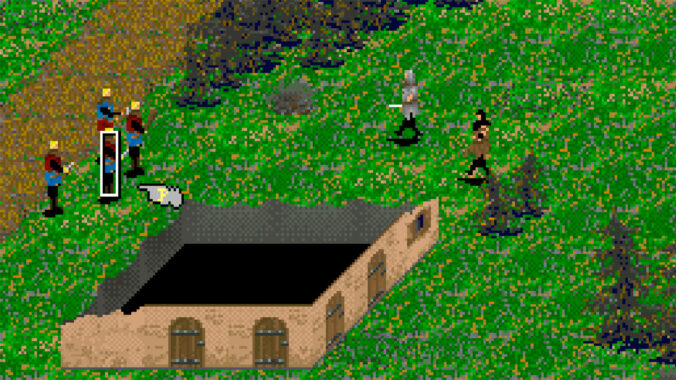
When Microprose launched Darklands in 1992, I became obsessed with the game. I played it hour after hour, day after day, week after week, always experimenting with new ways to explore the game world and vanquish the enemies. Replaying it now was still very satisfying, despite the dated graphic presentation.
Unlike the high-fantasy worlds inspired by Ultima or Dungeons & Dragons, Darklands is set in a historically grounded 15th-century Holy Roman Empire, where alchemy, saintly miracles, and medieval folklore are real. The game offers an open-ended experience where players can travel across Germany, engaging in political intrigue, mercenary work, or combating supernatural horrors like demons and witches. The dynamic world reacts to the player’s choices, and success relies on combat and diplomacy, alchemy, and knowledge of religious traditions. Though the interface and graphics are dated by modern standards, the sheer depth of the game makes it a rewarding experience.
Darklands, like many Microprose games of that time, comes with a comprehensive printed manual, a tome packed with historical references, gameplay mechanics, and world-building details. It was a rich companion that provided context for medieval German society, the role of saints, alchemical formulas, and the political landscape. It was as much an educational piece as a gameplay guide, encouraging players to immerse themselves in the setting rather than just skim for controls and shortcuts. In an era before easy internet guides, such manuals were crucial, and Darklands set a high standard with its depth and authenticity.
The character creation system is another remarkable aspect, resembling a mini-game in itself. Instead of simply selecting stats, players shape their characters’ past by choosing their upbringing, professions, and career paths, each choice influencing skills, attributes, and even aging. A character who has spent decades mastering alchemy will be formidable but will start with reduced vitality due to age. This approach forces players to balance youthful adaptability with the benefits of experience, making the process both strategic and deeply immersive.
Features like a detailed manual and an elaborate character creation system have largely vanished from modern gaming, replaced by quick in-game tutorials designed to get players into the action within minutes. The shift is likely due to evolving player expectations and a diminishing willingness to engage with slower, text-heavy introductions. Games today prioritize accessibility, which is not necessarily a bad thing. Still, it does mean that the sense of deep preparation and gradual mastery (once integral to RPGs) has been lost. Whether this reflects a decline in attention span or just a change in design philosophy is debatable, but it’s hard to deny that something valuable has been left behind.
One of the most fascinating elements of Darklands is its integration of medieval mythology, presenting a world where alchemical potions work, dragons haunt remote regions, and Christian saints can grant divine intervention (if one prays correctly). This blending of folklore with historical accuracy creates a unique atmosphere, reinforcing the idea that people in the Middle Ages truly believed in these forces. The inclusion of Christianity as a mythological system alongside pagan and occult elements is a subtle but intriguing move, especially for players with an atheistic perspective, as it places all supernatural elements on equal footing. Rather than preaching faith, Darklands treats belief as a mechanic, where devotion and knowledge of religious customs yield tangible results, mirroring the worldview of the era rather than modern sensibilities.
For my replay of Darklands, I went with an old strategy that I call the Blood, Sweat & Tears Plan. That is a jazz-rock band that started in the sixties and keeps playing under the same name but with none of the original musicians present. They were replaced gradually, but the band’s identity remains the same. In the game, the party accumulates fame and riches (money and equipment) that stay with the group even if individual members are replaced. So, I created a system for ending up with a strong group of adventurers reaching their peak based on previous party members’ blood, sweat, and tears.
I start with three fighters (with a past of recruit, soldier, and veteran, successively) and one healer (noble heir, student, physician). Their job is to accumulate fame and money, doing missions from fighting thugs in back alleys to defeating baron robbers in their castles. Once the healer is well trained in Read & Write, and the group is well equipped (including the coveted 37q plate armor from Nurnberg), I replace the fighters. This second party consists of one fighter who is marked to be expendable (recruit, soldier, veteran), one young fighter (recruit) with high perception, one young healer-alchemist (recruit) with high intelligence, and the old healer from the previous formation. These guys will advance deeper into the plot, going through the sabbat and the Monastery, and finally exploring the Citadel for the first time, where the expendable fighter is sacrificed (it’s an episode where you lose a team member, but with this revolving door strategy we can use this to our advantage). Meanwhile, the first young fighter is trained in artifice, and the healer-alchemist gets his healing and alchemy up to 60. In the Monastery, they can get 45q plate armor for everyone and +60 Latin. Time for the third party, which gets a second expendable fighter (recruit, soldier, veteran) to replace the first, a new young fighter (recruit) with high agility, a new healer-alchemist (recruit) with high intelligence, and keeps the high perception fighter from the previous formation. They basically repeat what the second party did, along the way training the healer-alchemist in healing and alchemy up to 60, collecting saint knowledge and alchemy formulas, and sacrificing the expendable fighter again. Then I get to my final party: the fighter with high perception, the fighter with high agility, a new young fighter (recruit) also with high agility, and the healer-alchemist with high intelligence. These guys have the fame, money, equipment, and loot accumulated by the previous formations. They are able to get all saint knowledge available and train everyone in religion up to 90, get the best equipment in the game, and finish all the quests, including killing dragons, clearing mines, and completing the cycle of Sabbat, Monastery, and Citadel. Very satisfying gameplay.
In many ways, Darklands was ahead of its time. While it never became a commercial success, its influence can still be seen in later RPGs that emphasize historical authenticity and player-driven narratives. It remains a cult classic, a relic of an era when games were sprawling, unapologetically complex, and designed for those willing to lose themselves in their depths.