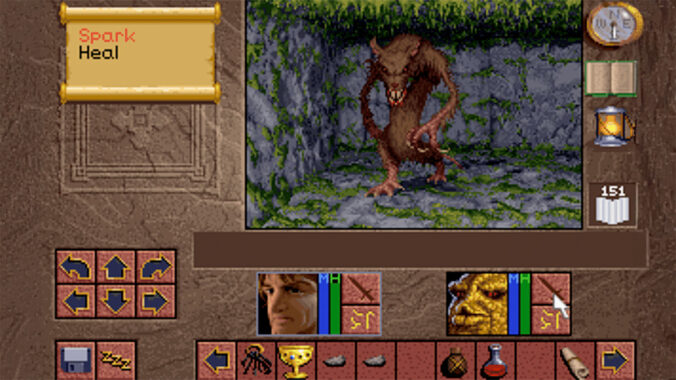
The next game in my revival series was Lands of Lore: The Throne of Chaos (Virgin Games, 1993), developed by Westwood Studios, the same guys who made the first two instalments of Eye of The Beholder. And this game has a very similar interface, with some clear improvements over the predecessors. Stepping away from the Dungeons & Dragons license, Lands of Lore brought its own mythology in what looks like a hybrid of RPG and adventure genres.
Set in the high-fantasy world of Gladstone, the game presents a classic struggle between good and evil. The story revolves around a powerful artifact, the Nether Mask, and the efforts of the kingdom to thwart its misuse by the malevolent sorceress Scotia. The player assumes the role of a chosen champion tasked by King Richard to prevent Scotia’s rise to power. The themes are quintessentially from medieval fantasy, with elements of heroism, betrayal, and mysticism.
You can’t create your own character and have to choose one of the available heroes to play. I went with Michael, a balanced choice with skills in both combat and magic. The party grows as the adventure progresses, with companions joining temporarily based on the plot. The challenges include the usual exploration and puzzle-solving, with combat against a diverse array of enemies. Resource management is crucial, as sometimes there’s a lack of food and potions (using magic to heal between battles will save the day), and your weapons don’t last forever. The puzzles are well-designed, often requiring good observation and a lot of experimentation.
It was quite pleasing playing Lands of Lore: The Throne of Chaos again. And I had the version released on CD, which came with great voice acting, including Patrick Stewart as King Richard.
Then I decided to play the sequel, Lands of Lore: Guardians of Destiny (Virgin Games, 1997). It marked a shift in tone and gameplay for the series. Developed by the same Westwood team, the game was designed during a period of significant technological change in gaming, including the rise of 3D graphics and free-roaming environments. As a result, it departed from the grid-based system of its predecessor, embracing a more dynamic and cinematic experience. Today it looks a bit primitive, and I prefer the traditional Eye of the Beholder style, but I can understand they wanted to try something innovative for the time. It just didn’t feel like it belonged to the same series.
The sequel takes place years after the events of The Throne of Chaos and follows Luther, a cursed young man caught in a struggle between opposing forces of light and dark. The story explores themes of duality, redemption, and destiny, with Luther’s transformations into beast and lizard forms playing a central role in both narrative and gameplay. It’s critical to learn when to use Luther’s beast form for combat and his lizard form for agility and puzzle-solving.
I never played Guardians of Destiny when it was launched, and playing it now wasn’t really a satisfying experience. Gameplay is a bit clunky and the game crashed constantly (I know, it wasn’t originally designed for a super fast computer made a quarter of a century later). So I gladly put it away and started looking for the next one.