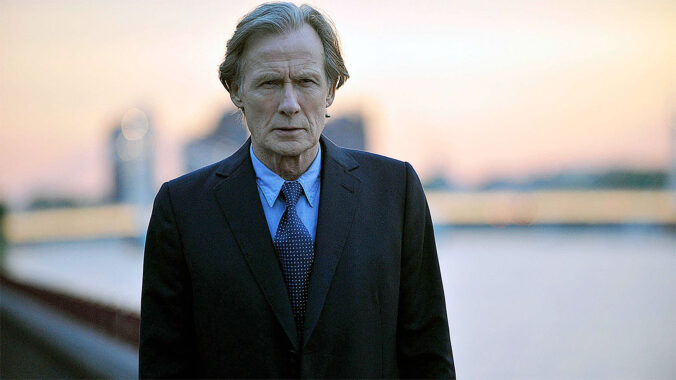
David Hare’s Worricker Trilogy, consisting of Page Eight (2011), Turks & Caicos (2014), and Salting the Battlefield (2014), occupies a curious place in modern British espionage fiction. Produced for television by the BBC but filmed and performed with the sophistication of high-end cinema, the trilogy feels like a deliberate attempt to create a contemporary counterpart to the moral and political spy stories associated with John le Carré. It succeeds not by imitating George Smiley, but by asking what a Smiley-like figure would look like in the twenty-first century. The answer is Johnny Worricker, played magnificently by Bill Nighy.
The trilogy was written and directed by David Hare, one of Britain’s most respected playwrights and political writers. Hare’s career has been defined by a fascination with the intersection of politics, institutions, and personal morality. Works such as Plenty, The Absence of War, and The Hours reveal a writer deeply interested in how individuals navigate corrupt or compromised systems. The Worricker films continue this preoccupation, functioning as both espionage thrillers and political critiques.
The obvious comparison is with John le Carré’s George Smiley. Both Smiley and Worricker are aging intelligence officers. Both are thoughtful rather than physical. Both rely on observation, patience, and judgment rather than action-heroics. Both operate within bureaucracies where loyalty is constantly tested. Neither possesses the glamour traditionally associated with fictional spies.
Yet the differences are as important as the similarities.
Smiley belongs to the Cold War. His world is defined by the conflict between East and West, capitalism and communism, NATO and the Warsaw Pact. One of le Carré’s great achievements was to reveal that beneath the noble rhetoric of that struggle lay manipulation, betrayal, blackmail, and murder. Smiley’s victories often come at terrible moral cost. The Cold War may have been necessary, but le Carré never allowed readers to believe it was clean.
Worricker serves a similar function for the War on Terror. By the time of Page Eight, the great ideological conflict of the twentieth century has been replaced by a murkier world of secret prisons, extraordinary rendition, surveillance, disinformation, and political expediency. The enemy is less clearly defined. Governments themselves increasingly become the source of anxiety. Worricker discovers that the corruption he must confront comes not from foreign adversaries but from his own political leadership.
This distinction is crucial. Smiley’s tragedy is that he fights dirty because the enemy fights dirty. Worricker’s tragedy is that the dirt often originates at home.
The trilogy is therefore less interested in espionage tradecraft than in political accountability. The central question is not “Can we catch the spy?” but “What happens when democratic governments abandon the values they claim to defend?”
Bill Nighy is extraordinary throughout. His performance is among the finest portrayals of an intelligence officer ever filmed. He avoids every cliché. Worricker is intelligent but rarely showy. He is weary without becoming cynical. He is detached without appearing cold. Nighy communicates entire pages of thought through a glance, a hesitation, or the smallest shift in expression.
Much of the trilogy depends upon silence, and Nighy understands this instinctively. Worricker spends much of the story listening rather than speaking. He is a man who has spent decades gathering secrets and has learned that the most dangerous thing in any room is often the person saying the least.
The supporting casts are equally remarkable. Across the three films appear performers such as Rachel Weisz, Helena Bonham Carter, Ralph Fiennes, Christopher Walken, Winona Ryder, Judy Davis, Ewen Bremner, and Michael Gambon. Few television productions have assembled such a consistently distinguished ensemble.
The casting serves an important purpose. These films are built around conversation rather than action. Entire sequences consist of two people in a room discussing politics, loyalty, or fear. Lesser actors would have made these scenes static. Here they become the heart of the drama.
An often-overlooked aspect of the trilogy is the role of jazz. Jazz is not merely part of the soundtrack; it is part of Worricker’s identity. Like many classic jazz musicians, Worricker appears to improvise while actually relying on deep knowledge and instinct. He moves through situations indirectly. He dislikes rigid structures. He values nuance over certainty. Jazz becomes a shorthand for an older, more reflective intelligence culture, one rooted in ambiguity and individual judgment rather than algorithms, databases, and political messaging.
The books that appear throughout the trilogy perform a similar function. References to writers such as Ernest Hemingway and Georges Simenon are not accidental. Both authors specialized in characters who maintain personal codes of conduct in morally compromised worlds. Hemingway’s protagonists often discover that courage consists not in winning but in behaving decently when defeat is inevitable. Simenon’s characters, especially Inspector Maigret, focus less on legal guilt than on understanding human weakness. Both sensibilities resonate strongly with Worricker. He is not trying to save the world. He is trying to preserve a fragment of personal integrity.
This brings us to the ending. One of the most striking aspects of the trilogy is that almost nobody receives what might conventionally be called a happy ending. Careers are damaged. Relationships remain unresolved. Trust has been broken. Some characters escape punishment. Others pay prices they do not deserve. Even Worricker’s apparent freedom feels provisional and melancholy. The trilogy ends not with triumph but with accommodation. That choice reflects Hare’s worldview. Political corruption is not defeated once and for all. Institutions are not purified. History does not bend neatly toward justice. At best, individuals make moral choices within flawed systems. Worricker survives, but survival is not victory.
This is where Hare ultimately departs from the conventions of the spy thriller. The purpose of espionage stories is often to reveal hidden truths. The Worricker Trilogy reveals them and then asks a harder question: what do you do once you know? Its answer is neither optimistic nor despairing. One acts according to conscience, even when conscience changes nothing.
That is a very British conclusion, very much in the tradition of le Carré, and perhaps the reason the trilogy lingers in the memory long after its conspiracies have faded. The real subject was never intelligence work. It was the cost of remaining decent in a world that rewards compromise.