When Tron premiered in 1982, it was unlike anything audiences had ever seen. Made by Walt Disney Productions and directed by Steven Lisberger, the film combined live-action footage with computer-generated imagery in ways that were not just new but revolutionary. Yet for all its visual daring, Tron remains a strange hybrid: a movie that wedded an almost childishly simple story to some of the most sophisticated visual technology of its time.
At its core, Tron tells a fairly naive story. Kevin Flynn (Jeff Bridges), a brilliant but wronged programmer, is digitized and transported inside a computer, where he must battle malevolent programs to reclaim evidence of his stolen work. Inside the digital world, programs appear as humanoid avatars of their users, a literal personification of software that feels endearingly clumsy today. The notion that “programs” could have personalities, faiths, and gladiatorial games seems laughably anthropomorphic, a product of a pre-internet imagination still struggling to visualize the invisible.
The plot unfolds as a straightforward hero’s journey filtered through a video-game lens: Flynn becomes a digital messiah, liberating enslaved programs from the tyrannical Master Control Program. There’s little emotional depth or philosophical nuance. The dialogue often lapses into techno-babble or spiritual platitudes about “the users”. Yet, this simplicity arguably works in the film’s favor, allowing the visuals and the conceptual world to take precedence, and its mythic overtones give a primitive sense of grandeur to what might otherwise be just a chase movie in neon armor.
Where Tron truly excels is in its audacious use of technology. Disney’s animators, effects artists, and computer scientists achieved a technical marvel long before digital filmmaking became standard practice. Though only about fifteen to twenty minutes of the film are genuinely computer-generated, the entire aesthetic (fluorescent lines, geometric light patterns, and glowing grids) feels entirely digital. The look was achieved through a combination of backlit animation, optical compositing, and early CGI, giving Tron a coherence and abstraction that was utterly unique at the time.
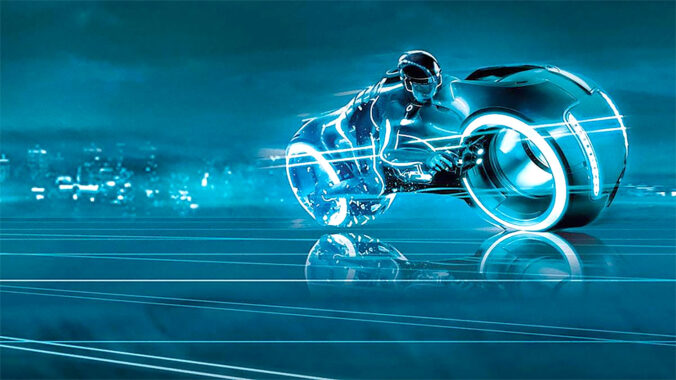
It was the first major studio film to make computer imagery a central design principle rather than a mere novelty. The light cycles, data tanks, and disc battles remain iconic, not because they are realistic, but because they are pure visual ideas, machines imagined through mathematics and art rather than mechanical engineering. In this way, Tron anticipated the future of digital aesthetics: clean, glowing, and immaterial.
Tron occupies a peculiar space in film history. It is both a corporate experiment by Disney (eager to regain relevance with younger, tech-savvy audiences) and an avant-garde visual project closer to experimental cinema than traditional science fiction. Its neon landscapes and geometric compositions recall the work of artists like Oskar Fischinger or early video art installations. The narrative might be clumsy, but the imagery evokes something visionary: a dream of humanity’s entry into the digital frontier.
When Tron: Legacy was released nearly three decades after Steven Lisberger’s 1982 original, it promised both a revival and a transcendence, a digital myth brought into the 21st century. Directed by Joseph Kosinski and scored by Daft Punk, the film sought to update Tron‘s primitive neon vision into a sleek cyber-symphony of light, geometry, and electronic pulse. What emerged was a visually dazzling but philosophically muddled sequel, oscillating between reverent mythmaking and narrative incoherence.
Even Tron: Legacy‘s fiercest critics concede its audiovisual power. Kosinski and cinematographer Claudio Miranda created one of the most distinctive digital worlds in modern cinema, a realm of sterile beauty, reflective surfaces, and minimalist architecture. Every frame seems designed like a concept art painting: light cycles streaking through black glass, towers pulsing with faint luminescence, Daft Punk’s robotic beats synchronizing with the visual rhythm.
The film’s aesthetic coherence is extraordinary, a total design vision that feels more like an art installation than a story. In this sense, Legacy continues what the original began, not a plausible depiction of computer space, but a dreamlike abstraction of it. It is less about technology than style as metaphysics, a meditation on control, perfection, and isolation rendered through geometry and sound.
Narratively, Tron: Legacy functions as a mythic sequel rather than a direct continuation. Sam Flynn (Garrett Hedlund), the disaffected son of Kevin Flynn (Jeff Bridges), enters the digital world (the Grid) in search of his long-lost father. Inside, he finds a totalitarian system ruled by Clu, a younger digital replica of Flynn who has turned his creator’s ideal of “perfection” into fascist tyranny. The story echoes countless archetypes: the prodigal son, the fallen god, the rebel angel.
And yet, beneath its mythic ambitions lies a host of unanswered questions. How can a digitized human bleed? Why does Flynn’s avatar age? How can a purely digital being like Quorra become flesh in the real world? Why does Tron, after years as the villainous Rinzler, suddenly revert to heroism without explanation? None of these have consistent answers, because Tron: Legacy is not really science fiction. It is digital mysticism.
Its rules are spiritual, not logical. The Grid is portrayed less as software than as an alternate dimension shaped by human thought. Flynn’s aging represents psychological weariness. Quorra’s materialization symbolizes enlightenment crossing into reality. Tron’s “conversion” is the awakening of a suppressed conscience. The film borrows the form of science fiction but uses it as a language for myth, sacrifice, and transcendence.
It is impossible to watch Tron: Legacy without sensing the influence of The Matrix trilogy. Both depict digital realms indistinguishable from reality, overseen by artificial overlords and populated by programs with human personalities. The parallels are striking. The Grid vs. The Matrix: self-contained digital worlds reflecting humanity’s flaws and aspirations. Clu vs. Agent Smith: the creation that turns on its creator, obsessed with perfection and control. Castor vs. The Merovingian: decadent exiles who understand the system better than its heroes. Flynn vs. Morpheus: aging guides who see beyond binary logic. Sam vs. Neo: reluctant heirs to a digital destiny.
However, while The Matrix builds an intricate philosophical architecture around its virtual world, merging cyberpunk with Gnosticism, existentialism, and Buddhist allegory, Tron: Legacy gestures toward profundity but rarely engages it. It borrows the aesthetic grammar of The Matrix (slow-motion combat, slick monochrome interiors, leather-clad deities) but not its intellectual rigor. The result is a film that feels profound while saying little that withstands scrutiny.
The film’s emotional core, the relationship between father and son, offers genuine resonance. Jeff Bridges gives a weary, Zen-like performance as the elder Flynn, a digital ascetic torn between guilt and enlightenment. His dual role as both creator and destroyer (Flynn and Clu) provides the story’s most potent theme: the hubris of trying to perfect the imperfect. In that sense, Legacy flirts with theological depth, with a creator imprisoned by his own creation, echoing Milton’s Paradise Lost more than any programming manual.
Yet the film is also a $170 million corporate product designed to sell both nostalgia and a new generation of merchandise. Its pacing alternates between meditative stillness and promotional spectacle. The human story is often drowned out by digital bombast. For a film about the boundary between real and virtual, it sometimes feels emotionally simulated and curiously cold.
Tron: Ares (Joachim Rønning, 2025) is the third live-action film in the franchise, following Tron (1982) and Tron: Legacy (2010). It takes place about fifteen years after Legacy, and features the rivalry between two corporations, ENCOM and Dillinger Systems, as they fight to bring digital constructs into the real world.
The film does attempt to preserve the franchise’s core concept: users, programs, and digital worlds bleeding into the physical world. But it also shifts the focus from the earlier theme (user/program relationships, deification of the user) into more recently familiar “AI in our world” tropes (corporations, digital beings entering meatspace). It is a semi-sequel (or a soft-reboot) rather than a seamless continuation.
One of the film’s stronger aspects is how it visually nods back to the original Tron aesthetics: neon lines, stark light/dark contrast, reflective surfaces, and minimalist digital architecture. While the original (1982) was limited by its time, its aesthetic language was iconic. Tron: Ares brings that back, especially when programs or entities from the Grid enter the physical world (or vice versa), showing light trails, digitized forms, and the sense of “digital becoming material”.
The plot, however, is weak and full of “unexplained science” moments, particularly regarding the so-called permanence code. This algorithm allows information transferred from the digital world to remain in the real world as matter, from an orange tree to a war machine to a “digital sentient being”. But how would that work? How is that mass created? Where do the atoms come from? Is energy converted into matter, or is there some pre-existing “matter bank”? The film treats this as a technological given rather than even trying to explain it.
The original Tron remains a landmark for its time: daring, low-budget yet visionary, conceptually brave in its depiction of the digital world. Tron: Ares doesn’t have the same surprise factor (how could it?) and the large budget gloss sometimes dilutes the conceptual edge. The first Tron could be rough and experimental, while this third film is slick and commercial. But it’s still the original that holds cultural weight.