Divinity: Original Sin (2014), the fourth main entry in the Divinity game series, sits in an interesting place in modern RPG history. It arrived at a time when the genre was leaning heavily toward cinematic presentation and streamlined mechanics, and instead pushed in almost the opposite direction: systemic depth, player freedom, and a willingness to be awkward if it meant being flexible.
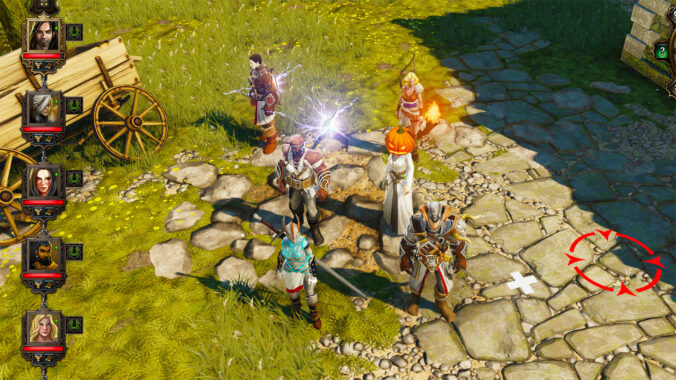
I did finish the game at the time of its launching, both with a party of four and with two lone wolves. This time I cheated a bit: I installed a mod that allows for a party of six instead of the normal four, so I could experience all the companion quests in one single run. It makes the game a bit easier, because this way you get more action points, but I have nothing against easy games. My main characters, Hawk and Raven, were a dual-wielding fighter and a pyro-geo mage (with a bit of witchcraft by the end, when there are more skill points available). Three of the companions, Madora, Jahan, and Bairdotr, I kept in their original roles of two-handed fighter, aero-hydro mage, and archer, respectively. Wolgraff, however, I kept in the homestead as a designated crafting and blacksmithing specialist. To replace him on the field, I hired the mercenary Seamus Black, who became the lockpicking and pickpocketing expert, as well as a second archer. It was fun.
At its best, the game feels like a playground for problem-solving. The combat system is the clearest example. It’s turn-based, but far from static. Surfaces (oil, poison, water, fire) interact in ways that encourage experimentation rather than optimization. You can freeze a battlefield, electrify puddles, or accidentally set your own party on fire. It’s messy, often unpredictable, and frequently satisfying. There’s a sense that the designers trust the player to discover possibilities rather than follow prescribed solutions, which gives even routine encounters a sense of improvisation.
The same philosophy carries into character building and progression. Instead of rigid classes, the game offers a toolkit. You can create hybrids that don’t quite make sense on paper but work in practice, and the system rarely punishes curiosity.
Cyseal, the opening city, deserves special mention. It’s dense, talkative, and full of small quests that interlock in subtle ways. There’s a slightly old-fashioned charm to how much time the game expects you to spend talking to NPCs, reading books, and piecing together clues. It evokes older RPGs without feeling entirely nostalgic.
That said, the same design instincts that make the game interesting also generate some of its most persistent frustrations.
The dialogue system, for example, introduces a mechanic where arguments with NPCs are resolved through a rock-paper-scissors mini-game. That shifts it from a quirky role-playing abstraction into something that directly affects outcomes: quest resolutions, rewards, access to information, and sometimes whether a situation escalates into combat. The problem is that this introduces a layer of arbitrariness at precisely the moment where the game should feel most responsive to player intent. You can invest in persuasion-related traits, shape your character’s personality, and choose dialogue options carefully, only to have the final result hinge on a short sequence of guessing correctly in rock-paper-scissors. When you lose, it doesn’t feel like your character failed, it feels like the system failed you.
Pacing is another recurring issue. The game has a tendency to overindulge in puzzles, especially toward the end. The Source Temple sequence is the clearest offender: a long stretch of multi-layered puzzles that interrupts the narrative momentum just as the story should be accelerating. Individually, some of these puzzles are clever. Taken together, they become exhausting, and the sense of discovery gives way to trial-and-error fatigue.
Inventory management and general interface friction add another layer of annoyance. The game predates some of the quality-of-life improvements that later entries would adopt, and it shows. Sorting items, tracking quest objectives, and managing equipment can feel more cumbersome than it needs to be, particularly in longer sessions.
Despite these issues, what remains is a game that’s easy to respect, even when it’s difficult to love consistently. It doesn’t aim for smoothness, it aims for possibility. Sometimes that leads to brilliance, sometimes to irritation.
In retrospect (and especially if you have played the sequel), Divinity: Original Sin feels like a prototype for something more refined rather than a perfectly balanced experience. But it’s a prototype with conviction. The systems are rich enough, and the ambition clear enough, that even its missteps contribute to its identity. It’s not a comfortable game, but it’s a memorable one.