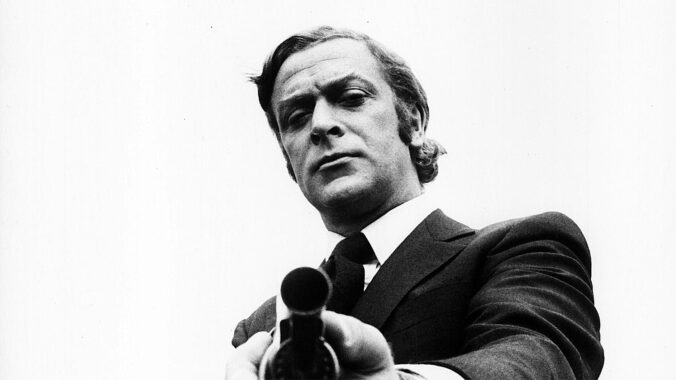
Ted Lewis’s Jack’s Return Home (1970) occupies an interesting position in crime fiction history. It is not as famous as the film it inspired, yet it is arguably one of the foundational texts of modern British noir. Before Lewis, British crime fiction often retained traces of the gentleman detective, the police procedural, or the thriller. Lewis dragged the genre into something nastier, more provincial, and more psychologically damaged. His England is not the picturesque England of village mysteries but a decaying industrial landscape full of petty criminals, corruption, class resentment, and moral rot.
It begins with the blunt, almost absurd sentence “The rain rained.” That is a good miniature of the whole book: plain, ugly, repetitive, fatalistic. The world does not dramatize itself for Jack Carter. It simply happens, and he moves through it with the same inevitability. Carter is a London underworld figure returning to a dingy mill town after his brother Frank’s suspicious death. He is observant, nasty, sexually predatory, class-conscious, and practical. The opening train sequence gives us the essential Carter immediately: smoking, drinking from a flask, thinking about his brother and his bosses, and possible trouble ahead. He is not going home out of sentiment. He is going home because a criminal insult has been committed inside the family structure, and because Frank’s death does not add up.
Mike Hodges’s movie adaptation Get Carter (1971) keeps the essential narrative: Jack Carter, a London gangster, travels north after his brother’s death and uncovers a pornographic blackmail/murder network. But the film relocates the emotional center. Lewis’s book is more internal, grimier, and more trapped inside Carter’s voice. Hodges’s film is colder, more architectural, and more iconic.
The biggest transformation is Michael Caine as the protagonist. Caine does not make Carter moral, but he makes him elegant. The clothes, the stillness, the voice, the absolute refusal to waste movement: these turn Carter from Lewis’s vicious working criminal into something closer to a lethal professional instrument. He was “sure, fine, and vicious”, in the words of Roger Ebert.
Roy Budd’s score is also not decoration. It gives the film its pulse. Budd’s Carter Takes a Train turns the journey north into ritual: sparse, jazzy, mechanical, cool. The music makes Carter seem more controlled than he is in the book. It gives him rhythm, poise, and myth.
The ending is the film’s most important alteration. In the novel, Carter is left horribly wounded and abandoned, but alive. In the 1971 movie, Carter is shot dead on the beach. That change makes the film more classically noir. The book leaves Carter in a living hell, while the film gives him the clean fatal punctuation of tragedy. He has solved the case and punished the guilty, but there is no moral restoration available. Revenge does not redeem him. It merely completes him.
Stephen Kay’s Get Carter (2000) changes the story more drastically. It moves the journey from London-to-Newcastle to Las Vegas-to-Seattle. Carter, now played by Sylvester Stallone, is a Vegas mob enforcer returning to Seattle after his brother’s apparent accident. The remake also uses a remix of Budd’s original theme, with Tyler Bates composing the score. Michael Caine’s appearance as Cliff Brumby is a strange gesture: homage, stunt casting, and self-sabotage all at once. Every time he appears, the better film enters the room.
The central difference is Stallone 2000 versus Caine 1971. Caine’s Carter is predatory. Stallone’s Carter is wounded. Caine’s sexuality is part of his menace: he moves through women as he moves through rooms, using access, pressure, and appetite. Caine’s Carter has sex with three women (and a phone sex scene with one of them). Stallone’s Carter has sex with nobody. That tells us almost everything. The 1971 Carter is an active agent of corruption, while the 2000 Carter is a man being cleaned up for a redemption arc.
The smoking detail works the same way. Caine’s Carter is all cigarettes, booze, and death-drive. Stallone’s Carter quitting smoking is not just a character quirk, it is a signal that this Carter is already in recovery from being Jack Carter. The remake wants him to be damaged but salvageable. Lewis and Hodges are not interested in salvage.
That is why the 2000 film feels less like an adaptation of Jack’s Return Home than a late-Hollywood revenge drama borrowing its skeleton. It softens the central horror: the original Carter is not a good man temporarily forced into violence, but a violent man briefly given a legitimate target. (From roughly the late 1980s through the early 2000s, Hollywood became increasingly uncomfortable with protagonists who were simply bad people. The tendency was to retain the character’s skills and toughness while softening their motives and increasing their capacity for remorse. You can see that in remakes like The Taking of Pelham 123, The Getaway, The Italian Job, and many others.)
So which adaptation is closer to the spirit of the book? The 1971 film, clearly. Not because it is literal in every detail. It is not. Caine is too elegant, Newcastle is not quite Lewis’s industrial town, and the ending is materially different. But it understands the moral temperature of the novel: rain, smoke, porn, class resentment, dead industry, bad sex, bent power, and revenge without purification.
Lewis gives us Carter as a thug with intelligence. Hodges and Caine turn him into an dark icon. The 2000 film turns him into a man looking for absolution. Only the first two really understand that Jack Carter is not there to be absolved.