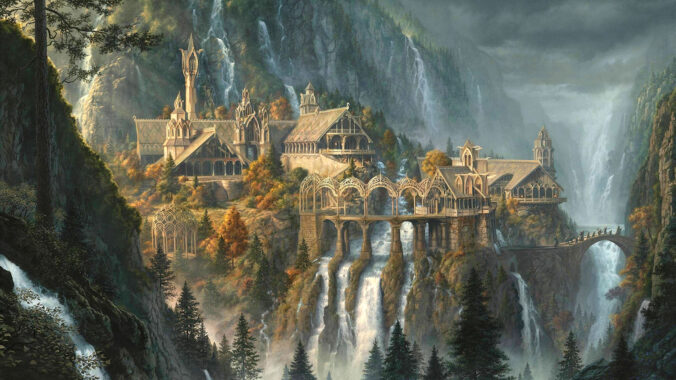
Few literary friendships have been as influential as that between J.R.R. Tolkien and C.S. Lewis. Both were Oxford scholars. Both were devoted Christians. Both loved mythology, fairy tales, and medieval literature. Both helped shape modern fantasy. Yet when one compares their major works, The Lord of the Rings and The Chronicles of Narnia, the differences are so striking that it is difficult to believe they emerged from the same intellectual circle.
The contrast begins with the most obvious question: how does Christian belief appear in the fiction?
For Lewis, the answer is straightforward. Christianity appears directly, almost openly. Narnia is filled with biblical themes that are barely disguised. Aslan dies to save a sinner, rises from the dead, and defeats evil through sacrificial love. The parallels with Christ are so clear that many readers understand them immediately, even as children.
Tolkien disliked this approach. He famously distinguished between allegory and applicability. Allegory, in his view, imposed a one-to-one correspondence between fiction and reality. A character stands for something else. A lion stands for Jesus. A witch stands for Satan. Tolkien preferred applicability, in which readers discover meanings for themselves rather than being guided toward a predetermined interpretation.
As a result, there is no Christ figure in The Lord of the Rings in the same way that Aslan functions in Narnia. Christian ideas are present everywhere, but they are dispersed throughout the story rather than concentrated in a single symbolic character. Frodo’s burden resembles a form of sacrificial suffering. Gandalf dies and returns. Aragorn is a healing king who restores the kingdom. Yet none of them is simply Jesus under another name.
The difference reflects a deeper divergence in how the two men viewed myth.
Lewis often used fantasy as a vehicle for communicating Christian truths. He once described his own conversion as involving the realization that Christianity was a “true myth.” Since myths could express profound truths, he saw no problem in employing fantasy narratives to illuminate Christian doctrine.
Tolkien viewed mythology differently. For him, myth was not merely a tool for conveying religious lessons. Myth possessed intrinsic value. Human beings, created by God, were themselves creators. Through storytelling they participated in what Tolkien called “sub-creation,” the making of secondary worlds that reflected the creativity of the divine creator.
This distinction explains much about their fiction. Lewis begins with theological ideas and then creates stories that illustrate them. Tolkien begins with the world itself. Middle-Earth exists before any specific plot. Tolkien spent decades developing languages, histories, genealogies, geography, calendars, cultures, and myths. Entire civilizations rose and fell before Frodo ever left the Shire. The stories emerge from the world.
Narnia works almost in reverse. Lewis creates exactly what the story requires. If Father Christmas needs to appear, he appears. If animals need to talk, they talk. If Bacchus and Roman river gods need to suddenly enter the narrative, they enter. Consistency is less important than the immediate imaginative or symbolic effect.
This difference often produces a striking contrast in tone. Middle-Earth feels ancient. Narnia feels improvised. That is not necessarily a criticism. Lewis was less interested in constructing a coherent secondary world than in creating a sequence of imaginative experiences. Narnia resembles a dream or a fairy tale. Middle-earth resembles an alternate history. Tolkien’s professional life probably pushed him toward the “world first” approach. He was a philologist. Languages came first, then histories to explain the languages, then stories to explain the histories. Middle-Earth almost grew archaeologically.
Readers who value worldbuilding often find Tolkien’s approach richer and more convincing. Readers who value symbolism and direct spiritual engagement often prefer Lewis.
The two authors also differed in their attitudes toward complexity.
Tolkien’s world is morally serious but rarely simplistic. Even villains possess histories and motivations. Boromir falls and is redeemed. Gollum is both pitiable and dangerous. Denethor is tragic rather than purely evil. Frodo ultimately fails in his mission and succeeds only because of events beyond his control.
Lewis tends toward clearer moral divisions. The White Witch is evil. Aslan is good. The theological lessons are usually easier to identify. This clarity is one reason Narnia is so accessible to younger readers.
The difference becomes even more noticeable when examining how the two authors handle evil.
For Tolkien, evil is corruption. It cannot create. It can only distort what already exists. Orcs are corrupted beings. Sauron cannot truly make anything new, he can only twist and dominate. This idea derives from a long Christian philosophical tradition, especially the thought of Augustine, who argued that evil is a privation of good (privatio boni) rather than an independent force.
Lewis accepts similar theological assumptions, but his fiction often presents evil more directly and symbolically. Evil characters function less as psychological studies and more as embodiments of temptation, pride, or unbelief.
One could say that Tolkien’s Christianity operates beneath the surface while Lewis’s Christianity operates on the surface. A reader can finish The Lord of the Rings without consciously thinking about Christianity at all. Yet the work is permeated by Christian ideas: providence, humility, mercy, sacrifice, free will, the corrupting nature of power, the dignity of ordinary people, and hope beyond despair. A reader can hardly finish The Lion, the Witch and the Wardrobe without recognizing its Christian foundations.
This distinction explains why Tolkien’s work often appeals strongly to non-Christian readers. The theological framework remains present but unobtrusive. Readers engage first with the story, characters, and world. The religious implications emerge gradually, if at all. Lewis, by contrast, frequently attracts readers who appreciate explicit spiritual themes. Those same qualities can also alienate readers who dislike being guided toward particular theological conclusions.
Ironically, Tolkien’s approach may have produced the more enduring mythology. Narnia remains beloved, but many adult readers eventually notice the machinery behind the story. The allegorical structure becomes increasingly visible. Once one sees Aslan as Christ, much of the symbolic puzzle is solved. Middle-Earth resists complete explanation. Its mysteries remain. Tom Bombadil remains enigmatic. The origins of certain beings remain uncertain. Ancient events echo through the narrative without being fully explained. The world seems larger than the story.
This may be the ultimate difference between the two friends. Lewis wanted fantasy to point beyond itself. Tolkien wanted fantasy to exist as a world in its own right. Lewis used myth in service of faith. Tolkien transformed faith into myth.
Both approaches emerged from sincere Christian conviction. Yet they produced radically different literary results. One created perhaps the most famous religious fantasy of the twentieth century. The other created a mythology so complete and convincing that many readers forget it was ever inspired by religion at all.